
Boxer training goes better when you stop fighting the breed and start working with it. Boxers are bouncy, physical, affectionate dogs that greet the world with their whole body, and they tend to stay puppy-like for a long time. Owners who expect a calm adult at one year old often get frustrated. Owners who plan for the bounce usually end up with a wonderful companion.
At All Dogs Unleashed Dog Training Bossier City, we work with a lot of high-energy dogs, and Boxers are some of the most fun to train once you understand what drives them. Below you will find the traits that shape Boxer behavior, the skills we focus on first, how to keep training safe in Louisiana heat, and a simple plan you can follow at home.
Want to talk through your own Boxer’s habits? Our team is glad to help.
Key Takeaways
- The American Kennel Club places the Boxer in the Working Group and describes its temperament as active, bright, and fun-loving.
- Jumping and mouthing are the two habits Boxer owners ask about most, and both improve fastest when you teach a clear replacement behavior.
- Boxers often mature slowly, so expect to keep reinforcing manners well past the first birthday.
- Boxers have short muzzles, and the AVMA notes that flat-faced dogs are more prone to breathing trouble and heat stress, so summer sessions should be short and scheduled for cool hours.
- Our two-week Board and Train program includes guaranteed results and lifetime support at no additional cost for graduates.
Understanding the Boxer Personality
The AKC breed profile for the Boxer lists the breed in the Working Group, with Germany as its country of origin and a temperament summed up as active, bright, and fun-loving. Those three words explain almost every training question we hear from Bossier City owners.
Active Means a Real Exercise Need
A Boxer is a strong, athletic dog that was developed for work. When that energy has no outlet, it comes out as zoomies in the living room, rough play with the kids, and a dog that cannot settle in the evening. Exercise alone will not fix manners, but a tired Boxer learns far better than a wired one.
Bright Means They Learn Fast, Including Bad Habits
Boxers pick up patterns quickly. If jumping on a guest once earned a laugh and a scratch behind the ears, your dog noticed. That intelligence is a gift during training, because a Boxer that understands the rules tends to follow them with enthusiasm. It also means inconsistent rules get tested again and again.
Fun-Loving Means Play Is Your Best Tool
Most Boxers adore people and games. Tug, short retrieves, and quick bursts of praise can be stronger rewards than food for many of them. We build training around that love of play, then teach the dog to turn the excitement up and down on cue.
The Four Habits That Frustrate Boxer Owners
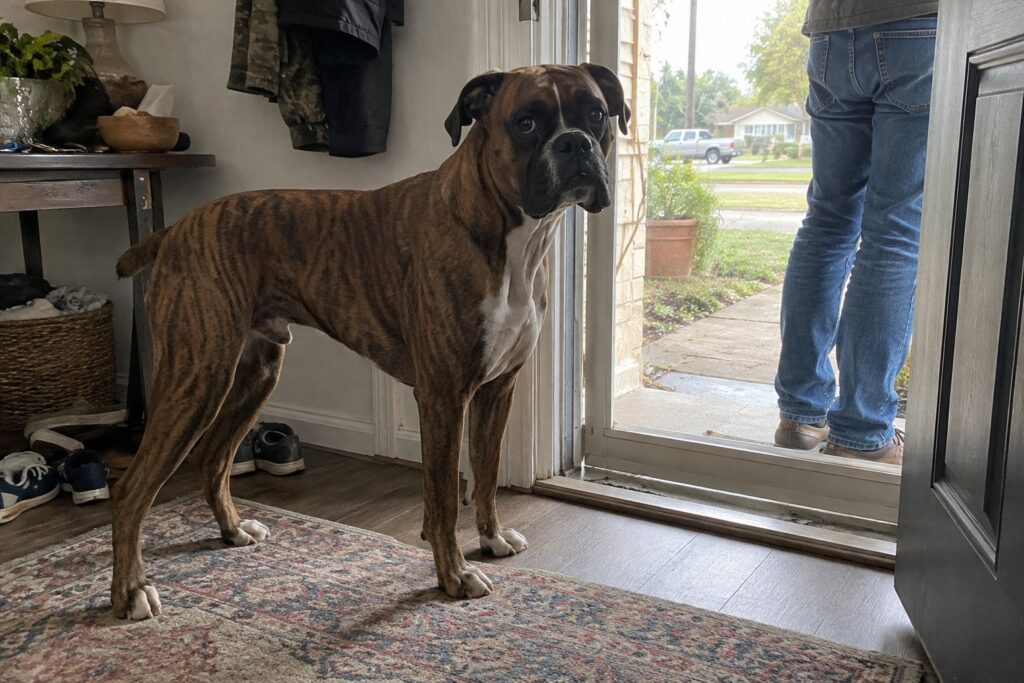
Every dog is an individual, but certain patterns come up with Boxers again and again. Knowing what is normal for the breed helps you respond calmly instead of taking it personally.
| Habit | Why It Happens | What to Teach Instead |
|---|---|---|
| Jumping on people | Excited greeting style, attention reward | A “sit” for greetings, four paws on the floor before petting |
| Mouthing hands and sleeves | Play style, teething, overarousal | Toy redirection and a calm “settle” break |
| Pulling on leash | Strength plus enthusiasm | Loose leash walking with frequent direction changes |
| Ignoring cues when excited | Slow maturity, low impulse control | Short, repeated impulse control drills with rising distractions |
Jumping
Boxers are famous for their bouncy greetings, and many will leap straight up to get closer to your face. The fix is not pushing the dog down or shouting, since both can feel like play. Instead, ask for a “sit” before the dog has a chance to jump, reward it generously, and have visitors turn away if the paws come up. Attention only comes when all four feet are on the floor.
Mouthing
Young Boxers use their mouths in play, and some keep doing it into adulthood if nobody teaches otherwise. When teeth touch skin, freeze, offer a toy, and praise when the dog takes it. If the dog stays wound up, end the game for a minute and ask for a “down” to help the body calm. Mouthing is common, but if you see stiff posture, growling over objects, or hard bites, talk to a professional, and read our notes on dog bite prevention for Bossier families.
Pulling
A Boxer that pulls can be hard to hold, especially for kids or older family members. Start leash work in a quiet place, reward the dog for staying near your leg, and change direction whenever the leash tightens. Our article on training a dog to walk on a leash in Bossier walks through the steps in more detail.
Selective Listening
Many owners tell us their Boxer knows “sit” perfectly in the kitchen and forgets it the moment a squirrel runs by. That is not stubbornness so much as a skill that has not been practiced around distractions yet. The answer is to raise difficulty slowly and reward heavily when the dog gets it right in a new place.
Why Boxers Need a Longer Training Runway
Boxers are often described as slow to mature, and in our experience the goofy adolescent stage can stretch well past the first birthday. A Boxer may look full grown while still acting like a teenager. That does not mean training is not working. It means the foundation needs regular maintenance while the dog grows up mentally.
Set Realistic Expectations by Age
| Age Range | Typical Focus | Owner Priority |
|---|---|---|
| Puppy | Socialization, name response, crate routine | Short sessions, lots of positive new experiences |
| Adolescent | Impulse control, polite greetings, leash manners | Consistency, even when progress seems to slip |
| Young adult | Reliability around distractions | Practice in new places, maintain daily routines |
| Mature adult | Maintenance and enrichment | Keep skills sharp, watch weight and health |
Start Socialization Early
A friendly Boxer that has met many people, dogs, sounds, and surfaces in a controlled way is easier to train later. If you have a young pup, our puppy socialization steps for Bossier City owners give you a good starting checklist.
Use a Crate as a Calm Space
Because Boxers can be busy indoors, a crate gives them a place to rest and gives you a break. Build it up as a comfortable spot with chews and quiet time rather than punishment. Our tips on crate training a dog into a calm routine apply well to this breed.
If your Boxer is strong, bouncy, and not listening yet, our two-week program gives your dog structured practice every day while you get a break.
Boxer Training in Louisiana Heat
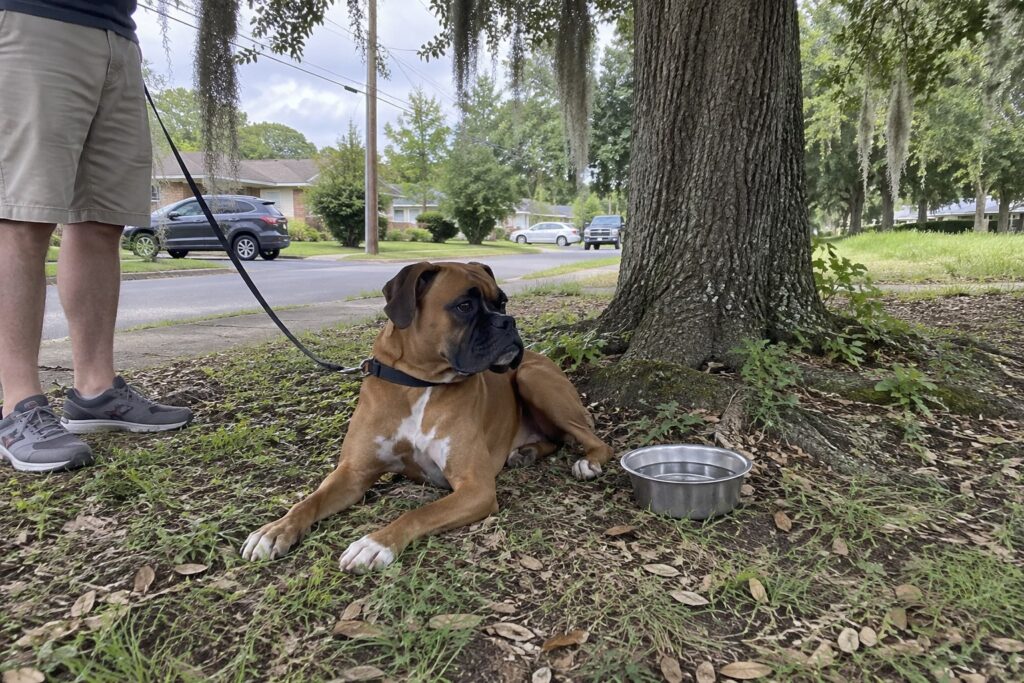
Boxer training around Bossier City has one challenge owners in cooler places do not face as often, which is our long, humid summer. Boxers have short muzzles, and the AVMA explains that brachycephalic, or flat-faced, breeds can have a harder time breathing and cooling themselves. Panting is how dogs shed heat, so a shorter airway makes hot, sticky days riskier.
Plan Sessions Around the Weather
From late spring into early fall, schedule walks and outdoor training for early morning or after sunset. Keep sessions short, offer water often, and move practice indoors or into the shade when the afternoon heat builds. Hot pavement can also hurt paws, so test it with the back of your hand before a walk.
Know the Warning Signs
Heavy, noisy panting, a dog that lags behind or lies down and will not get up, drooling, wobbliness, or very red gums are signs to stop immediately. Move the dog to a cool place, offer water, and call your veterinarian right away if signs do not improve quickly. Heatstroke is an emergency. When in doubt, err on the side of a shorter session.
Fall Is Your Best Training Season
October and November bring cooler mornings to the Ark-La-Tex, which makes this a great time to build longer walks and outdoor practice back in. Use the weather to work on leash manners and calm greetings before the holidays. If you will have guests over for Halloween on October 31 or Thanksgiving on November 26, start practicing door manners now so your Boxer is not launching at every visitor.
A Practical Boxer Training Plan for Home
Good results come from short, regular sessions more than occasional long ones. Here is the routine we suggest for most Boxer households.
Daily Structure
- Exercise first, with a walk or play session timed for cooler hours.
- Two or three five-to-ten-minute training sessions spread through the day.
- A food puzzle or chew to help the dog settle afterward.
- Quiet crate or bed time so the dog learns that calm is part of the day.
Core Skills in Order
Start with name response and “sit,” then add “down,” a polite greeting routine, and a reliable “come.” Once those are steady at home, add “place” or a mat cue so your Boxer has a job to do when the doorbell rings. Then practice everything on walks, in the yard, and around mild distractions. Off-leash freedom should wait until the basics are rock solid, and our post on training a dog off leash in Bossier City safely explains why.
Keep the Whole Family on the Same Page
A Boxer will quickly learn which family member allows jumping. Agree on the same cue words and the same rules for greetings, furniture, and play. Write them down and post them on the fridge if that helps. Consistency is what turns a smart, bouncy dog into a dependable one.
How Professional Training Helps
Some Boxers do well with an owner working at home. Others need more structure than a busy household can provide, especially when the dog is strong enough to knock people over. That is where professional help pays off.
Two-Week Board and Train
Our Board and Train program runs a fixed two weeks. Your Boxer stays at our facility and works through multiple structured sessions each day, and our trainers vary the exercise settings so skills hold up in new places. Supervised socialization is based on each dog’s temperament. In the final days, we focus on handler transition training so you learn how to keep the results going at home. Graduates receive guaranteed results and lifetime support at no additional cost, and Affirm financing is available.
In-Home Lessons
If you would rather learn alongside your dog in your own space, our in-home dog training works on real problems where they happen, like the front door, the backyard, and the kitchen.
Choosing the Right Option
| Option | Best For |
|---|---|
| Board and Train | Strong, excitable Boxers that need daily structured practice and owners short on time |
| In-Home Lessons | Owners who want hands-on coaching for specific household habits |
| Refresh Training | Program graduates who want to sharpen skills that have slipped |
Ready to talk about your Boxer? Call us at (318) 562-6536 and we will help you choose the right next step.
About All Dogs Unleashed Dog Training Bossier City
All Dogs Unleashed Dog Training Bossier City helps owners across Bossier Parish and Northwest Louisiana turn energetic, distractible dogs into calm, reliable companions. Our fixed two-week Board and Train program gives dogs like Boxers multiple structured sessions every day, with handler transition training before they head home. We also offer in-home lessons, boarding, and refresh training. Board and Train graduates receive guaranteed results and lifetime support at no additional cost, so you have help as your Boxer keeps maturing.
Frequently Asked Questions
Are Boxers hard to train?
Boxers are smart and eager to please, so they can learn quickly. The challenge is their energy and slow maturity, which make them easily distracted, especially in adolescence. Short, upbeat sessions, plenty of exercise, and consistent household rules usually make a big difference. Many owners find that structure, more than effort, is what was missing from their routine.
How do I stop my Boxer from jumping on people?
Teach a polite greeting instead of only correcting the jump. Ask for a “sit” before the dog gets excited, reward it right away, and have guests ignore the dog until all four paws are on the floor. Practice with family first, then with visitors. Everyone in the house needs to follow the same rule, or the jumping will keep coming back.
At what age do Boxers calm down?
Boxers often keep a playful, puppy-like attitude longer than many breeds, and some stay bouncy well into adulthood. Every dog is different, so there is no fixed age. Training, exercise, and a calm daily routine help much more than waiting it out. Keep practicing manners through adolescence, even when it feels like progress has stalled for a few weeks.
Is it safe to train my Boxer outside in summer?
It can be, with care. Boxers are a short-muzzled breed, and flat-faced dogs have a harder time cooling off. Train in early morning or evening, keep sessions short, offer water often, and use shade or indoor space during the hottest hours. Stop right away if your dog pants heavily or lags, and call your veterinarian if signs continue.
Why does my Boxer mouth my hands?
Mouthing is a common part of how Boxers play, especially young dogs that are teething or overexcited. Redirect to a toy, pause the game when teeth touch skin, and give the dog a chance to calm down with a “down” or a short break. If mouthing turns into hard bites or comes with stiff body language, get professional help.
Is Board and Train a good fit for a Boxer?
For many Boxers it is a strong fit. Our fixed two-week program gives your dog multiple structured sessions every day, with practice in varied settings and supervised socialization based on temperament. You learn how to handle your dog during the final days. Board and Train graduates also receive guaranteed results and lifetime support at no additional cost.
Boxer training takes patience, but a Boxer that understands the rules is one of the most joyful dogs you can share a home with. Focus on polite greetings, gentle mouths, loose leashes, and heat-smart routines, and keep practicing as your dog matures. If you want help, call (318) 562-6536 or reach out online, and visit our facility at 4500 Benton Rd in Bossier City.
Ready to Get Started with All Dogs Unleashed Dog Training Bossier City?
Your Boxer has plenty of heart and energy. We can help you channel it into good manners. Call (318) 562-6536 today to talk with our team about Board and Train or in-home lessons.