
Crate training a dog requires more than placing your dog inside and closing the door. Dogs that lack a structured introduction to confinement develop anxiety, resistance, and disruptive behaviors that compound over time. All Dogs Unleashed Dog Training Shreveport provides experienced trainers and a proven, step-by-step approach to crate conditioning for local households.
Our team has conditioned crates for hundreds of dogs across Northwest Louisiana, and every program is backed by a written guarantee and lifetime support so your dog builds a calm, reliable routine from the start. Ready to build a calmer routine for your dog? Our team is here to help.
Key Takeaways
- Crate training a dog works best when introduced gradually through a structured, step-by-step process rather than immediate confinement.
- Crate size, material, and placement all affect how quickly your dog accepts the space as a safe zone.
- Dogs in Shreveport’s warmer climate benefit from wire crates placed away from direct heat sources to stay comfortable during crate time.
- Whining or barking during crating is a behavioral signal, not a reason to release your dog immediately.
- Working with experienced trainers accelerates crate acceptance and reduces the risk of reinforcing anxious or resistant behavior.
Why Does Crate Training a Dog Build Behavioral Stability?
Is a Crate a Punishment or a Behavioral Anchor?
A crate is a behavioral anchor, not a punishment. Crate training a dog works because it satisfies an instinctive preference for bounded, den-like spaces that reduce ambient arousal and support calm resting states. Dogs without a defined resting space frequently display separation anxiety symptoms: excessive vocalization, destructive chewing, and inappropriate elimination. The crate addresses this by giving your dog a predictable, low-stimulation environment associated with safety rather than isolation.
One of the most common crate training mistakes is reactive use. Placing your dog in the crate immediately after misbehavior destroys the positive association that makes the entire protocol work. The crate must be introduced as a neutral-to-positive space from the first interaction, every time, without exception.
How Does Confinement Training Reduce Anxiety and Destructive Behavior?
Confinement training reduces anxiety by interrupting the behavioral patterns that develop when a dog has no defined space of its own. High-drive breeds common across the Shreveport area, including Labrador Retrievers, German Shepherds, and American Pit Bull Terriers, are especially prone to destructive behavior without a consistent crate routine. If you are already seeing signs of distress during absences, read our guide on our dog training programs in Shreveport before beginning the steps outlined in this article.
Your presence at home does not eliminate the need for crate training. Dogs benefit from a structured resting space regardless of owner availability, because the crate builds self-regulation skills your dog will rely on throughout its life. These foundational crate training tips apply whether your dog is eight weeks old or eight years old.
Step 1: Select and Prepare the Right Crate
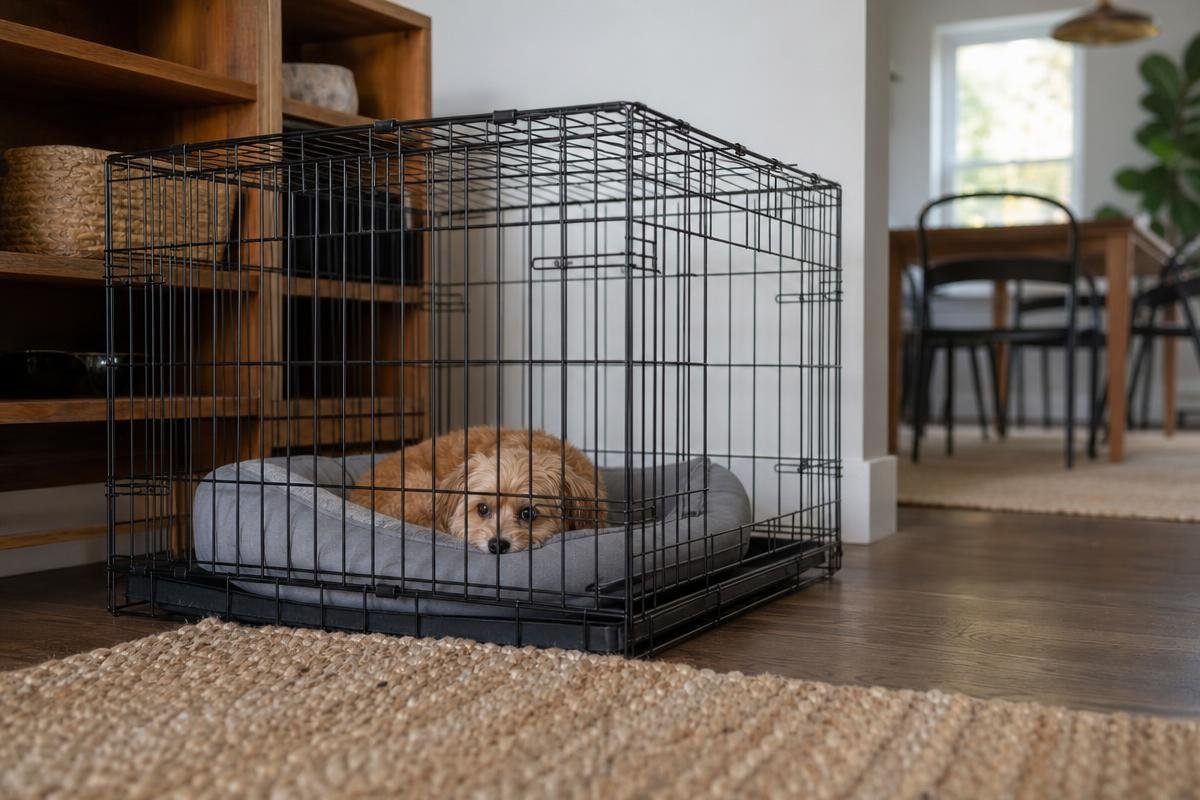
Proper crate selection is the foundation of how to crate train a dog effectively. The wrong crate size or material creates conditions that work against behavioral progress before training even begins. Selecting the correct crate requires evaluating your dog’s size, breed tendencies, and the specific conditions of your Louisiana home.
What Crate Size and Material Work Best?
The crate must allow your dog to stand fully upright, turn around, and lie down without restriction. It should not be large enough for your dog to designate one corner for elimination. For puppies, use a crate sized for the adult dimensions and install a divider panel to reduce the interior space as training progresses.
Material selection matters significantly in Northwest Louisiana’s humid subtropical climate, where summer temperatures regularly exceed 95°F.
Wire crates provide the airflow necessary to keep your dog comfortable during warm months and remain the preferred choice for most households in this part of Louisiana. Plastic airline-style crates offer a more enclosed, den-like environment that some dogs find calming, but they restrict ventilation. Soft-sided crates are appropriate only for dogs that have already completed foundational obedience training and present no destructive behavior.
Where Should You Place the Crate?
Position the crate in a low-traffic area where your dog can observe normal household activity without being in the center of it. Avoid placement near exterior doors, high-noise zones, or windows that receive direct afternoon sun, which is a real risk in Louisiana homes during summer. Many of the older homes in South Highlands and Broadmoor have smaller rooms and limited wall space, so plan crate placement before you buy to avoid crowding a walkway or blocking airflow. Neighborhoods with elevated ambient noise, including areas near busy corridors in Caddo Parish, present additional triggers for alert behavior in crated dogs.
Line the crate floor with a washable mat or fitted crate pad. Avoid loose bedding for dogs that chew, as ingested material creates a safety risk. These crate training tips apply regardless of breed, though the working and sporting breeds already mentioned often require pre-crate exercise to reach a calm, settled state before confinement begins. A morning walk near Betty Virginia Park or a session at a nearby dog-friendly green space burns energy before crate time.
Step 2: Build Positive Associations with the Crate
Forcing a dog into a crate before positive associations are established produces anxiety, resistance, and behavioral regression. The introduction phase requires patience, controlled reward delivery, and a strict no-pressure protocol during the first 24 to 48 hours. Owners managing the high-drive sporting breeds noted earlier should use especially high-value rewards during this phase, as these breeds require stronger reinforcement to override natural arousal levels.
What Should the First 24 to 48 Hours Look Like?
During initial introduction, the crate door remains open at all times. Your dog investigates freely, enters and exits without restriction, and receives no pressure to remain inside. Toss high-value treats progressively further toward the back of the crate, allowing your dog to exit freely after each reward. Never close the door prematurely during this phase.
Once your dog enters without hesitation, begin feeding regular meals inside the crate with the door open. After several successful meal entries, close the door briefly during feeding and reopen it before any distress signals appear. This sequence builds voluntary entry before any confinement is introduced, which is the foundation of effective in-home dog training in Shreveport.
How Do You Use Food, Toys, and Reward Markers Correctly?
Stuffed food-dispensing toys, such as rubber Kong-style toys filled with xylitol-free peanut butter or your dog’s regular food, extend voluntary crate time without pressure. Critically, keep these rewards crate-exclusive.
Scarcity reinforces the crate as the location where high-value outcomes occur. If your dog receives the same reward freely throughout the day, the crate loses its reinforcement value. For structured crate training tips and guidance on reward-based behavioral modification, watch our training videos to see these techniques applied in real-world sessions.
Step 3: Introduce Confinement and Build Duration Gradually
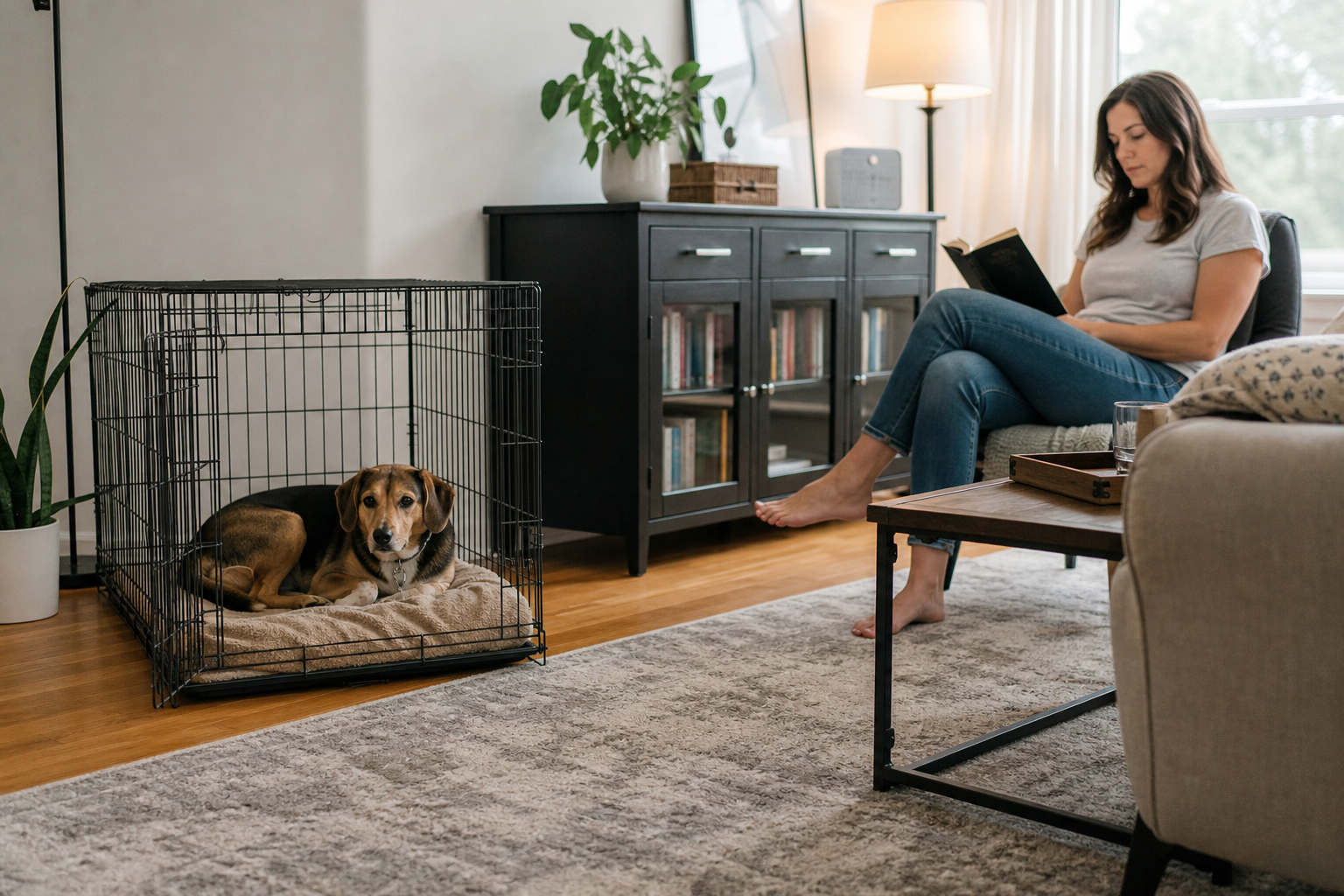
Building duration is where most dog crate routines either succeed or collapse. The most common mistake owners make is increasing confinement time too quickly, which triggers distress responses and forces the entire protocol backward. Consistency across sessions matters far more than speed.
How Do You Use the Incremental Duration Method?
Begin structured sessions at five minutes with you present in the room. Release your dog before any distress behavior appears, then increase in five-to-ten-minute increments across multiple daily sessions. Most adult dogs reach calm thirty-minute intervals within the first week using this approach.
Puppy crate training requires additional caution. Young puppies need frequent breaks, and appropriate crate time varies by age, health, and individual needs. Ask your veterinarian or a qualified trainer for guidance tailored to your dog. Owners with extended or irregular shift schedules, common among military and healthcare families in the area, sometimes feel pressure to accelerate this timeline.
Rushing duration progression is the primary driver of crate training regression, regardless of schedule demands. If you need structured guidance on building a realistic crate routine around a demanding schedule, our in-home dog training in Shreveport program addresses exactly that.
How Do You Read Stress Signals and Adjust the Timeline?
Whining, pawing, excessive salivation, or escape attempts signal that the duration increment was too large or that the association phase from Step 2 was incomplete. When these behaviors appear, reduce immediately to the last successful interval and rebuild from that point. These are among the most practical crate training tips an experienced trainer can offer: the dog is communicating clearly, and the correct response is to listen.
If your dog shows ongoing distress, pause the session and return to the last comfortable interval. Consult a qualified trainer or veterinarian when distress continues or worsens. You can also watch our training videos to see correct release timing demonstrated in real sessions.
Struggling with nighttime whining or a dog that panics the moment the door closes? Our trainers can assess your dog’s specific triggers and build a plan around them. Call (318) 593-7321 to schedule a consultation.
Step 4: Establish a Consistent Daily Crate Schedule
A predictable dog crate routine reduces anticipatory anxiety more effectively than any single training technique. When your dog can anticipate confinement periods, uncertainty disappears and calm compliance follows. A practical structure for most households includes crating for 30 to 60 minutes after morning feeding and exercise, again during a midday rest period, and for a defined window in the early evening before the final outdoor elimination opportunity.
How Do You Structure Crate Time Around Meals, Exercise, and Sleep?
Working and sporting breeds, including Labrador Retrievers and German Shepherds, require adequate physical exercise before each crate session. During summer months, when temperatures regularly exceed 95 degrees Fahrenheit, morning exercise before 8 a.m. is often the most practical window before crating.
Owners who live near Cross Lake often use the early-morning cool for shoreline walks that drain energy before confinement. Our experienced trainers offer additional in-home dog training in Shreveport for owners who need help structuring a schedule around extended or variable work shifts.
What Does an Overnight Crating Routine Look Like?
Puppy crate training at night requires placing the crate near your bedroom during the first several weeks. This positioning allows you to respond to elimination needs without your dog associating nighttime confinement with isolation. Consistency in the pre-crate sequence, including a final elimination trip, brief calm interaction, and crate entry on cue, is the single most reliable predictor of overnight acceptance.
These crate training tips apply equally to adult dogs being introduced to a new nighttime routine. Need help building a crate schedule that works for your household? Call our team at (318) 593-7321 to get started.
Step 5: Extend Crate Training to Real-World Absences
Your dog is ready for unsupervised confinement when it holds calm behavior reliably across 60-to-90-minute supervised intervals without vocalizing or showing stress signals. At that point, introduce brief, low-key departures. No extended goodbye rituals. Leave quietly, return before distress begins, and greet your dog calmly to avoid reinforcing excitement at the moment of release.
Owners who commute long distances or work extended shifts in healthcare or petrochemical industries often feel pressure to accelerate this phase to match their schedules. That pressure is one of the primary drivers of crate training failure in local households.
How Do You Transition from Supervised to Unsupervised Confinement?
Extend departure duration using the same incremental logic covered in Step 3. Your dog’s behavioral response determines the pace, not a fixed calendar. If your dog shows distress after a duration increase, reduce the interval and rebuild. If your schedule makes this gradual progression difficult to manage alone, in-home dog training in Shreveport allows our experienced trainers to work within your household routine and apply consistent behavioral modification in the environment where your dog actually lives.
What Common Mistakes Cause Crate Training Setbacks?
Most owners make the same errors when they begin leaving the house. Specific mistakes to avoid include:
- Using the crate as punishment, which reverses the positive associations built in Step 2
- Releasing the dog while it vocalizes, which directly reinforces distress behavior
- Advancing duration too quickly after a single successful session
- Inconsistency between household members, which gives the dog conflicting behavioral signals
Every person in the home must apply the same protocol. One inconsistent household member can undo days of structured progress.
Step 6: Maintain the Routine and Prevent Regression
Completing the six-step crate training process does not mean the dog crate routine is finished. Dogs that have achieved calm, consistent crate compliance can lose that conditioning gradually if the structure is removed or inconsistently maintained. Periodic reinforcement sessions, short crating intervals paired with a high-value reward even when no absence is planned, preserve acceptance and prevent behavioral drift over time.
Multi-dog households in Caddo Parish should pay particular attention here. Inter-dog tension during confinement is a common regression trigger, and individual crate conditioning must continue even after initial training is complete for every dog in the home.
How Do You Maintain the Crate Long-Term After Training?
The crate should remain accessible as a voluntary resting space indefinitely. Removing it eliminates a behavioral anchor the dog uses for self-regulation, which can destabilize an otherwise calm dog. If regression occurs months after successful crate training a dog, return to shorter supervised intervals with positive reinforcement before resuming normal duration.
When Should You Transition Away from the Crate?
Unsupervised household freedom is appropriate only after the dog demonstrates zero destructive behavior, no elimination accidents, and no distress vocalization across several consecutive weeks. Transition gradually: begin with supervised access to a single room before expanding to the full home. Dogs with a history of resource guarding, separation anxiety, or destructive behavior should not receive full household freedom without completing a structured board and train program first.
Crate Training Considerations for Shreveport Dogs and Households
What Climate, Housing, and Breed Factors Matter in Shreveport?
Crate training a dog in this region requires attention to environmental conditions that owners in cooler, drier climates rarely consider. Summers regularly exceed 95°F, making crate placement a genuine welfare decision. Wire crates positioned near air-conditioned airflow and away from west-facing windows are strongly preferred from late spring through early fall. Crate covers that trap heat should be removed entirely during warmer months.
Households in Broadmoor, Allendale, and the Highland area face elevated ambient noise from traffic and outdoor activity. That noise triggers alert behavior in crated dogs, extending the time required to achieve calm compliance. A white noise machine placed near the crate reduces auditory stimulation and supports faster settling. Multi-dog households across the Bossier City and Benton areas should condition each dog to an individual crate before any shared confinement period, as inter-dog tension during crating is a common regression trigger.
Working and sporting breeds common to the area, including American Pit Bull Terriers and high-drive shepherd-type dogs, require a full exercise session before any crate rotation. Skipping pre-crate exercise with these breeds produces the anxiety and vocalizations that owners frequently misread as crate aversion.
How Does Our Team Support Shreveport Owners Beyond This Guide?
When independent efforts stall, our experienced trainers at 1220 Shreveport Barksdale Hwy, Shreveport, LA 71105 provide structured intervention. Our board and train programs in Shreveport integrate crate conditioning into a structured daily schedule, producing accelerated behavioral results.
Clients with variable or overnight shift schedules benefit particularly from this format, as crate duration planning is built directly into the program. Every program is backed by a written guarantee and lifetime support. Call (318) 593-7321 to enroll your dog today.
Frequently Asked Questions
How long does crate training a dog typically take?
Crate training timelines vary with a dog’s history, age, temperament, and consistency at home. Build the routine gradually, and adjust the pace when your dog shows signs of stress or needs more time.
What size crate does my dog need?
The crate must allow your dog to stand at full height without hunching, turn in a complete circle, and lie fully stretched out. For puppy crate training, purchase a crate sized for your dog’s adult dimensions and use a divider panel to limit the interior space. An oversized open area encourages a puppy to eliminate in one corner and sleep in another, which undermines the conditioning process entirely.
Should I leave water in my dog’s crate?
For confinement periods under two hours, providing water before crating is generally sufficient. For longer periods, attach a spill-resistant crate-mounted water bottle or a no-tip bowl to the crate door. Standard bowls tip and saturate bedding, which creates discomfort and can increase anxiety during confinement.
Is it acceptable to crate a dog while I am at work all day?
Adult dogs should not remain crated more than four to six consecutive hours during the day. Owners with full-time or extended-shift schedules, including many families near Barksdale Air Force Base who operate on variable hours, should arrange a midday break through a trusted contact or a professional facility. ADU Shreveport dog boarding can provide care for longer absences.
All Dogs Unleashed Dog Training Shreveport offers this option specifically for working households managing longer confinement windows.
What should I do if my dog whines or barks in the crate at night?
First, confirm that elimination needs have been fully met before the dog enters the crate for the night. If vocalization begins, do not open the crate during active whining or barking. Wait for a brief, natural pause in the noise, then calmly open the door. Releasing your dog during active vocalization teaches that noise produces results, which reinforces the behavior rather than extinguishing it.
At what age can I start crate training a puppy in Shreveport?
Crate training can begin with brief, positive sessions once your puppy is ready to settle comfortably. Pair each session with appropriate rewards, and consult your veterinarian for age-specific guidance. For a structured approach to early obedience work alongside crate conditioning, our team recommends reviewing puppy training in Shreveport to understand which foundational commands pair most effectively with crate introduction.
Can an older dog be crate trained if it has never used a crate before?
Adult and senior dogs can be crate trained using the same six-step protocol outlined in this guide. Initial resistance reflects a learned expectation of freedom, not a fixed behavioral trait. Persistent refusal in an older dog, particularly one displaying signs of generalized anxiety, may warrant a professional assessment rather than continued independent attempts.
If you have worked through these six steps and your dog is still resisting the crate, the issue is rarely the dog. It is usually a gap in the association phase, an inconsistency in the household routine, or an underlying anxiety pattern that a written guide cannot fully address. Our team at 1220 Shreveport Barksdale Hwy, Shreveport, LA 71105 is ready to assess exactly where the protocol broke down and build a plan specific to your dog.
Ready to Get Started with All Dogs Unleashed Dog Training Shreveport?
Call (318) 593-7321 to speak with our team directly. We’re ready to answer your questions, walk you through your options, and help you find the right solution for your needs. Whether you’re just starting to plan or ready to move forward, we’ll make the process simple and stress-free. Reach out today and let’s talk about how we can help.