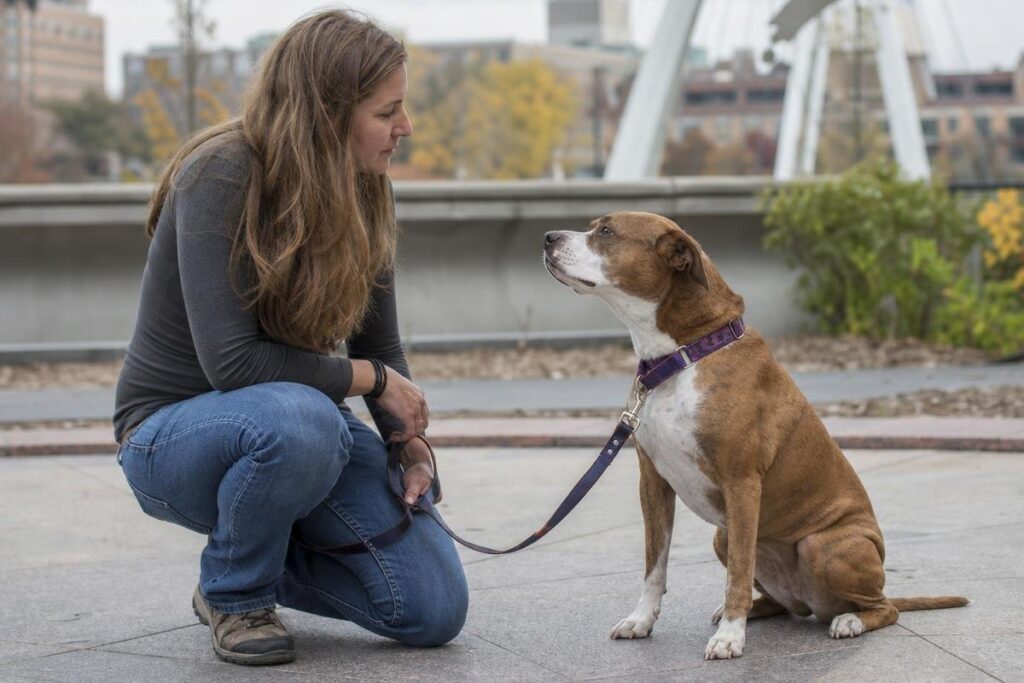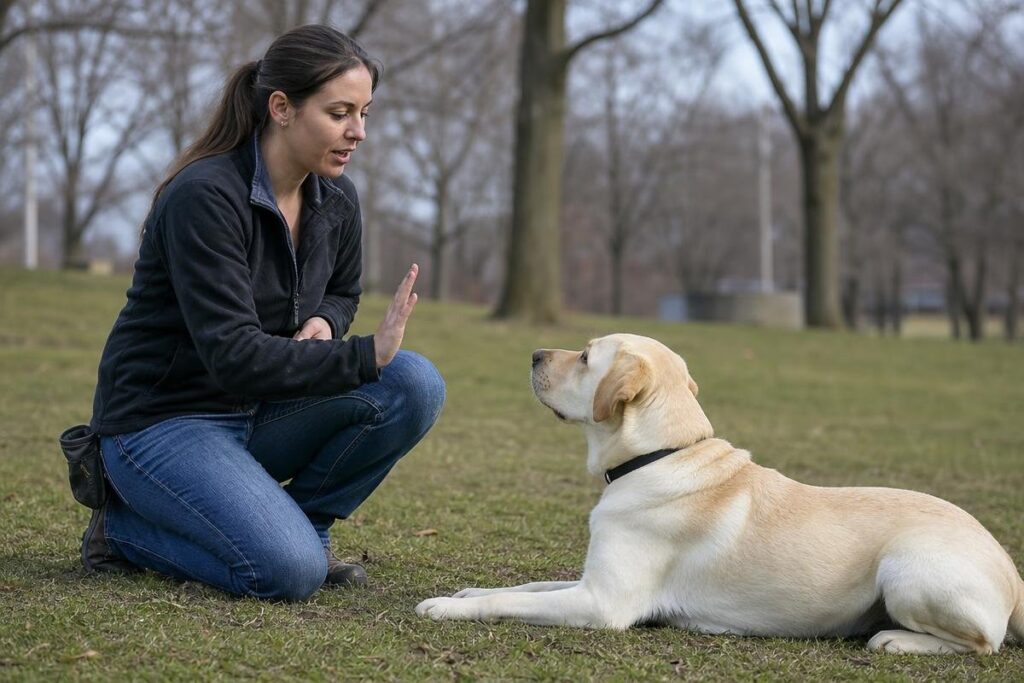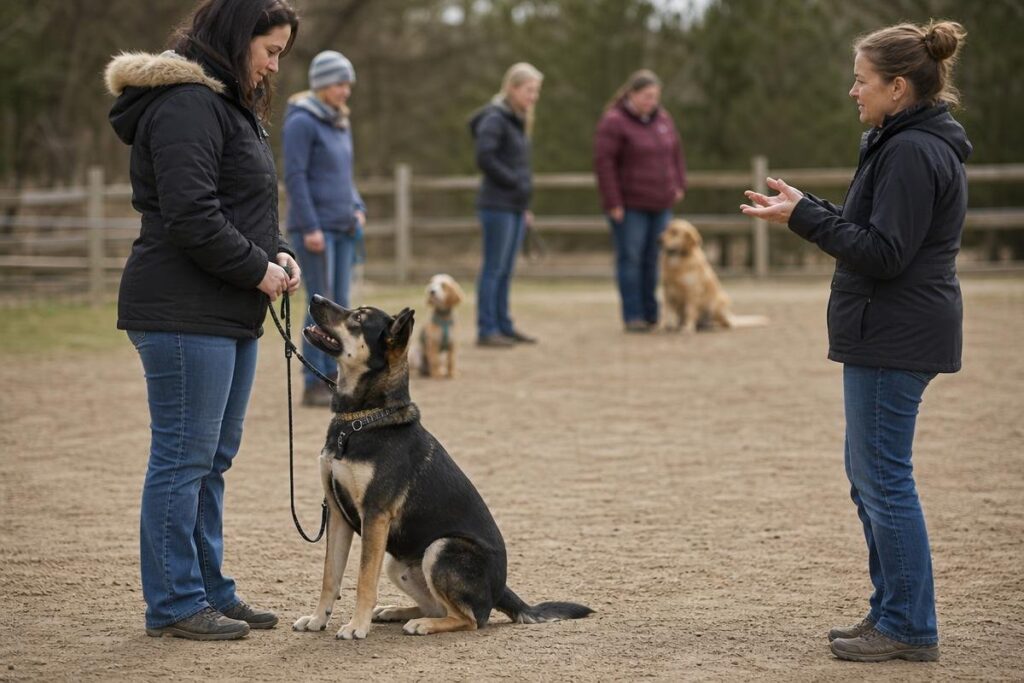

Labrador Retrievers are one of the most popular breeds across the Des Moines metro, and also among the most commonly rehomed nationally due to ongoing behavior issues that owners were not prepared to manage. High prey drive, relentless energy, and poor impulse control make Labrador retriever training a distinct challenge that generic obedience advice rarely addresses.
All Dogs Unleashed Dog Training Des Moines provides immersive canine instruction built around breed-specific behavioral patterns, backed by a money-back guarantee and lifetime support so your dog’s progress holds long after training ends. Ready to turn your Lab’s energy into reliable responsiveness? Let’s build a plan.
Key Takeaways
- Labrador retriever training requires impulse control work before advanced obedience commands will hold in real-world environments.
- Labs are highly food-motivated, which makes reward-based training effective but also reinforces demanding and jumping behaviors if applied incorrectly.
- Leash reactivity and prey drive are the two most common chronic issues reported by Des Moines Lab owners.
- Structured daily routines reduce anxiety-driven mouthing, destructive chewing, and hyperactivity in Labs of all ages.
- Reliable recall must be established before any Lab with prey drive is allowed off-leash in open or multi-use environments.
Why Lab Owners in Des Moines Struggle at the Park
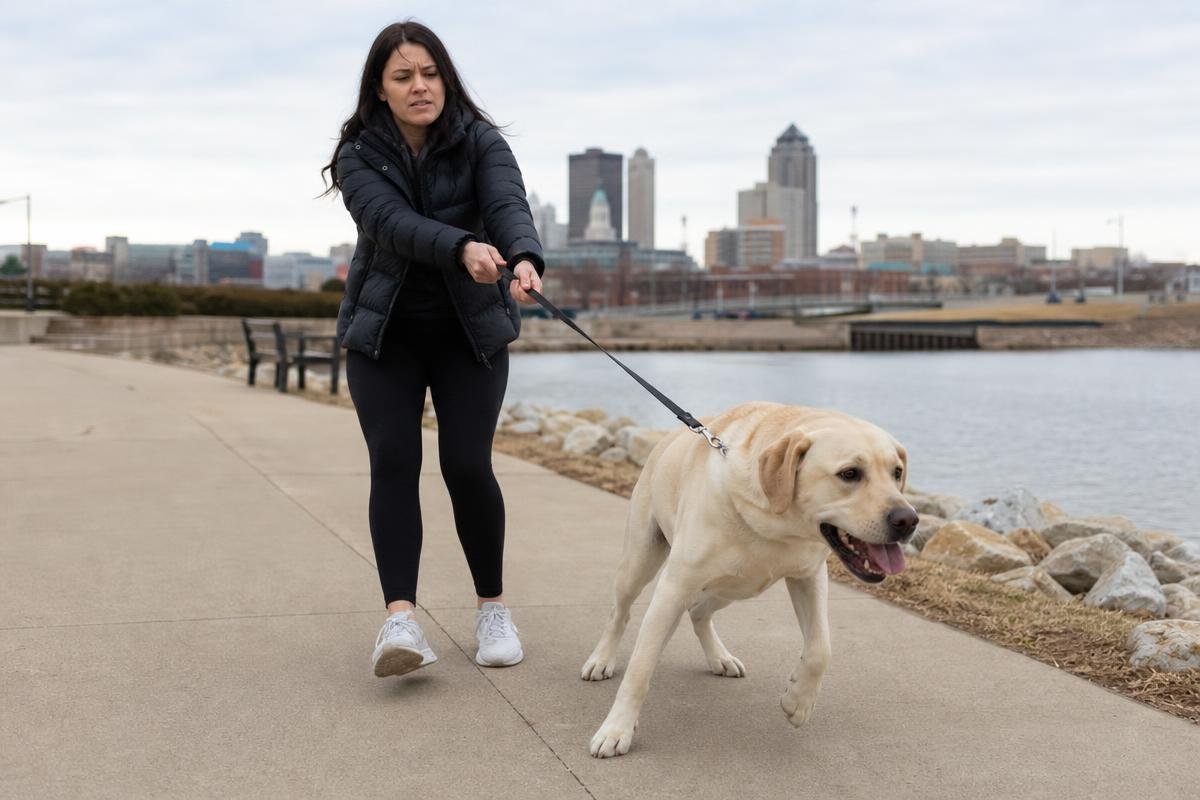
You know the feeling. You head toward Gray’s Lake Park for a simple evening walk, and within thirty seconds your Labrador Retriever has spotted the water, locked onto a passing cyclist, and turned a peaceful outing into a full-body workout you did not plan for. That pulling, lunging, and selective hearing is not a personality flaw. It is a breed-wiring problem that requires a structured solution.
This article covers 8 trainer-tested approaches to Labrador Retriever training built around how this breed actually thinks and reacts, not generic obedience advice recycled for every dog on the block. Whether your dog is a young puppy or an adult with entrenched habits, these steps address the specific impulses that make training Lab puppies in Des Moines harder than most owners expect.
Our professional dog trainers in Des Moines work with dogs of all breeds, ages, and temperaments, and our lifetime support means you can reach out for guidance whenever a new behavior surfaces, even years after your program ends.
If you want professional help now rather than later, call All Dogs Unleashed at (515) 480-7977. Ask us to build a program around your dog’s specific behavioral profile.
What Makes Labrador Retrievers Different to Train?
Labrador Retrievers are harder to train than most breeds because their genetic prey drive, slow behavioral maturity, and relentless food motivation require impulse control work before standard obedience commands will hold. These dogs were selectively bred for generations to retrieve game in cold water, work alongside hunters, and remain highly responsive to human direction. Those traits do not disappear in a suburban backyard in Ankeny or West Des Moines.
Prey drive, a powerful mouth, and relentless environmental curiosity are features of the breed, not behavioral flaws. Without structured daily routines to direct those instincts, they become the chronic problems that frustrate owners within the first year.
Labradors also mature slowly. Most do not reach behavioral maturity until age two or three. Owners who expect a calmer dog after the first birthday are often caught off guard when adolescent impulsivity continues well past that point. Understanding this timeline is the first step in knowing how to train a Labrador Retriever effectively, and why consistency across months matters more than any single training session.
The Lab’s Genetic Drive
Prey drive, mouthiness, and leash reactivity are all breed-linked traits in Labradors. They are not signs of a stubborn or dominant dog. At Gray’s Lake Park, a Labrador that spots waterfowl on the water, cyclists on the path, and another dog across the grass is not ignoring its owner out of defiance. Its genetic wiring is firing on all cylinders simultaneously. The same applies along the Clive Greenbelt trail system, where joggers, bikes, and off-leash dogs create a constant stream of stimuli that overwhelm a dog with no impulse control foundation.
These drives need direction, not elimination. Labrador impulse control training gives those instincts a structured outlet. Impulse control is the organizing principle connecting every effective training approach for this breed, and it runs through all eight tips covered in the next section.
Why High Food Motivation Is a Double-Edged Tool
High food motivation makes Labradors exceptionally responsive in low-distraction environments. That same motivation becomes unreliable the moment a squirrel crosses the path at Waterworks Park or food smells drift from a nearby picnic area. The reason is straightforward: continuous reinforcement, meaning a treat every single time, creates a dog that performs only when food is visible. A variable reward schedule, where treats appear unpredictably, builds more durable responsiveness because the dog cannot predict when the reward is coming.
High-value treats remain the right choice in high-distraction settings. The error is never fading treat frequency as reliability improves at home. Our in-home dog training services address this directly by building reliable responsiveness in the environment where your dog lives before graduating exposure to parks and public spaces where the stakes are higher.
8 Labrador Retriever Training Tips Des Moines Owners Should Follow
Labrador retrievers are eager, high-energy dogs that respond well to structure, but that same drive makes consistency non-negotiable. These eight labrador retriever training tips give Central Iowa owners a clear, ordered path from foundational obedience to real-world reliability.
1. Build Impulse Control First
Labrador impulse control training starts with micro-moments: require a “wait” before meals, before doors open, and before a toy is released. These small repetitions compound into reliable responsiveness when your dog faces genuine distractions outdoors.
2. Sequence Foundational Obedience by Environment
Teach sit, down, stay, and come in a quiet indoor space before moving to the backyard, then to low-traffic sidewalks in Beaverdale or Waukee neighborhoods. Your dog must meet the criteria at each level before you add distraction; skipping steps creates inconsistency, not speed.
3. Correct Mouthiness Without Drama
A calm, firm “off” followed immediately by a redirect to a chew toy or tug is the correct response to mouthing. Every person in the household must respond identically; a single family member who allows the behavior resets weeks of progress.
4. Follow a Structured Daily Routine
Fixed feeding times, two short training blocks, adequate exercise, and scheduled rest reduce the ambient anxiety that drives destructive behavior. Predictability is a training tool; your dog’s nervous system responds to it before a single command is given. This matters even more during Iowa winters, when snow and single-digit windchills cut outdoor exercise short and a predictable indoor routine keeps a bored Lab from redirecting that energy into chewing and counter-surfing.
5. Develop Leash Manners Before Hitting the Trails
Start labrador leash training in your driveway, not on a busy trail system where joggers, cyclists, and other dogs create constant competing stimuli. For a deeper look at the mechanics, read our guide on in-home dog training services in Des Moines where we cover loose-leash work in controlled settings before progressing outdoors.
Not sure which of these steps your Lab is stuck on? Book a free behavior assessment and we’ll map the exact starting point.
6. Use Graduated Exposure for Socialization
Flooding a Labrador into a crowded environment before your dog has coping skills creates reactivity, not confidence. Keep your dog curious but not overwhelmed, and read our guidance on our immersive residency training where graduated exposure work is built into every stay.
7. Teach the Place Command for Home Management
A designated mat or bed on command gives owners a reliable tool when guests arrive, during meals, or when your dog is overstimulated. If jumping on visitors is already an entrenched habit, our resource on how to stop a dog from jumping on people walks through the connection between place training and door-greeting manners. Our puppy training program introduces the place command early, before jumping becomes a rehearsed pattern.
8. Proof Commands in Real-World Scenarios
A command obeyed only in the living room is a rehearsed behavior, not a trained one. Progress from your backyard to quiet sidewalks, then to higher-distraction environments like the East Village’s busy foot traffic or the wooded trails at Walnut Woods State Park in southwest Des Moines, where naturalistic distractions test genuine reliability.
Common Mistakes Lab Owners Make (and How to Avoid Them)
Attempting to correct entrenched habits in a Labrador Retriever is significantly harder than preventing them. Most of the owners we work with across the metro made the same three mistakes before calling us. Recognizing them early is the fastest way to protect the progress you want to make.
Waiting Too Long to Start Training
Labrador Retrievers can begin foundational commands at 8 weeks old, yet many owners in the Central Iowa area wait until 6 to 12 months, by which point the dog has already rehearsed pulling, jumping, and mouthing hundreds of times. Those rehearsals become habit. Iowa winters compound the problem: owners who delay past September lose months of prime outdoor socialization and proofing weather before cold limits their options.
If you are wondering whether your 10-month-old is too old to start, the answer is no, but every month of delay costs you. Reviewing puppy training milestones to hit in the first 16 weeks gives you a clear benchmark for where your dog should be.
Letting Household Rules Stay Inconsistent
Labrador Retrievers are perceptive. When one family member allows the dog on the furniture and another corrects it, your dog does not learn that the behavior is wrong. Your dog learns that rules are negotiable. A Labrador with optional rules will test every boundary, every time. If your dog listens to you but ignores everyone else in the house, inconsistent enforcement is almost always the cause.
Every person in the household must apply the same criteria, every repetition. Our guide on in-home dog training services in Des Moines covers how to align your whole household around a single set of expectations.
Skipping the Crate
Crate training is not cruel for a high-energy breed. It is a management tool that prevents unsupervised rehearsal of chewing, counter-surfing, and house-soiling while your dog’s impulse control is still developing. A Labrador left unsupervised without a crate will practice the exact behaviors you are trying to eliminate. If you are unsure where to start, our residency training program establishes crate acclimation alongside every other foundational skill.
These mistakes are fixable. Our trainers work with Labrador Retrievers at every age and stage. Call us at (515) 480-7977 to find the right program for your dog.
When Should You Consider Professional Labrador Training in Des Moines?
At-home practice works well for basic commands, but some behavioral issues grow faster than owner-led repetition can correct them. Knowing where that line falls saves you months of frustration and keeps your dog safe in the process.
Signs Your Lab Needs More Than At-Home Practice
Leash reactivity that has escalated from barking to full lunging is one of the clearest signals. On a busy trail like the Raccoon River Park system, where joggers, cyclists, and other dogs appear around every bend, that level of reactivity becomes a genuine safety risk. Graduated exposure training at home rarely produces the consistency needed to resolve it.
Other thresholds to take seriously: mouthiness that has progressed to breaking skin, recall failure in any off-leash situation, and dog-directed aggression on walks. If your dog cannot be trusted at Birdland Dog Park or in a crowded public space without incident, the behavior has moved beyond what standard at-home practice can reliably address. Our in-home dog training services can be a strong first step for households that need structured guidance without removing the dog from the home environment.
What to Expect From Our Training Programs
Our board and train program places your dog in an immersive, structured environment where professional trainers deliver consistent daily sessions from day one. For busy Central Iowa households where schedules shift and training repetitions get skipped, that consistency is exactly what deeply rooted habits require. Trainers on our team, including Mike and Eric, work directly with each dog throughout the residency rather than rotating through unfamiliar handlers.
Our professional training team has earned 247 reviews at a 5.0 average from owners across the Des Moines metro area, and every program is backed by a money-back guarantee. You can connect with us at our office at 699 Walnut St, Suite 400, Des Moines, IA 50309, or call (515) 480-7977 to discuss which program fits your dog’s specific needs.
Training Your Lab for Des Moines Life: Parks, Trails, and Neighborhoods
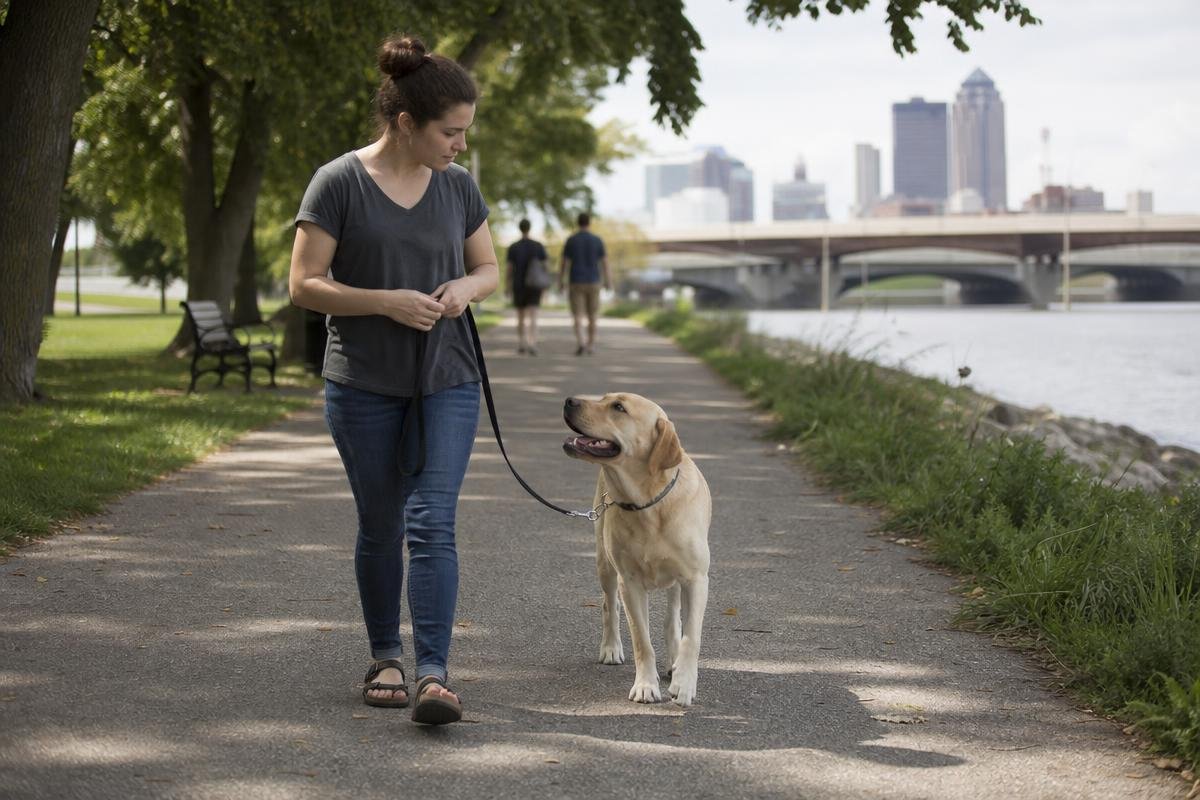
Generic obedience practice in your backyard does not prepare a Labrador Retriever for the real world. Central Iowa’s parks and trail systems create distraction profiles that expose every gap in your dog’s training. Our trainers treat these locations as graduated exposure environments, moving from lower-stimulation settings to high-traffic urban corridors as your dog’s reliability builds.
Proofing Commands at Des Moines’s Most Distracting Locations
Walnut Woods State Park in the southwest metro is where we typically start. The wooded trail environment introduces naturalistic distractions, scent, wildlife movement, uneven terrain, without the density of foot traffic that urban corridors bring. Your dog learns to hold a sit or heel position even when the environment feels unpredictable.
From there, the Principal Riverwalk in the East Village raises the difficulty considerably. Outdoor dining, dense pedestrian traffic, and cyclists moving in multiple directions create impulse-control challenges that push even a well-trained Labrador Retriever. This is where labrador leash training gets tested against real-world scenarios, not controlled repetition.
The Beaverdale and Sherman Hill neighborhoods add another layer. The trail corridors near the Iowa State Fairgrounds area bring your dog face to face with joggers, other dogs, and unpredictable movement patterns. Leash-reactive Labradors frequently struggle here. If your dog is pulling, lunging, or fixating on other animals along these routes, our in-home dog training services can address those patterns before they become entrenched.
Off-Leash Readiness for Central Iowa Environments
Birdland Dog Park is not the place to discover your dog’s recall is unreliable. A Labrador Retriever with prey drive will override a weak recall the moment a squirrel crosses the field. Before entering any off-leash environment in the metro, your dog needs a recall that holds under distraction, not just in the kitchen.
Our trainers use a structured readiness checklist before recommending off-leash access in public spaces. If you are unsure where your dog stands, an immersive residency builds that reliability through daily, real-world repetition. Labrador retriever training tips mean little without the consistent practice that public environments demand. Call us at (515) 480-7977 to discuss where your dog is in that progression.
Frequently Asked Questions
How long will it take before my Labrador reliably listens?
Foundational commands show reliable responses within 4 to 8 weeks of consistent daily work. True reliability under distraction, the kind that holds at Gray’s Lake with geese twenty feet away, takes 3 to 6 months. Adolescent Labrador Retrievers between 6 and 18 months often regress as hormones peak. This is normal, not a sign that training failed.
What is the most important command to teach first?
Impulse control exercises like “wait” and “leave it” should come before everything else. A Labrador Retriever that cannot pause before acting will struggle to hold a stay or return on recall when the environment gets interesting. Build that pause first, and every other skill follows more cleanly.
Are Labrador Retrievers actually easy to train?
Labrador Retrievers are among the most trainable breeds, given their food motivation and eagerness to work with people. “Easy to train” does not mean “trains itself.” Their energy and slow maturation require consistent structure that many owners underestimate, especially during the adolescent phase.
Why does my Labrador keep jumping on people?
Jumping is self-reinforcing attention-seeking behavior. Remove all reinforcement the instant four paws leave the ground: turn away, cross arms, zero eye contact. Reward four-on-the-floor consistently every single time. For a full breakdown of this behavior, our guide on how to stop a dog from jumping on people covers the correction sequence in detail.
What does professional Labrador training cost in Central Iowa?
Program costs vary by format and duration. Contact our team directly at (515) 480-7977 or visit alldogsunleashed.com/des-moines for current program details and pricing specific to your dog’s needs.
Is my older Labrador too set in its ways to train?
Older Labrador Retrievers can absolutely be trained. The capacity for learning does not disappear with age, though the approach may need to account for physical limitations and longer-established habits. Our resource on training an older dog in Des Moines: what actually works addresses this directly.
Is board and train a good option for Labrador Retrievers?
The immersive, structured environment of a residency program removes the inconsistencies of home life and allows our trainers to build reliable responsiveness quickly. Many owners across the metro report a night-and-day difference after even one week of structured stay.
Ready to stop managing the chaos and start seeing real results? Call our team at (515) 480-7977 and find the right program for your Labrador Retriever. All Dogs Unleashed backs every program with a money-back guarantee, and our team has helped hundreds of Central Iowa dogs and their owners get to the other side of stubborn, ongoing behavior problems.
Ready to Get Started with All Dogs Unleashed Dog Training Des Moines?
Call (515) 480-7977 to speak with our team directly. We’re ready to answer your questions, walk you through your options, and help you find the right solution for your needs. Whether you’re just starting to plan or ready to move forward, we’ll make the process simple and stress-free. Reach out today and let’s talk about how we can help.