
Living through Iowa’s long winters means your dog and cat share close quarters for months at a time, and unmanaged tension between them creates daily stress for every member of the household. Persistent behavioral problems between species do not resolve on their own. All Dogs Unleashed Dog Training Des Moines specializes in immersive canine instruction designed to produce reliable responsiveness in real-world scenarios, including homes with both dogs and cats where dog and cat training is the central challenge.
Led by Mike and a team that has worked with hundreds of pets across Central Iowa, we provide guaranteed results and lifetime support for the life of your dog. Ready to create a calmer home for every pet under your roof?
Key Takeaways
- Structured dog and cat training reduces inter-species conflict that worsens during Iowa’s extended indoor winter months.
- Graduated exposure training is the most reliable method for teaching your dog to remain calm around a resident cat.
- Persistent prey drive and reactivity toward cats require consistent, structured correction, not passive redirection.
- Our lifetime support means you can return for follow-up sessions related to your training program as long as you own your dog.
- All six methods below build toward reliable responsiveness in the same real-world environment your pets share every day.
Why Dogs Chase Cats, and What That Behavior Actually Signals
Chasing behavior directed at a cat is not a single problem with a single solution. Two dogs can display nearly identical pursuit behavior for entirely different neurological reasons, and misidentifying the cause is one of the most common reasons dog cat introduction training fails before it ever truly begins. Distinguishing the root drive is the first step toward any structured intervention.
Prey Drive vs. Territorial Reactivity
Prey drive is a conditioned arousal state triggered by movement, distinct from territorial reactivity, which involves resource-guarding and barking rather than pursuit. A dog operating from prey drive will exhibit a hard stare, forward weight shift, dilated pupils, and a low, stalking posture before the chase begins. The behavior is largely silent and focused. Sighthounds such as Greyhounds and Whippets, terrier breeds, and herding breeds including Border Collies and Australian Shepherds carry significantly elevated prey drive and require a more structured desensitization gradient before any shared-space exposure.
Territorial reactivity looks different. That dog barks, postures, and resource-guards specific areas rather than fixating on the cat as a moving target. The intervention approach for territorial reactivity centers on boundary conditioning and impulse control, not the graduated exposure sequence that prey drive requires. Treating one as the other wastes time and increases stress for both animals.
Reading Your Dog’s Body Language Before an Introduction
A dog is not ready for face-to-face contact when it shows a hard stare, a stiff or rigidly elevated tail, and a complete inability to disengage from the cat when called by name. These signals indicate conditioned arousal that no amount of encouragement will override in the moment. Owners in Beaverdale who mistake this fixation for curiosity or excitement frequently accelerate introductions too quickly, setting the process back significantly.
Readiness signals look like the opposite: a loose body, soft eye contact, and reliable name recall even when the cat is visible. Our dog training programs in Des Moines assess exactly these markers before any introduction phase begins. If you are uncertain which category your dog falls into, schedule a behavioral assessment with our team at (515) 480-7977.
Method 1: Scent Introduction Before Any Visual Contact
Attempting to introduce a dog and cat visually before olfactory acclimation has occurred is one of the most common errors shared-space households make, and it routinely sets the entire process back by weeks. Dogs process scent as social information first. Normalizing the cat’s scent as a non-threatening stimulus before any visual contact gives your dog’s nervous system a chance to register the cat as familiar rather than novel.
The protocol is straightforward. Place a blanket, towel, or bedding item carrying the cat’s scent in a calm, controlled space and allow your dog to investigate it freely. Timing matters: introduce the item when your dog is in a calm baseline state, ideally after exercise and not immediately after feeding.
Reward calm, measured investigation with high-value treats. If your dog becomes aroused, fixated, or begins vocalizing, remove the item immediately and try again in a shorter session. This is not failure; it is calibration. The scent introduction phase should progress at your dog’s pace before any visual introduction is appropriate.
Owners in the East Village and across older neighborhoods with compact floor plans regularly work through this phase as part of our in-home dog training services in Des Moines, where our trainers guide the scent introduction sequence inside the actual household environment. Beginning with olfactory desensitization produces measurably more stable outcomes in homes with both dogs and cats across the Des Moines metro. Ask about our board-and-train program by calling (515) 480-7977.
Method 2: Graduated Exposure Training Through a Barrier
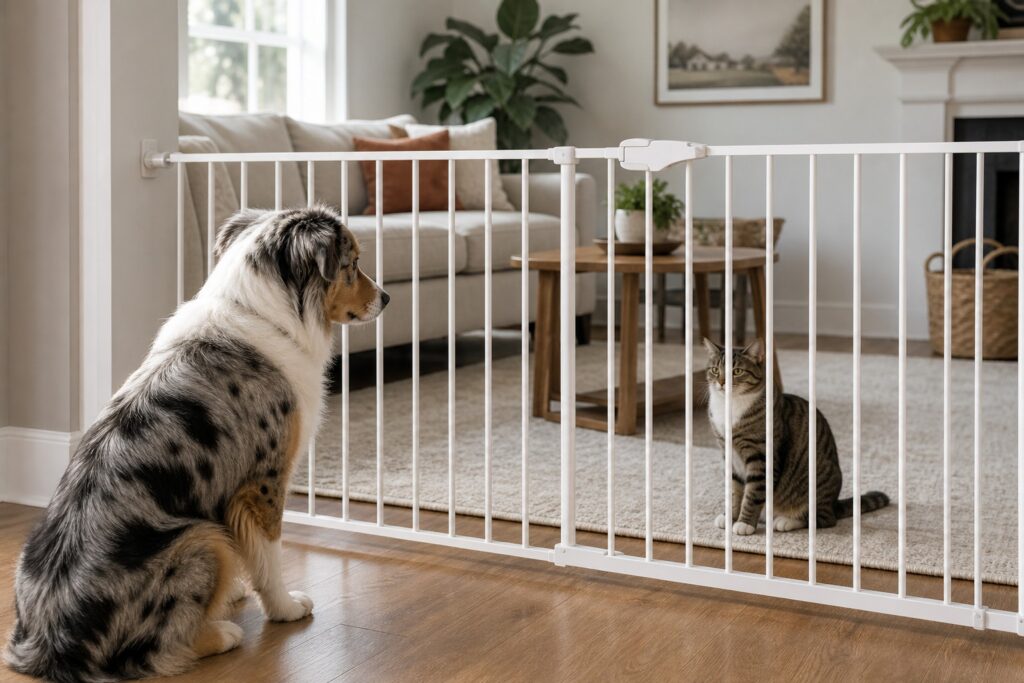
Once scent acclimation is established, visual exposure through a physical barrier is the next phase. A baby gate, exercise pen, or cracked door gives your dog a clear sightline to the cat while eliminating the possibility of physical contact. The training objective at this stage is not interaction. Your dog is learning to maintain a calm, disengaged state with the cat present as a visual stimulus.
The specific behavior our trainers mark and reward is voluntary disengagement. Any moment your dog breaks eye contact with the cat on its own, that behavior gets marked immediately and reinforced. Your dog is not being rewarded for ignoring a command. Your dog is being rewarded for choosing calm over arousal. Barrier sessions begin at 30 to 60 seconds and increase in duration only when your dog demonstrates consistent calm across multiple sessions at the current threshold.
Rushing this phase is the most common error we see in shared-space environments across the Des Moines metro. Owners often collapse the desensitization gradient too quickly because the animals appear tolerant, a pattern we see frequently in Ingersoll-area homes where dogs and cats share a single main living floor. Apparent tolerance is not trained calm. Rushing creates a conditioned arousal response that is significantly harder to extinguish than the original reactivity.
If your dog is struggling to hold disengagement through barrier sessions, our in-home dog training services in Des Moines and structured dog board and train programs both address graduated exposure within a controlled, progressive framework. Get a free consultation by calling (515) 480-7977.
Method 3: Building a Reliable ‘Leave It’ Command Before Shared Space
A reliable “Leave It” command is the behavioral prerequisite for any shared-space introduction. Without it, you have no mechanism to interrupt your dog’s fixation once the barrier comes down. A dog that ignores “Leave It” around a cat is not ready for unsupervised cohabitation, regardless of how well earlier stages went.
Our trainers build “Leave It” through a three-stage progression. Each stage must be mastered before advancing, and stage three must be trained specifically with the cat as the stimulus. Generalization from stages one and two is not sufficient.
The Three-Stage Progression
- Object-level: Your dog leaves a treat on the floor on cue. Low stakes, controlled environment, high repetition.
- Environmental-level: Your dog disengages from a real-world distraction in a low-distraction setting, such as a passing squirrel or a dropped food item.
- High-value stimulus level: Your dog disengages from the cat on cue, at a controlled distance, before any off-leash shared space is attempted.
The command is considered reliable only when it is proofed at your dog’s threshold distance from the cat across multiple sessions. Our Dog Board and Train Services in Des Moines, IA build this full sequence into structured daily routines, giving your dog consistent repetition across real-world scenarios. Call (515) 480-7977 to discuss which program fits your household.
Method 4: Controlled On-Leash Introductions in Shared Space
Rushing this step produces a specific and serious consequence: a cornered, defensive cat will hiss or scratch, and that reaction can trigger a prey-drive escalation that sets back weeks of acclimation work. Many households reach this stage before the foundational work is truly solid. If your dog cannot hold a sit-stay reliably, address that gap first through our Dog Training Programs in Des Moines before attempting shared-space introductions.
Leash Selection and Setup
Your dog must be on a standard 6-foot leash, not a retractable one. Retractable leashes remove your ability to control approach speed and distance in real time. The moment your dog begins moving toward the cat, you need immediate, physical control of that momentum.
The cat must retain full freedom of movement and access to elevated escape routes throughout the session. A cat with no exit will become defensive. That defensive response is what triggers escalation.
Session Length and Arousal Signals
Keep initial sessions to 5 to 10 minutes. Maintain your dog in a calm sit or down-stay, reward disengagement from the cat, and end the session before arousal climbs.
End the session immediately if you observe any of the following:
- A hard stare resuming toward the cat
- Inability to respond to a “Leave It” cue
- A forward weight shift onto the front legs
- Vocalization directed at the cat
These signals indicate your dog’s arousal threshold has been reached. Continuing past that point reinforces reactive behavior rather than calm coexistence. Need help building the obedience foundation this step requires? Call our team at (515) 480-7977 to discuss dog cat introduction training and structured obedience work.
Method 5: Establishing Separate Safe Zones and a Structured Daily Routine
Even after successful on-leash introductions, environmental management remains non-negotiable. In split-level homes and open-plan living areas common across Clive, West Des Moines, and Johnston, spatial delineation requires deliberate planning. Your cat must have access to at least one room or elevated area your dog cannot enter. That separation stays in place until your dog demonstrates reliable calm consistently over an extended period of shared-space exposure.
Iowa’s long winters keep pets indoors together for months at a time. That extended proximity makes environmental architecture more critical, not less. One unsupervised chase rehearsal can undo weeks of desensitization work. Crating or tethering your dog during any unsupervised period is not optional during this phase.
Structured Daily Routines That Reduce Conflict
Structured daily routines lower baseline arousal before shared-space sessions begin. Exercise your dog first. A dog that has already expelled physical energy is significantly less reactive to feline movement. Feed your dog and cat simultaneously in separate areas to remove resource-guarding as a variable entirely.
Our in-home dog training services in Des Moines address exactly this kind of shared-space coaching, building the spatial and behavioral structure your household needs. If the daily routine is inconsistent, progress stalls. Consistency across every member of your household is what produces lasting, reliable responsiveness in your dog. Call us at (515) 480-7977 to discuss a plan specific to your home layout.
Method 6: Off-Leash Reliability Around Cats, the Final Phase
Off-leash shared space is not a reward for patience. It is a behavioral threshold your dog must earn through demonstrated reliability across every prior method. Three prerequisites must be met before you remove the leash entirely: a ‘Leave It’ response that holds at zero distance from the cat, consistent disengagement on cue across repeated supervised on-leash sessions, and a solid recall that holds even when the cat is moving across the room.
The transition itself follows a specific sequence. Begin by dropping the leash so it drags on the floor, giving you a quick grab point if arousal escalates. Your dog should spend several sessions in this dragging-leash state before the leash is removed entirely. Off-leash does not mean unsupervised. You must be present and actively reading early arousal signals, stiffening posture, a fixed gaze, or slowed deliberate movement, throughout every shared session.
Training is complete when your dog can remain in the same room as the cat, off-leash, for sustained supervised periods without fixating, stalking, or requiring a ‘Leave It’ cue. That is the standard. For dogs in Windsor Heights, Ankeny, or Johnston households where cats and dogs share limited indoor space through long Central Iowa winters, reaching this standard matters. Our dog training programs in Des Moines include structured dog and cat training built around graduated exposure for dogs at every stage of this process.
Some dogs, particularly those with high prey drive, may never reach full off-leash reliability around cats. That is a realistic outcome, not a failure. Our trainers assess each dog’s ceiling honestly during an initial consultation so you can plan accordingly.
When Professional Dog and Cat Training Is the Right Call in Des Moines
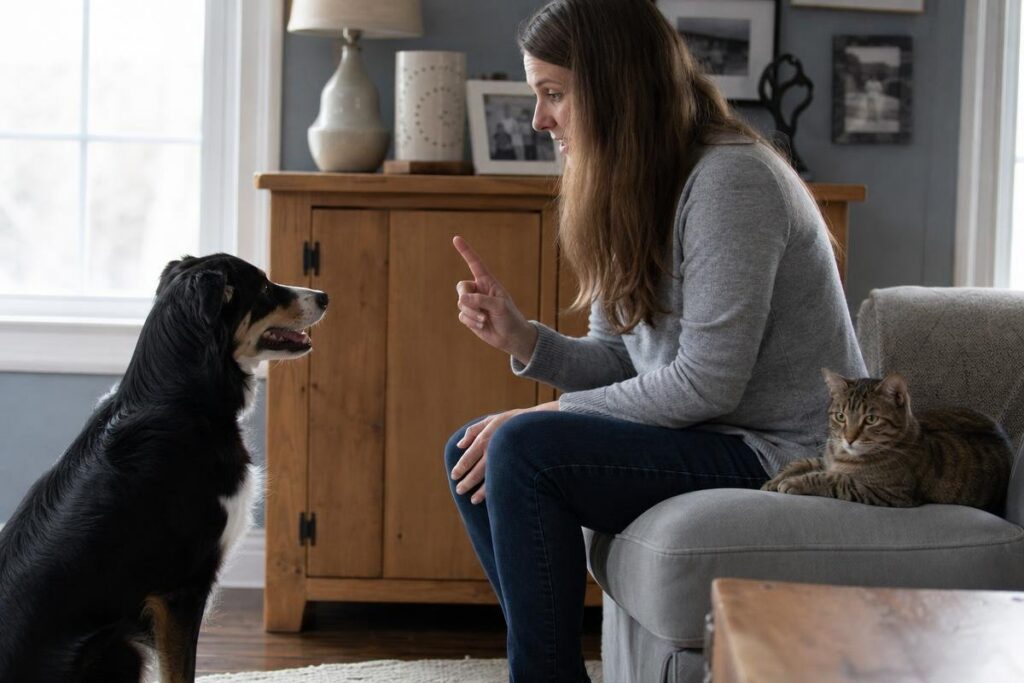
These methods can help many dogs, but some behavioral thresholds require structured professional intervention. If your dog has made physical contact with your cat, cannot complete scent introduction without sustained arousal, or has a documented history of predatory aggression toward small animals, self-directed training has reached its limit. These are signs that professional support may be needed, not owner failures.
Persistent Behavioral Problems That Require Trainer Intervention
Certain behavioral patterns signal that the introduction process needs professional oversight before it progresses further. Our team regularly works with households across Clive, West Des Moines, and Johnston where self-directed introductions escalated before the owner recognized the warning signs.
- Your dog cannot disengage from a cat’s scent without sustained, high-intensity arousal lasting more than a few seconds after redirection.
- Your dog has made direct physical contact with or injured a cat during a controlled introduction attempt.
- Your dog displays predatory aggression, including stalking posture, fixation, or lunging, that does not respond to obedience commands already in place.
- Barrier reactivity has increased rather than decreased across multiple graduated exposure sessions.
These are not signs that your dog is untrainable. They are signs that the behavioral threshold requires a structured program, not continued repetition of the same approach. Our in-home dog training services place a trainer directly in the household environment where your dog and cat actually cohabitate, which produces faster and more reliable results than any facility-based simulation.
How Our Team Approaches Multi-Pet Household Training
All Dogs Unleashed Dog Training Des Moines holds a 4.9-star rating across 200-plus Google reviews, and Mike and the team bring that same structured methodology to every multi-pet case across the Central Iowa service area. For dogs that need foundational obedience before any cat introduction begins, our Dog Board and Train Services in Des Moines build reliable responsiveness before your dog returns home.
Every program is backed by guaranteed results and lifetime support. Call (515) 480-7977 to schedule a consultation.
Frequently Asked Questions
How long does dog and cat training take?
Progress varies by dog, household setup, training history, and safety needs. Dogs with predatory behavior or limited obedience history may need a more cautious, individualized plan. Full off-leash reliability is not appropriate for every dog.
Can every dog be trained to live safely with a cat?
Most dogs can reach a manageable cohabitation threshold with structured training. Breed tendencies and individual history are the primary variables. Safety takes priority over cohabitation, and our trainers will give you an honest assessment of your dog’s realistic ceiling before you commit to a protocol.
What is graduated exposure training?
Graduated exposure training is a systematic desensitization protocol that exposes your dog to the cat at incrementally decreasing distances and increasing durations. Your dog remains below its arousal threshold at every stage. Advancing too quickly collapses the protocol and typically requires starting over.
Should I handle this myself or work with a professional?
Owners with solid foundational obedience already in place can often execute the early phases independently. Dogs with predatory aggression history or no foundational obedience should work with a professional from the outset. Our dog training programs in Des Moines are structured to address both scenarios.
What if my dog has already chased or injured my cat?
A prior chase or injury incident requires returning to foundational obedience before any reintroduction attempt. The barrier phase must be extended significantly, and the overall protocol executed more conservatively. Call (515) 480-7977 before attempting further introductions on your own.
Does your team offer in-home training for multi-pet households?
Yes. Our in-home dog training services are available throughout Polk County, including Clive, West Des Moines, and Johnston. In-home training is particularly effective for households with both dogs and cats because our trainers work directly in the cohabitation environment where the behavior actually occurs.
If your dog has shown prey-drive behavior toward your cat, or if a prior introduction escalated, contact our team before trying again. Call All Dogs Unleashed Dog Training Des Moines at (515) 480-7977 or visit us at 699 Walnut St Ste 400, Des Moines, IA 50309. We will assess your dog’s realistic training ceiling before you invest further time in a protocol that may need professional support.
Ready to Get Started with All Dogs Unleashed Dog Training Des Moines?
Call (515) 480-7977 to speak with our team directly. We’re ready to answer your questions, walk you through your options, and help you find the right solution for your needs. Whether you’re just starting to plan or ready to move forward, we’ll make the process simple and stress-free. Reach out today and let’s talk about how we can help.