
Dog car sickness can turn a holiday drive into the mountains into a long, messy afternoon. Many Denver families load the dog into the car for a cabin weekend, a ski trip, or a visit with relatives across the Front Range, only to notice drooling and whining and hear that unmistakable sound from the back seat before they even reach the foothills. The good news is that most dogs can learn to ride more comfortably with some preparation and patience.
At All Dogs Unleashed Dog Training Denver, we work with dogs every day on calm, confident behavior, including how they handle the car. Below, we explain why dogs get carsick, how to tell motion sickness from car anxiety, and the steps that help before you head west on I-70 this winter.
Is your dog stressed about the car? Tell us about your dog and your travel plans.
Key Takeaways
- The American Kennel Club notes that carsickness is common in dogs and is most often seen in puppies, because the inner ear structures used for balance are not fully developed yet.
- Some dogs feel physically nauseous, while others have learned to associate the car with stress, and many dogs have a mix of both.
- Gradual conditioning, starting with a parked car and building up to short trips, is one of the most effective ways to reduce car stress before a long mountain drive.
- A secured crate or a harness attached to a seatbelt in the back seat keeps your dog safer and can limit the visual motion that adds to nausea.
- If your dog still gets sick after training and practical changes, talk with your veterinarian about whether medication is appropriate.
Why Dogs Get Carsick
Carsickness is not a sign that your dog is being difficult. It is a real physical and emotional response, and understanding where it comes from makes it much easier to fix.
Balance and the Inner Ear
According to the American Kennel Club, motion sickness in dogs is related to the sense of balance, just like it is in people. It is most often seen in puppies, much as it is most common in young children, because the parts of the inner ear that manage balance are still developing. Many dogs outgrow it as they mature. The American Kennel Club also notes that some dogs never fully outgrow the nausea, and those dogs need more help to ride comfortably.
Learned Car Anxiety
The second cause is emotional. The American Kennel Club explains that a dog whose first few car rides ended in vomiting may start to connect the car itself with feeling sick. Other dogs link the car with unpleasant events, such as a trip to the vet. Once that association forms, the stress alone can bring on drooling, panting, and nausea, even before the car starts moving. Anxiety and motion sickness often feed each other, which is why a dog can seem to get worse with every trip.
Why Mountain Drives Are Harder
A quick trip across town to Washington Park is very different from a long drive into the high country. Heading west from Denver on I-70 means climbing into the mountains, with winding stretches, grade changes, and the stop-and-go traffic that often builds on busy winter weekends. A dog who handles a short ride to the store may still struggle on a two- or three-hour mountain drive, so it pays to prepare before holiday travel begins.
Is It Dog Car Sickness or Car Anxiety?
The signs of motion sickness and car anxiety overlap a lot, and many dogs show both. Still, paying attention to when the signs start and how your dog acts can point you toward the right approach.
Common Signs to Watch For
The American Kennel Club lists whining, drooling, licking the lips, and vomiting as signs of car stress. You may also notice yawning, restlessness, panting, trembling, or a dog who refuses to settle.
Clues That Point to Each Cause
Timing matters. A dog who rides happily at first and then starts drooling once the road gets curvy is more likely dealing with motion sickness. A dog who balks at the car door, trembles before the engine starts, or tries to hide when you pick up the keys is showing signs of anxiety. Our post on dog body language every Denver owner should read covers the subtle stress signals that are easy to miss.
| What You Notice | More Likely Motion Sickness | More Likely Car Anxiety |
|---|---|---|
| When it starts | After the car has been moving for a while, especially on curves | Before the car moves, or as soon as the dog sees the car |
| Body language | Drooling, lip licking, listless or quiet | Panting, trembling, whining, trying to escape or hide |
| Getting into the car | Usually willing | Resists, freezes, or has to be lifted in |
| Short parked sessions | Usually fine | Still stressed even when the car is off |
| Best first step | Practical comfort changes and shorter trips | Gradual conditioning and building positive associations |
If your dog vomits often, seems unwell outside the car, or shows any symptoms that worry you, check in with your veterinarian. Repeated vomiting can have causes that have nothing to do with the car, and only a vet can rule those out.
Conditioning Your Dog to the Car Before the Big Trip
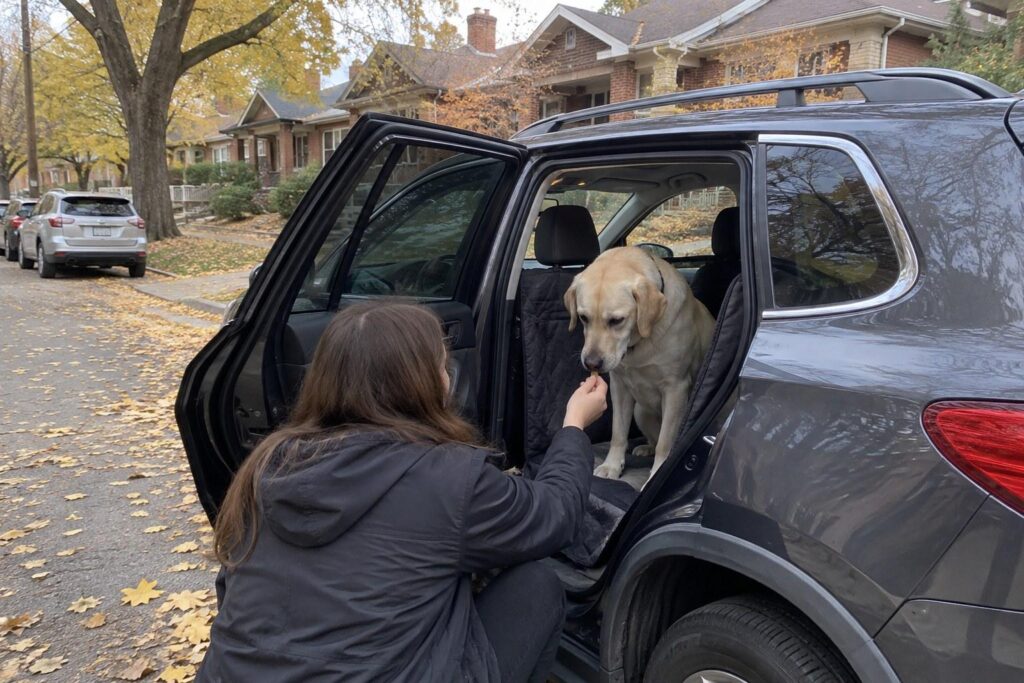
The most reliable long-term fix for car stress is changing how your dog feels about the car. That takes time, so start weeks before your holiday drive, not the night before.
Start With a Parked Car
The American Kennel Club recommends beginning with a few minutes a day sitting in the car with your dog without turning it on or driving anywhere. Sit quietly, offer praise, and keep the mood relaxed. Once your dog is comfortable, start the engine and let it run for a few minutes while you play or offer treats, then turn it off and get out. Repeat this for several days until your dog is happy to hop in.
Build Up to Short Drives
Next, drive to the end of the block and back. Then try a short trip to somewhere your dog enjoys. Denver has plenty of good options, such as a walk along the Cherry Creek Trail, a loop at Sloan’s Lake, or a stroll in City Park. Ending the drive somewhere fun teaches your dog that the car leads to good things, not just the vet. The American Society for the Prevention of Cruelty to Animals also recommends a series of short drives before a long trip, gradually lengthening the time spent in the car.
Step Back When Needed
If your dog gets sick or stressed at any stage, the American Kennel Club suggests going back a step or two and building tolerance again. Stay calm if there is a setback. Yelling or making a fuss only adds stress.
| Stage | What to Do | Move On When |
|---|---|---|
| 1. Parked car, engine off | Sit with your dog for a few minutes, praise and treats | Your dog gets in willingly and relaxes |
| 2. Engine running | Run the engine a few minutes, play or reward, then exit | No drooling, panting, or trembling |
| 3. Very short drive | Drive to the end of the block and back | Your dog stays calm the whole time |
| 4. Short fun trip | Drive to a nearby park or trail your dog enjoys | Your dog looks forward to the car |
| 5. Longer drives | Gradually add time and some curvier roads | Your dog handles 45 to 60 minutes comfortably |
Some dogs move through these stages quickly with practice at home. Others carry deep car anxiety that is hard to change on your own, and daily structured work with a trainer can make a real difference.
Setting Up the Car for a Comfortable Ride
While you work on conditioning, a few practical changes can make every trip easier on your dog’s stomach and nerves.
Restraint: Crate or Harness
The American Society for the Prevention of Cruelty to Animals calls a well-ventilated, secured crate the safest option for a pet in case of an accident. The crate should be large enough for your dog to stand, sit, lie down, and turn around, and it should be secured so it will not slide during a sudden stop. If you skip the crate, the American Society for the Prevention of Cruelty to Animals recommends keeping your dog in the back seat in a harness attached to a secured seatbelt, and not letting your dog ride with its head out the window.
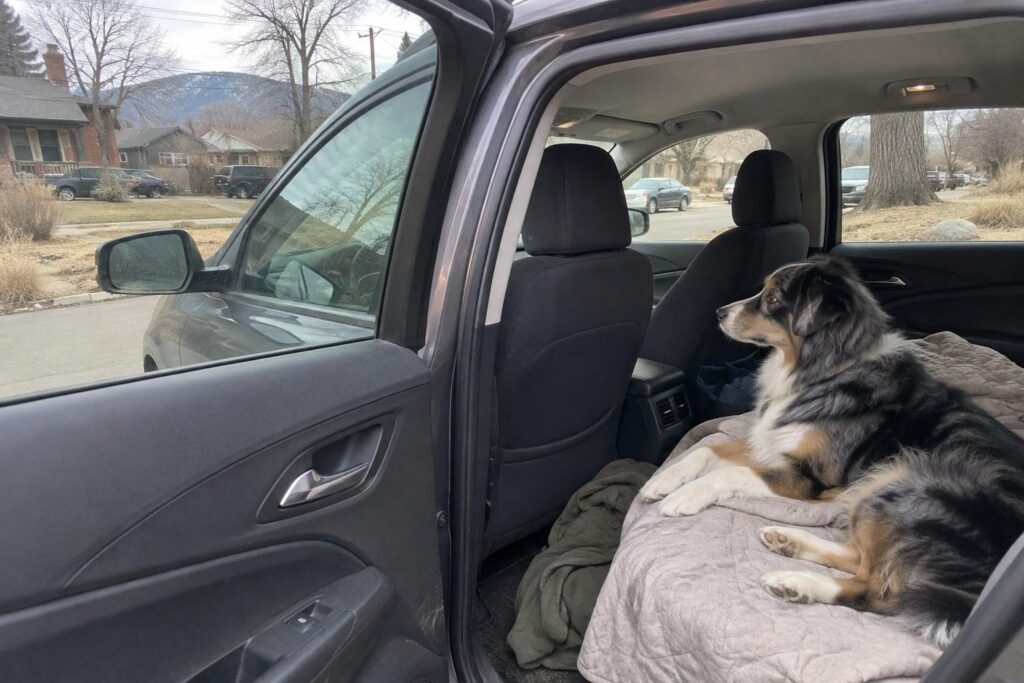
Restraint also helps with nausea. The American Kennel Club suggests placing your dog in the middle of the back seat so they are more likely to look forward, and notes that some owners use a solid-sided crate to limit what the dog sees. Watching scenery blur past a side window can make nausea worse. If trails are on the agenda once you arrive, see our tips on training your dog for Denver hiking trails and mountains.
Fresh Air and Temperature
The American Kennel Club notes that lowering the windows a few inches can help equalize air pressure and reduce nausea, and that keeping the car cool and well ventilated helps too. On a cold Colorado morning, crack the windows just a little rather than blasting the heat. Never leave your dog alone in a parked car. The American Society for the Prevention of Cruelty to Animals warns that a parked car can become dangerously hot in warm weather and dangerously cold in winter.
Feeding, Water, and Breaks on a Mountain Drive
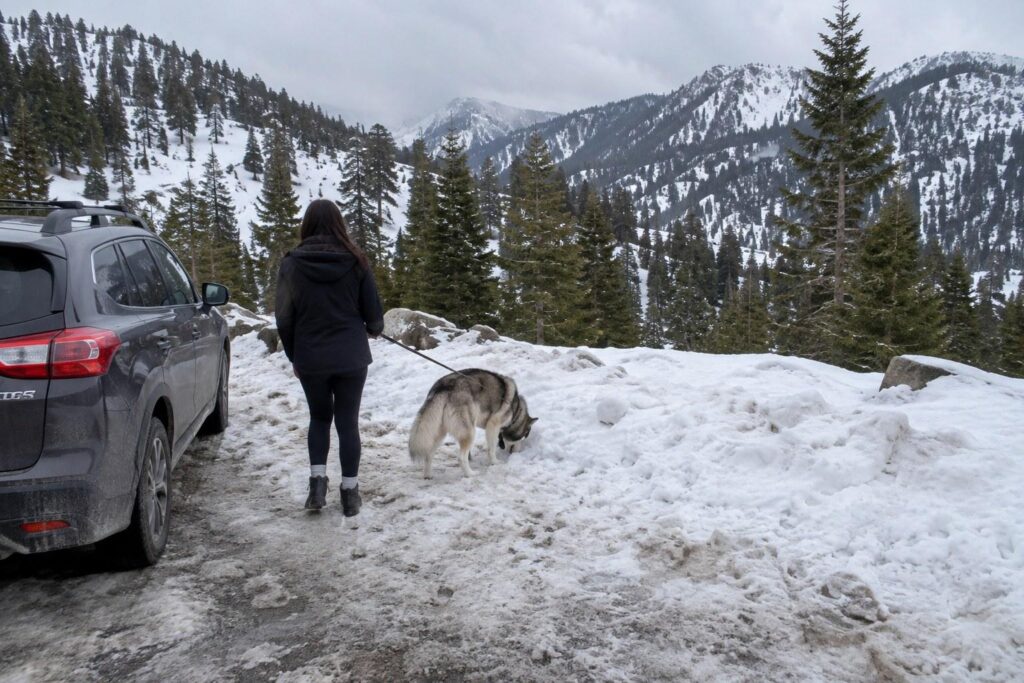
What your dog eats before the drive, and how you pace the trip, can matter as much as anything else.
Feeding Timing
An empty or nearly empty stomach usually helps a carsick dog. Guidance varies on exactly how long to wait. The American Kennel Club suggests withholding food for 12 hours before a car trip if possible, while the American Society for the Prevention of Cruelty to Animals recommends a light meal three to four hours before departure and no feeding in a moving vehicle. Both agree that fresh water should stay available. Because every dog is different, especially young, small, or diabetic dogs, ask your veterinarian which approach fits your dog.
Plan Breaks and Watch the Roads
Short breaks give your dog a chance to stretch, sniff, and settle their stomach. Keep your dog leashed at every stop, since a nervous dog in an unfamiliar place may bolt. Our post on what to do if your dog gets loose is worth a read before any road trip.
Winter conditions can also stretch a drive much longer than planned. The Colorado Department of Transportation encourages drivers to check current road and weather conditions at COtrip.org or by calling 511 before heading out, and to know Colorado’s passenger vehicle traction and chain laws. A long delay is easier on everyone when your dog is secured, comfortable, and has water on hand.
When to Talk to Your Veterinarian About Medication
Training and comfort changes help many dogs, but not every dog. The American Kennel Club notes that when other approaches do not work, a veterinarian may recommend medication for nausea or anxiety. That decision belongs to your vet, who can consider your dog’s age, health, and history.
Signs It Is Time to Call
Schedule a vet visit if your dog vomits on nearly every ride despite gradual conditioning, if car stress seems severe or is getting worse, or if your dog shows signs of illness outside the car.
Never Medicate on Your Own
Do not give your dog human motion sickness pills, leftover prescriptions, or herbal products without your veterinarian’s approval. The American Kennel Club is clear that owners should consult a vet before giving any medication or herbal remedy. Medication works best as one part of a plan that also includes training, not as a replacement for it.
How Professional Training Helps With Car Anxiety
If your dog is physically fine but still panics around the car, the issue is usually behavior, and behavior is what we work on every day.
Our Two-Week Board & Train Program
Our Board & Train program is a two-week program where your dog lives at our facility and works with experienced trainers in daily structured sessions. Each dog starts with an intake assessment so we understand their habits and triggers. The program includes residential work on anxiety and fear-based responses, which is often the root of car stress. In the vast majority of cases, dogs complete the program within the two-week timeframe. Board & Train includes guaranteed results and lifetime support.
Daily repetition builds the skills that carry over to the car: settling on command, staying calm around new places, and listening when things get exciting. Dogs with a bite history need an evaluation before acceptance.
Private Lessons and In-Home Training
If you would rather work through car anxiety at home, in-home dog training lets a trainer help you right in your driveway and your own car. Sessions typically run 4 to 12 appointments, and everyone in the household is involved so your dog gets the same message from the whole family. Private lessons at our facility are also available.
Refresh Training and Boarding
Dogs who have trained with us before can benefit from refresh training when old habits creep back. And if a long mountain drive simply is not right for your dog this season, our dog boarding offers a comfortable alternative at our non-crowded facility, with outdoor turf and both indoor and outdoor play areas. Some families also use our daycare for shorter days out. You can compare everything on our dog training programs page.
Not sure which option fits your dog? Call us at (720) 310-7337 and we will help you find the right path before your next trip.
About All Dogs Unleashed Dog Training Denver
All Dogs Unleashed Dog Training Denver helps local dogs become calm, reliable companions at home, on the trail, and in the car. Our two-week Board & Train program leads the way, supported by private lessons and in-home training, refresh training, and boarding at our facility at 2301 Blake St in Denver. Our experienced trainers focus on practical skills like settling on command and staying relaxed in new situations, so your dog can join more of the trips your family loves.
Frequently Asked Questions
Do dogs grow out of car sickness?
Many do. The American Kennel Club notes that carsickness is most often seen in puppies because the inner ear structures that control balance are still developing, and many dogs outgrow it as they mature. Some dogs stay prone to it throughout their lives, though. If an adult dog still gets sick, gradual conditioning and a conversation with your veterinarian are good next steps.
Should I feed my dog before a long car ride?
A light or empty stomach usually helps. The American Kennel Club suggests withholding food for about 12 hours before a car trip when possible, while the American Society for the Prevention of Cruelty to Animals recommends a light meal three to four hours before leaving. Both say to keep fresh water available. Puppies, small dogs, and dogs with medical conditions may need a different plan, so ask your veterinarian first.
Is it better to use a crate or a seatbelt harness in the car?
The American Society for the Prevention of Cruelty to Animals calls a secured, well-ventilated crate the safest option in case of an accident, as long as it is big enough for your dog to stand, sit, lie down, and turn around. If you do not use a crate, keep your dog in the back seat in a harness attached to a secured seatbelt. A solid-sided crate can also limit visual motion.
How long does it take to get a dog used to car rides?
It varies with the dog and how strong the car stress is. Some dogs relax after a week or two of short daily sessions, while others need much longer. The key is moving forward only when your dog is calm at each stage and stepping back after a setback. Starting several weeks before a holiday mountain trip gives you room to go slowly.
Can I give my dog medicine for car sickness?
Only with your veterinarian’s guidance. The American Kennel Club notes that a vet may recommend medication for nausea or anxiety when other approaches have not worked, but owners should never give human medications, leftover prescriptions, or herbal remedies on their own. Your vet can weigh your dog’s age, health, and history and choose a safe option. Medication works best alongside training and practical changes.
Can Board and Train help a dog with car anxiety?
It can help with the behavior behind it. Our two-week Board & Train program includes daily structured sessions with experienced trainers, including residential work on anxiety and fear-based responses. Dogs build skills like settling on command and staying calm in new situations. Board & Train includes guaranteed results and lifetime support. For true motion sickness, also see your veterinarian.
Help Your Dog Enjoy the Drive to the Colorado Mountains
Dog car sickness does not have to keep your dog home this winter. With gradual conditioning, a secured and comfortable setup, smart feeding timing, and your veterinarian’s input when needed, most dogs can learn to handle the drive into the mountains much better. To talk about training before your next trip, call (720) 310-7337 or reach out online. You can also visit us at our facility at 2301 Blake St in Denver.
Ready to Get Started with All Dogs Unleashed Dog Training Denver?
A calmer car ride starts with a calmer dog. Call All Dogs Unleashed Dog Training Denver at (720) 310-7337 to find the right program for your dog before your next mountain road trip. All Dogs Unleashed Dog Training Denver is located at 2301 Blake St, Denver, CO 80205.