
You’ve probably heard someone say a dog “bit out of nowhere.” It almost never happens that way. Dogs are constantly communicating, mostly through body language, and they typically give multiple warning signals before any escalation. The problem is that most of those signals are subtle, and most owners miss them.
Learning to read dog body language is the closest thing to learning your dog’s actual language. Once you can do it, you’ll prevent more behavioral problems, avoid dangerous situations, and build a much stronger relationship with your dog. This guide breaks down exactly what to look for, body part by body part, plus the stress ladder that tells you when your dog is heading toward a problem.
For a foundational overview of how dogs communicate, our Communication 101: Reading Your Dog’s Body Language post is a useful starting point. This guide goes deeper into specific signals and how to interpret them in real situations.
Why Reading Your Dog’s Body Language Matters More Than You Think
Most behavioral incidents, from bites to leash explosions to resource guarding, are preceded by a series of clear warning signals that the human in the situation didn’t notice. Lip licks, yawns, head turns, whale eye, and stiff postures all show up before growling, and growling shows up before snapping or biting.
Owners who can read these signals can:
- Prevent dog bites, especially around children and unfamiliar visitors
- De-escalate tense situations before they become problems
- Recognize stress during vet visits, grooming, or travel
- Build trust by responding appropriately to their dog’s communication
- Make better decisions about dog parks, playdates, and social outings
It’s one of the highest-leverage skills you can develop as a dog owner.
Dogs Communicate With Their Whole Body, Not Just Their Tail
A wagging tail does not mean a happy dog. That’s one of the most common misconceptions in dog ownership, and it’s contributed to countless bites. Reading body language correctly means looking at the whole picture. Dogs communicate through five main channels:
- Eyes (gaze, pupil size, blinking)
- Ears (position and movement)
- Mouth (tension, lip position, panting)
- Body posture (loose vs. stiff, weight distribution)
- Tail (position, speed of wag, stiffness)
Plus a sixth, fur and hackles, which can stand up when the dog is aroused regardless of whether that arousal is fear, excitement, or aggression.
The key principle: signals must be read together, not in isolation. A wag with a stiff body and hard stare means something completely different than a wag with a loose body and soft eyes.
The Eyes: What Your Dog’s Gaze Is Really Saying
Eyes are one of the most reliable indicators of how a dog is feeling because they’re hard to fake. Here’s the decoder:
| What You See | What It Usually Means |
|---|---|
| Soft, almond-shaped eyes with relaxed lids | Calm, content, comfortable |
| Bright, alert eyes with normal pupil size | Engaged, interested, attentive |
| Hard, fixed stare without blinking | Threat, challenge, or high arousal |
| Whale eye (white visible at the corner) | Stressed, uncomfortable, “leave me alone” |
| Dilated pupils when not in dim light | Fear, high arousal, stress |
| Squinting or partially closed eyes | Submissive, appeasement, “I’m not a threat” |
| Avoiding eye contact / looking away | Trying to de-escalate, polite refusal |
| Half-closed, sleepy eyes | Relaxed, content |
Whale eye is one of the most important signals to recognize. When you can see the whites of your dog’s eyes because they’ve turned their head away from something but kept their gaze on it, they’re stressed. This shows up frequently when children hug dogs around the neck.
The Ears: Position Tells You Everything

Ear reading takes a little practice, especially with breeds that have floppy or cropped ears. The base of the ear is what you watch, not the floppy part itself.
| Ear Position | What It Usually Means |
|---|---|
| Neutral position (natural resting) | Relaxed, comfortable |
| Forward and alert | Interested, focused on something |
| Forward and tense, nearly stiff | High alert, possible threat detection |
| Slightly back and relaxed | Friendly, submissive, appeasement |
| Pinned flat against the head | Fear, stress, or submission |
| One ear forward, one back | Listening to multiple inputs, mild confusion |
| Twitching rapidly | High arousal, possible anxiety |
For floppy-eared breeds (Beagles, Spaniels, Labs, etc.), watch for the base of the ear lifting, the slight pull forward or backward at the skull, and the visible tension in the muscles around the ear.
The Mouth: Beyond the Smile
Dogs use their mouths for a wide range of communication beyond chewing and barking. The tension and shape of the mouth tells you a lot.
| What You See | What It Usually Means |
|---|---|
| Loose, slightly open mouth, soft jaw | Relaxed, content |
| Closed mouth with no tension | Alert, focused |
| Closed mouth, tight, drawn back at corners | Stressed, anxious |
| Quick lip lick (no food present) | Stress, appeasement, “I’m uncomfortable” |
| Big, exaggerated yawn (not tired) | Stress, attempt to self-calm |
| Heavy panting when not hot or active | Stress, anxiety, pain |
| Lip curl showing front teeth | Warning, “back off” |
| Full snarl with all teeth visible | Serious threat, possible bite incoming |
| “Smile” with relaxed mouth and squinting eyes | Friendly submission (genuine, not appeasement) |
The lip lick is one of the most common stress signals owners miss. If your dog flicks their tongue out repeatedly when no food is involved, they’re telling you they’re uncomfortable.
The Body and Posture: Loose vs. Stiff Is the Key
If you remember nothing else from this guide, remember this: loose, wiggly bodies = relaxed dogs. Stiff, frozen bodies = stressed or aroused dogs. That single distinction will catch the majority of issues.
| Body Posture | What It Usually Means |
|---|---|
| Loose, wiggly, weight evenly distributed | Relaxed, comfortable, friendly |
| Play bow (front down, rear up) | Inviting play, friendly |
| Weight shifted forward, body tense | Confident, possibly threatening |
| Weight shifted back, body lowered | Fearful, defensive |
| Frozen, completely still | Warning sign, possible escalation incoming |
| Cowering, body lowered, tail tucked | Fear, submission |
| Standing tall, hackles raised | High arousal, fear, or aggression |
| Body turning sideways or away | De-escalation, “I’m not a threat” |
| Rolling onto back showing belly | Either submission or genuine relaxation (read context) |
Freezing is critically important. A dog that suddenly stops moving, stops wagging, and goes completely still is on a low rung of the aggression ladder. Respect that signal. Don’t push the interaction.
The Tail: Why Wagging Doesn’t Always Mean Happy
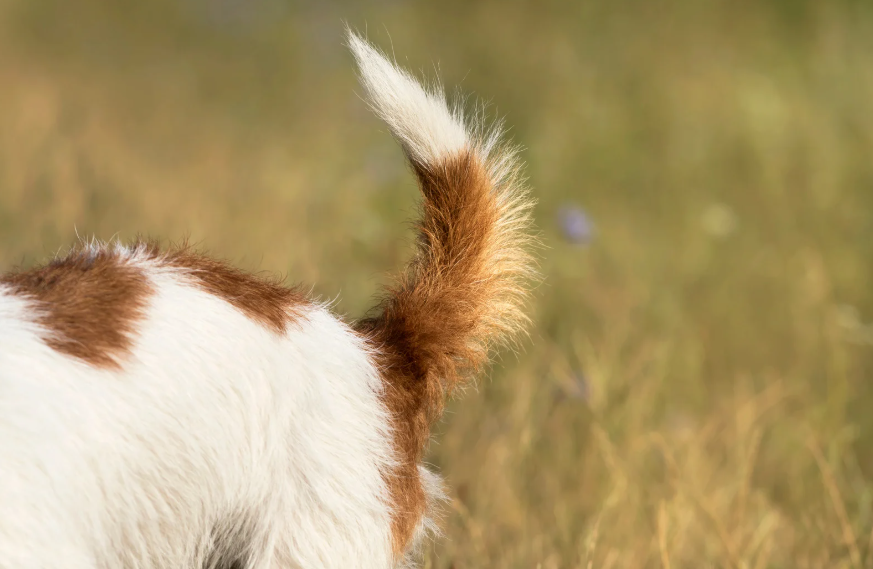
Tail communication has three main variables: position, speed, and stiffness. All three matter.
Position:
| Tail Position | What It Usually Means |
|---|---|
| Neutral (level with the back) | Relaxed |
| Slightly raised, loose | Confident, content |
| High and stiff, almost vertical | Alert, possibly aggressive |
| Low | Uncertain, submissive |
| Tucked between legs | Fear, severe stress |
Wagging speed and style:
- Fast, loose, sweeping wag with a wiggly body = friendly, excited
- Slow, tentative wag with a stiff body = uncertain, cautious
- Rapid, stiff wag with a tense body = high arousal (could go either way)
- Side-to-side helicopter wag with the whole rear end moving = very happy
- Wagging with hackles up and stiff body = warning sign
A common myth is that any wagging means a friendly dog. Many bites have happened to people who saw a wagging tail and ignored every other warning signal. Always read the tail in context with the body posture.
The Ladder of Stress Signals (And Why You Should Never Skip a Rung)
Veterinary behaviorists describe a “ladder of communication” that dogs climb when they’re uncomfortable or stressed. The lower rungs are subtle. The higher rungs are obvious. The goal is to catch the lower rungs so your dog never feels the need to climb.
Here’s the ladder, from lowest to highest:
- Yawning, lip licking, blinking (very subtle calming signals)
- Turning head away, whale eye (clear “I’m uncomfortable”)
- Turning whole body away, low body posture (asking for distance)
- Walking away, hiding behind owner (active avoidance)
- Standing still, tucked tail, ears back (frozen, fearful)
- Stiffening body, hackles up (warning escalation)
- Growling, showing teeth (clear verbal warning)
- Snapping or air-biting (final warning before contact)
- Biting (last resort)
The most important point: if your dog skips rungs, it usually means earlier signals were ignored or punished in the past. A dog that goes from “fine” to “growling” with no visible warning has likely had their lower-level signals dismissed many times before.
This is also why you should never punish a growl. The growl is your dog warning you. Punish the warning, and the next time they’re uncomfortable, they may skip straight to a snap or bite. Address the cause of the discomfort instead.
Reading the Whole Picture: Three Common Scenarios
Body language always has to be read in context. Here are three real-life situations and how to interpret what you’re seeing:
Scenario 1: Your dog meeting a new person at the door
A friendly, relaxed dog will show: loose body, wiggly tail wag, soft eyes, mouth slightly open, ears in neutral or slightly forward position. Maybe a play bow. Maybe a quick sniff and then turning back to you.
A nervous or unsure dog will show: stiff body, hesitation to approach, looking away, lip licking, possibly hiding behind you. Tail might be low or tucked. Don’t force the interaction.
A potentially dangerous situation: stiff body, hard stare at the visitor, hackles up, low growl, weight forward. Immediately separate the dog and get professional help.
Scenario 2: Your dog at the vet
Most dogs show stress at the vet, even calm ones. Watch for: panting when it’s not hot, repeated yawning, lip licking, trying to leave the room, whale eye, tucked tail, freezing on the exam table, drooling, shedding excessively. These are all normal vet stress signals.
If the signals escalate to growling or snapping, the vet team needs to know so they can adjust their approach. Punishing this is exactly the wrong response.
Scenario 3: Your dog meeting another dog on a walk
Healthy greeting: both dogs approach in a curve (not head-on), loose bodies, soft eyes, brief sniff (usually rear-end first), then either disengaging or starting to play.
Warning signs: head-on stiff approach, hard stare, raised hackles, freezing, growling, body weight forward, tail high and stiff. Increase distance immediately.
For dogs that consistently show warning signs around other dogs on walks, our guide on walking a reactive dog covers the layered training approach.
Play vs. Aggression: How to Tell the Difference
Healthy dog play looks chaotic but follows clear rules. Aggression looks similar at first glance but lacks those rules. Here’s how to tell:
| Healthy Play | Concerning Behavior |
|---|---|
| Both dogs take turns chasing and being chased | One dog always chases, the other always runs |
| Frequent play bows (signaling “I’m playing”) | No play bows, just intense focus |
| Self-handicapping (bigger dog softens for smaller) | One dog overpowers without restraint |
| Loose, bouncy body movements | Stiff, intense body movements |
| Soft mouths during contact | Hard biting with full pressure |
| Both dogs voluntarily re-engage after pauses | One dog tries to disengage but can’t |
| Tail wagging with whole-body wiggle | Stiff or absent tail wag |
| Brief breaks where dogs check in with each other | Continuous escalation without breaks |
| Mounting is brief and reciprocal | Mounting is one-sided and persistent |
If you’re at a dog park or watching a playdate and you’re not sure whether it’s play or escalating, separate the dogs briefly. Healthy play resumes naturally once both dogs have had a chance to reset. Aggression doesn’t.
What to Do When You See Stress Signals
Once you know how to read the signals, the next step is responding appropriately. A practical action plan:
- Increase distance from the trigger. The single most effective de-escalation tool. Move your dog away from whatever is causing stress.
- Reduce the intensity of the situation. Lower your voice, slow your movements, give your dog space to think.
- Don’t force the interaction. If your dog is showing stress around a person, dog, or situation, don’t push them through it.
- Reward calm behavior once they recover. Bring out a high-value treat once your dog is back to a relaxed state.
- Take note of the trigger. Pattern recognition is key. The same stressor today will likely be a stressor tomorrow.
- Consult a professional if patterns persist. Repeated stress around specific triggers needs structured behavior modification work.
For dogs with deeper trauma backgrounds whose stress signals are constant, our blog on working with and training a traumatized dog covers the broader rehabilitation approach. For dogs showing aggression-related body language, our post on common types of aggression in dogs breaks down the different categories.
For more on the broader communication framework between humans and dogs, our piece on understanding your dog’s language covers complementary ground.
Frequently Asked Questions
Does my dog feel guilty when they look “sorry” after doing something wrong?
No. The “guilty look” is actually appeasement behavior. Your dog is reading your body language (frustrated tone, tense posture) and offering submissive signals to defuse the situation. They don’t connect the look to a past event the way humans assume. They’re responding to you, right now.
Why does my dog yawn when I hug them?
Hugging is not a comforting gesture in dog language. Many dogs find hugs stressful, especially from strangers or children. The yawn is a calming signal, your dog telling you they’re uncomfortable. Most dogs tolerate hugs from people they trust, but tolerate is the operative word.
What does “whale eye” actually mean?
Whale eye is when you can see the whites of your dog’s eyes because they’ve turned their head away but kept their gaze fixed on something. It’s a stress signal indicating they’re uncomfortable but trying to monitor a perceived threat. Common around children climbing on dogs, when a dog is guarding food, or when a stranger gets too close.
Can dogs with cropped ears or docked tails still communicate properly?
Yes, but with reduced visual signaling. Dogs with cropped ears or docked tails compensate with other body language, but they lose some of the nuance, which can lead to miscommunication with other dogs. Other dogs may misread their intentions because the visual cues are limited.
My dog’s tail wags when they’re about to bite. How is that possible?
A wag with a stiff body, raised hackles, hard stare, and forward-shifted weight is a sign of high arousal, not happiness. The wagging here indicates that something has the dog’s intense attention, but the rest of the body says it’s not a positive interest. This is exactly why reading the whole body matters.
Should I correct my dog for growling?
No. Growling is your dog’s communication that they’re uncomfortable and need space. Punishing the growl teaches them that growling causes additional stress, which can result in skipping the warning entirely and going straight to a snap or bite next time. Address the underlying cause of the discomfort, not the warning itself.
About All Dogs Unleashed
All Dogs Unleashed is a professional dog training facility serving Bossier City, Shreveport, and the surrounding communities. Located at 4500 Benton Rd, Suite 200, Bossier City, LA 71111, our team helps owners build a deeper understanding of their dogs through professional training that prioritizes communication, trust, and clear structure. All Dogs Unleashed works with dogs at every level, from puppies learning the basics to adults working through complex behavioral issues.
Want to Better Understand What Your Dog Is Telling You?
Reading body language is a skill that takes practice, but you don’t have to figure it out alone. Whether your dog is showing concerning signals, struggling with reactivity, or you simply want to build a stronger relationship through better communication, the right professional support makes a real difference.
Our dog training programs, in-home dog training, and board and train options are built around teaching both you and your dog how to communicate clearly.
Call us at (318) 562-6536 or visit our contact page to schedule a consultation. Let’s help you understand your dog the way they’ve always wanted to be understood.