
Most Bossier City dog owners think a tired dog is a happy dog, and they’re not wrong. But what most owners don’t realize is that physical exercise alone isn’t what tires a dog out. The real fatigue, the kind that produces a calm, well-behaved dog who sleeps soundly and isn’t constantly inventing problems, comes from mental stimulation. Research backs this up clearly: 10 minutes of focused mental work tires a dog more than 30 minutes of physical exercise.
That’s where enrichment comes in. Enrichment is everything you do to engage your dog’s mind, senses, instincts, and natural behaviors. Sniffing, problem-solving, foraging, exploring new environments, working through challenges. The dogs that get adequate enrichment are noticeably calmer, less destructive, less anxious, and more well-adjusted than dogs who only get walks and meals. Here are 10 enrichment ideas that work for Bossier City dogs, plus how to use them effectively.
Why Enrichment Matters More Than Just “Tiring Your Dog Out”
A 2014 study published in the Journal of the American Veterinary Medical Association found that shelter dogs given enrichment activities twice a day spent 65% more time resting quietly after just three days. The behavioral improvements are real and measurable.
Dogs without adequate enrichment tend to invent their own. That’s where most “behavior problems” come from. The dog chewing the couch isn’t being bad. They’re under-stimulated. The dog barking at every leaf isn’t poorly trained. They’re under-stimulated. The dog who can’t settle in the evening isn’t anxious. They’re under-stimulated. Adding 10–20 minutes of enrichment a day often resolves issues that owners had been trying to fix with corrections, more walks, or training that wasn’t addressing the root cause.
This matters even more in Bossier City. Our long, hot summers limit outdoor time to early mornings and late evenings for several months a year. Dogs who only got their stimulation from walks suddenly have nothing to do for the bulk of the day. Building a strong indoor enrichment routine isn’t optional during a Louisiana summer, it’s essential.
For dogs whose understimulation has already turned into chewing or digging, our blog on understanding and eliminating destructive chewing covers how to address the symptom while you build out the enrichment that prevents it.
The 4 Categories of Dog Enrichment
The 10 ideas below all fall into one of four categories. A balanced enrichment routine includes some of each:
- Cognitive enrichment, problem-solving and learning (puzzles, training, finding hidden things)
- Sensory enrichment, engaging the senses, especially scent (sniffing, novel textures, scent games)
- Physical enrichment, body engagement that goes beyond standard walks (varied terrain, climbing, swimming, digging)
- Social and environmental enrichment, interactions with other dogs, people, and new environments
The most enriched dogs get a mix every day. The most underenriched dogs get only repeated physical exercise on the same routes. Variety is the actual goal.
Idea #1: Snuffle Mats and Food Scatters
A snuffle mat is a piece of fabric with strips of cloth tied throughout, designed to hide kibble or treats in the folds. Your dog has to use their nose to find each piece. It’s one of the most effective and accessible enrichment tools available, and it costs less than a single bag of premium treats.
You can buy snuffle mats online for $15–$25, or make one from a rubber sink mat and strips of fleece. For dogs new to the concept, sprinkle treats on top first so they understand the game. Then start hiding the treats deeper in the folds. A 5–10 minute snuffle session before you leave the house in the morning gives most dogs more mental work than a brisk walk around the block.
A simpler version is a food scatter. Take your dog’s regular meal, walk to the back yard, and toss the kibble across the grass. Let them forage. This single change to mealtime adds significant enrichment without spending money or buying anything.
Idea #2: Stuffed Kongs and Frozen Treats
The classic Kong toy has been around for decades for a reason: it works. Stuff a Kong with peanut butter (xylitol-free, always check the label), wet food, plain Greek yogurt, mashed banana, or a mixture of soaked kibble and treats. Freeze it for 4–6 hours before giving it to your dog.
A frozen Kong takes 20–45 minutes for most dogs to fully clear, and the licking and chewing release calming hormones (dogs find chewing genuinely soothing). Frozen Kongs are especially valuable in Bossier City summers, when they double as enrichment and a cooling treat. They’re also a go-to tool for separation anxiety, fireworks nights, thunderstorms, and any other situation where you need your dog occupied and calm.
Other stuffable options worth keeping on hand include West Paw Toppls, lick mats spread with frozen peanut butter, and hollow marrow bones. Rotate between them so your dog doesn’t get bored of the same shape and texture.
Idea #3: Scent Work and “Find It” Games
Dogs experience the world primarily through scent. Their olfactory ability is roughly 10,000 to 100,000 times stronger than ours, depending on the breed. Engaging that sense is one of the most enriching things you can do for them.
The simplest version is a “find it” game. Have your dog sit and stay, then place a few treats around the room, under a chair, behind a pillow, on a bookshelf. Release them with “find it” and let them search. Most dogs love this game from the first round, and you can make it harder over time by hiding treats in different rooms or in more challenging spots.
A step up is teaching them to find specific scented items. Hide their favorite toy and send them to find it. Once they’re proficient, try hiding it in another room. The game uses the same neural circuits that working detection dogs use professionally. Ten minutes of structured scent work tires most dogs more thoroughly than a 30-minute walk.
Idea #4: Puzzle Toys and Treat-Dispensing Balls
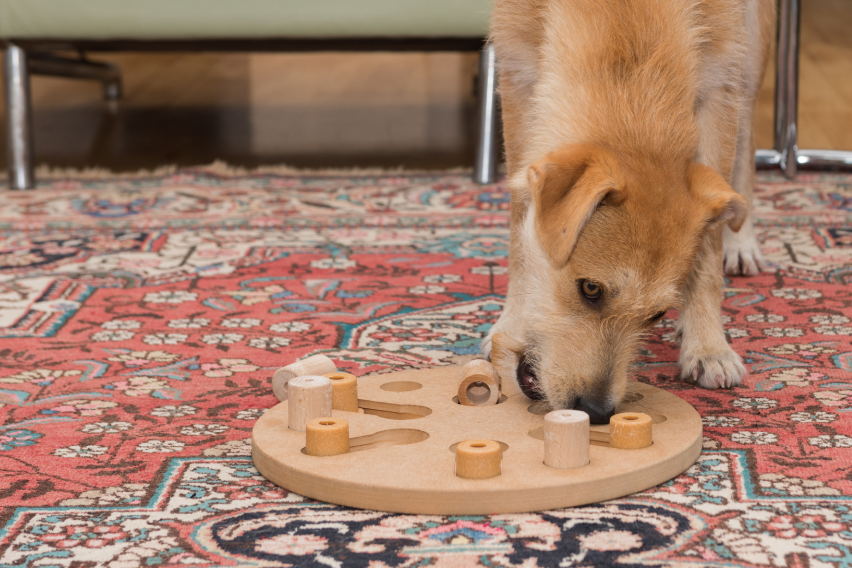
Puzzle toys come in various difficulty levels, from simple flip-and-find designs to multi-step puzzles requiring sliding compartments and lifted lids. Brands like Outward Hound, Trixie, and Nina Ottosson make graduated lines specifically designed to scale with your dog’s skill level.
Start easy. A puzzle that’s too hard frustrates dogs and they give up. Once they’ve mastered the easy version, move to medium, then advanced. The progression itself is enriching because each new puzzle requires fresh problem-solving.
For active feeding, treat-dispensing balls (like the Kong Wobbler or Bob-A-Lot) make your dog work for their meal by rolling, batting, and nudging the toy. Replacing the food bowl with a dispensing toy turns a 30-second eating event into a 15–20 minute enrichment session.
Idea #5: Training Sessions as Daily Enrichment
Most owners think of training as something you do to fix behaviors. It’s also one of the most powerful enrichment activities available. Five minutes of focused training engages your dog’s problem-solving, attention, and communication skills more than a 20-minute walk.
Daily 5–10 minute training sessions provide enrichment whether you’re working on basic obedience, polishing existing commands, or teaching new tricks. Tricks especially are underrated. Spin, bow, shake, roll over, weave through your legs, find your keys, none of these have to be useful to be valuable. The act of learning itself is the enrichment.
For more on the foundation skills you can build through training, our blog on how to teach your dog obedience commands covers the basics. For dogs who struggle to focus during training, our piece on 5 tips to build your dog’s attention span is a useful starting point.
Idea #6: Vary Your Walking Routes
Most dogs walk the same loop every day. Out the door, around the block, back home. The route gets familiar fast, and what should be enriching becomes nearly automatic. The dog gets physical exercise but minimal sensory input.
Bossier City and the surrounding area have plenty of options for varied walks. Walker Place Park offers trails through wooded areas with completely different smells and textures than residential streets. Mike Wood Memorial Park has a one-mile maintained trail that feels different from neighborhood walks. The trails at Red River National Wildlife Refuge are scent-rich environments that engage your dog’s nose for the entire walk.
Even staying in your neighborhood, varying the route adds enrichment. Walk the loop in reverse. Cross to streets you don’t usually visit. Stop at different intersections so your dog gets new corners to investigate. Park your car a few blocks away and walk from a new starting point. None of these changes cost anything, and all of them increase the enrichment value of the walks you’re already doing.
Idea #7: “Sniffari” Walks
A “sniffari” is a walk where you let your dog set the pace and follow their nose. No agenda. No hurry. No pulling them away from the bushes they want to investigate. The point isn’t getting from point A to point B. The point is letting your dog read the neighborhood through scent.
This is the opposite of a structured heel walk, and it serves a completely different purpose. A sniffari for 20 minutes provides more mental enrichment than a brisk 45-minute structured walk. Your dog comes home tired in a calm, satisfied way, not in a wired, over-stimulated way.
Sniffaris work especially well for dogs that struggle with reactivity or anxiety on walks. Letting them control the pace and engage their nose helps them stay below threshold, and the natural calming effect of sniffing reduces overall stress. Build a couple sniffaris into your weekly routine alongside your regular walks.
Idea #8: A Designated Dig Pit
Digging is a natural canine behavior, and trying to eliminate it entirely is usually a losing battle. Channeling it into an approved spot is much more effective than punishing it everywhere.
A dig pit can be as simple as a corner of the yard you’ve designated for that purpose, or a child’s plastic sandbox or wading pool filled with sand. Bury treats, toys, and chews in the sand. Encourage your dog to dig them up. The combination of natural behavior, scent work, and reward makes this one of the most enriching activities you can set up at home.
This is particularly valuable for terriers, dachshunds, huskies, and other breeds with strong digging instincts. It’s also a smart move for any dog who’s been digging holes in your lawn or destroying flower beds. They’re going to dig somewhere. Better that it’s the spot you’ve chosen than the spot you wish they hadn’t.
Idea #9: Toy Rotation and Novelty

Most dogs have a pile of toys they ignore most of the time. The pile is too familiar. The toys have lost their novelty.
Toy rotation fixes this without spending a dollar. Pick three or four favorite toys to leave out at any given time. Put the rest away in a closet or bin. Once a week, swap out the available toys for some from the storage bin, and put the previous batch away. The “rediscovered” toys feel new again, and your dog engages with them like they did when they were first introduced.
For maximum enrichment value, hide the rotated toys around the house instead of leaving them in a basket. Now finding the toy is part of the game. You can also pair this with food enrichment by stuffing rotated toys with treats before hiding them.
Idea #10: Social Enrichment (Done Right)
Dogs are social animals, and most benefit from regular interaction with other dogs and people beyond their immediate household. The key word is “right.” Social enrichment that goes badly creates more problems than it solves.
Good social enrichment looks like:
- Playdates with one or two known, well-behaved dogs in a controlled space
- Visits to dog-friendly patios at calm times of day
- Walks with a friend who also has a friendly, well-matched dog
- Training group classes where the social environment is moderated
- Occasional visits to friends’ or family members’ homes
Social enrichment that often goes badly looks like:
- Crowded public dog parks with unknown dogs of unknown temperaments
- Forcing introductions with reactive or fearful dogs
- High-stimulation environments for dogs who are easily overwhelmed
- Long social outings that exceed your dog’s tolerance window
Read your specific dog. Some thrive on group play. Others prefer one-on-one interaction. Some are introverts and do better with quiet observation than active socializing. Match the enrichment to the dog you actually have, not the social butterfly you wish you had.
Bonus: Indoor Enrichment for Bossier City’s Hot Months
When summer hits and outdoor time gets restricted to dawn and dusk, indoor enrichment becomes essential. Quick options to keep in your back pocket:
- Frozen Kongs or lick mats first thing in the morning before the heat
- Indoor scent games using cardboard boxes with hidden treats
- Stair climbs or hallway fetch sessions for physical movement
- Training sessions in a cool room
- Puzzle feeders for breakfast and dinner instead of bowls
- A kiddie pool of cool water in a shaded spot for water-loving dogs
- A blanket fort or cardboard box maze to explore
Most of these take 10 minutes or less but make a meaningful difference in your dog’s energy level and mood through the day.
How Much Enrichment Does Your Dog Actually Need?
There’s no single answer because it varies by breed, age, and individual temperament. A senior Basset Hound needs less than an adolescent Border Collie. A working-line German Shepherd needs more than a Cavalier King Charles Spaniel.
The best gauge is your dog’s behavior. A dog who’s getting adequate enrichment settles calmly between activities, sleeps soundly, doesn’t invent problems to solve (chewing, barking, destruction), and isn’t restless or pestering you for attention. A dog who’s getting inadequate enrichment shows the opposite: trouble settling, demanding behavior, restlessness, finding their own (usually destructive) entertainment.
For most adult dogs, a baseline of 30–60 minutes of physical exercise plus 15–30 minutes of mental enrichment per day is a reasonable starting point. High-energy breeds and adolescents often need more. Senior dogs and lower-energy breeds often need less. Adjust based on what you’re seeing in your dog’s behavior.
For dogs whose understimulation is showing up as constant whining or attention-seeking, our piece on why is my dog whining more than normal covers the diagnostic side. For dogs who are over-aroused and bouncing off the walls, our blog on how to curb overexcitement in your dog addresses how enrichment fits into the broader fix.
When Enrichment Isn’t Solving the Problem
Enrichment fixes a lot of dog behavior issues, but not all of them. If you’ve added consistent enrichment to your dog’s routine and you’re still seeing significant behavior problems, the issue is probably something deeper than under-stimulation. Common situations where enrichment alone isn’t enough:
- Genuine separation anxiety (the dog panics, not just gets bored)
- Fear-based reactivity that needs structured behavior modification
- Resource guarding or aggression
- Severe noise phobias (fireworks, thunderstorms)
- Trauma history requiring patient rehabilitation
- Foundational obedience gaps that need formal training
For these situations, professional support is the right next step. Our dog training programs include behavior work that addresses the underlying issues enrichment alone can’t fix. In-home dog training is often the right format because the work happens in your dog’s actual environment, where the issues actually occur. For dogs that need an intensive structured reset, board and train can provide the foundation that ongoing enrichment then maintains.
Frequently Asked Questions
How long should an enrichment session last?
For most enrichment activities, 10–20 minutes is the sweet spot. Long enough for real engagement, short enough to leave your dog satisfied rather than over-tired or frustrated. Frozen Kongs can last 30–45 minutes naturally. Quick training sessions can be as short as 5 minutes and still be effective.
Can I overdo enrichment?
Yes, although it’s harder to overdo than to underdo. Constant high-intensity enrichment without rest can leave a dog overtired or even create a hyperaroused state where they can’t settle even when given the chance. Build in real downtime alongside the enrichment. The goal is a balanced day with mental work, physical work, social interaction, and quiet rest.
Is enrichment just for puppies and high-energy dogs?
No. Adult dogs, senior dogs, low-energy breeds, and even sick or recovering dogs all benefit from enrichment. The activities just look different. A senior dog might do well with gentle scent games and short training sessions. A high-energy adolescent might need puzzle toys, scent work, training, and social enrichment all in the same day. Match the enrichment to your dog.
Will enrichment fix my dog’s separation anxiety?
It helps, but it usually isn’t enough on its own for true separation anxiety. A frozen Kong at the start of a departure provides a positive distraction and can reduce mild anxiety. Severe separation anxiety, where the dog panics, destroys things, or hurts themselves trying to escape, needs structured behavior modification work alongside enrichment.
My dog destroys puzzle toys instead of solving them. What do I do?
This usually means the puzzle is too hard and your dog is frustrated, or the toy isn’t appropriate for their chew strength. Try easier puzzles, supervise the first sessions to teach them how the puzzle works, and use chew-resistant materials for heavy chewers. Some dogs simply prefer scent work or training over puzzles, and that’s fine too.
Do I need to spend a lot of money on enrichment products?
No. Some of the most effective enrichment costs nothing: scattering kibble in the yard, hiding treats around the house, varying walking routes, daily training sessions, food puzzles made from cardboard boxes. A few quality items (a Kong, a snuffle mat, one or two puzzle toys) cover the basics for under $50 total, and they last for years.
About All Dogs Unleashed
All Dogs Unleashed is a professional dog training facility serving Bossier City, Shreveport, and the surrounding communities. Located at 4500 Benton Rd, Suite 200, Bossier City, LA 71111, our team helps families build well-rounded dogs through training, structured enrichment, and the kind of daily routines that produce calm, confident behavior. All Dogs Unleashed believes that most “behavior problems” are actually unmet needs, and the right combination of training, enrichment, and structure resolves more issues than corrections ever could.
Need Help Building the Right Routine for Your Dog?
If your dog is showing signs of under-stimulation despite your best efforts, or if you’re not sure where to start with building an enrichment routine that fits your specific dog, the right professional support makes a real difference. We can evaluate what your dog actually needs and help you build it into a daily rhythm that works for your household.
Call us at (318) 562-6536 or visit our contact page to schedule a consultation. Let’s give your dog the kind of mentally engaged, well-rounded life that produces the calm, well-behaved companion you’re working toward.