
Goldendoodle training looks easy on paper. Doodles are friendly, smart, and eager to be around people, so many owners expect good manners to show up on their own. Then the teenage months hit, and that sweet puppy starts launching at guests, grabbing sleeves, and ignoring you the moment a squirrel crosses the yard.
At All Dogs Unleashed Dog Training Frisco, we work with dogs of every breed, and doodles and other poodle mixes bring a very specific set of strengths and habits. Below, we walk through what to realistically expect, which behaviors need the most attention, and how structured training turns all that enthusiasm into a dog you can take anywhere in Frisco.
Want help getting your doodle on track? Our team can walk you through the options.
Key Takeaways
- Goldendoodles and Labradoodles blend two people-focused, high-energy breeds, so expect a social, busy dog that needs clear rules and daily outlets.
- Jumping and mouthiness are the two most common doodle complaints, and both improve fastest when every person in the household responds the same way.
- Calm handling of paws, ears, and face should be practiced at home from day one, because doodles need regular coat care for their whole lives.
- Recall is a safety skill, and it has to be built step by step with rising distractions before you trust it in an unfenced space.
- Our two-week Board and Train program gives a doodle daily, consistent practice, then hands-on transfer sessions teach you how to keep the results going at home.
Understanding the Doodle Temperament
Two Parent Breeds, One Busy Dog
A Goldendoodle is a cross between a Golden Retriever and a Poodle, and a Labradoodle swaps in a Labrador Retriever. Both mixes inherit sporting-dog drive from the retriever side and quick, sensitive intelligence from the Poodle side. The AKC describes the Standard Poodle as an active, proud, and very smart breed, which lines up with what we see in doodles every day.
That combination usually means a dog that learns fast, including the habits you did not mean to teach. A doodle that gets attention for barking at the back door will figure that out in a day or two. The upside is that good habits stick just as quickly once the rules are consistent.
Why Size and Generation Matter Less Than Routine
Owners often ask whether a mini, medium, or standard doodle will be easier to train, or whether an F1 or F1B cross behaves differently. Individual dogs vary a lot, even within one litter, so we focus on the dog in front of us rather than the label. A small doodle that jumps is still a jumping problem, and it is often tolerated longer because it seems cute.
What predicts success far more reliably is structure: predictable feeding and potty times, clear boundaries on furniture and doorways, and short daily training sessions. If you are starting with a young puppy, our Frisco puppy training guide covers those early building blocks in more detail.
How Doodles Compare to Their Retriever Parents
If you have read our golden retriever training tips for Frisco owners or our Labrador retriever training tips, much of that advice carries over. The differences come from the Poodle side, which can add sensitivity to sound and handling plus a bit more cleverness around rules.
| Trait | What You May See in a Doodle | Training Focus |
|---|---|---|
| Social drive | Greets everyone, often by jumping | Calm greetings with “sit” as the default |
| Retriever mouth | Carries, chews, and grabs hands or leashes | Redirect to toys and reward a soft mouth |
| Poodle intelligence | Learns quickly and tests loopholes | Consistent rules from every family member |
| Energy level | Zoomies, restlessness, nuisance behaviors | Daily exercise plus mental work |
| Sensitivity | Startles at noises or new handling | Gradual, positive exposure |
Managing Doodle Energy in a Frisco Household
Exercise Needs Both Body and Brain
Most doodles need real daily exercise, and a quick lap around the block rarely covers it. A bored doodle tends to invent its own jobs, like digging in the backyard, stealing socks, or barking at every delivery driver. Physical activity helps, but mental work is what actually settles many of these dogs.
Try mixing structured walks with short training games, food puzzles, and practice on a “place” cue where your dog settles on a bed. Ten focused minutes of training can tire a doodle more than a long, aimless walk. If you want ideas for outings, our roundup of the best dog parks and trails in Frisco for active dogs is a good place to start.
Working Around North Texas Heat
Doodle coats hold heat, and North Texas stays warm well into the fall. Plan longer walks for early mornings or evenings, check pavement with the back of your hand before heading out, and carry water. On hot afternoons, swap outdoor miles for indoor training games, and talk to your veterinarian if your dog seems to struggle in warm weather.
Teaching an Off Switch
Energy is not the problem. A dog that cannot settle is. We teach doodles that calm behavior earns good things: a bone after lying quietly, a walk after sitting at the door, attention after four paws are on the floor. Over time the dog learns that relaxing is a skill it gets paid for, and the house gets noticeably quieter.
Stopping the Jumping Habit
Why Doodles Jump on People
Jumping is almost always a greeting. Doodles want to get close to faces, and when they are puppies, people often reward that with petting and happy voices. By the time the dog weighs fifty pounds, the habit is well rehearsed and guests are getting scratched or knocked over.
A Consistent Greeting Plan
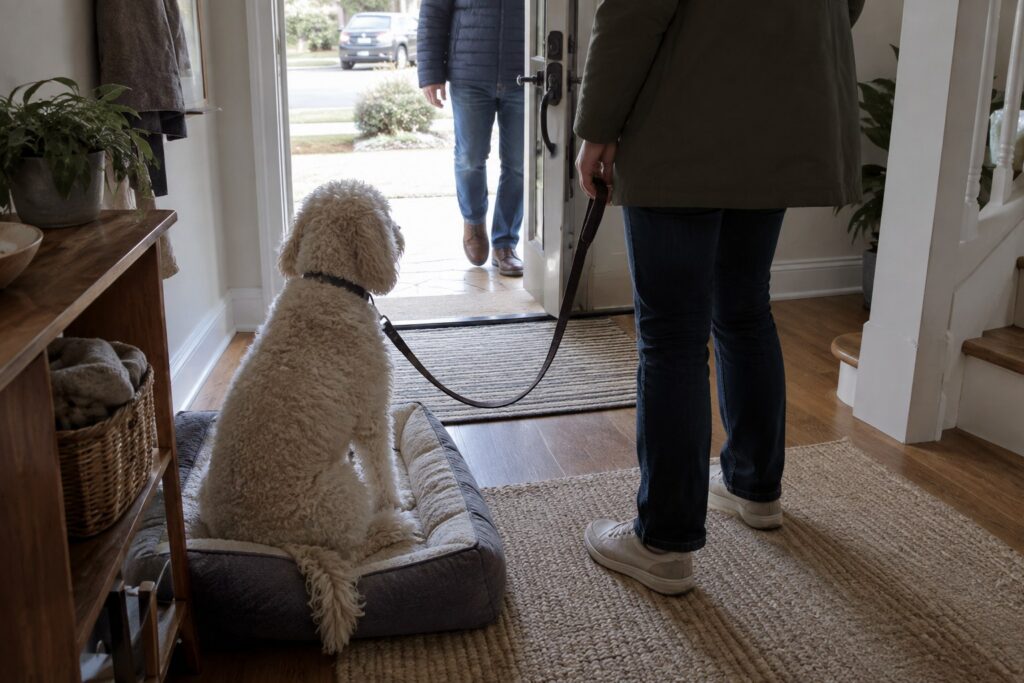
The fix is simple to describe and hard to do consistently. Pick one greeting behavior, usually “sit,” and make it the only way your dog gets attention. When the dog jumps, turn away or step back and withhold attention. The instant all four paws hit the floor or the dog sits, reward calmly.
Every person in the house has to follow the same plan, including kids and visitors. Keep a leash on your doodle when guests arrive so you can guide it into position instead of chasing it. Many Frisco homes have busy front doors with neighbors, deliveries, and kids coming and going, so practicing door manners with a “place” cue pays off daily.
| Situation | What Not to Do | What to Do Instead |
|---|---|---|
| Guests at the door | Let the dog rush and greet freely | Leash on, “place” or “sit,” release to greet calmly |
| You come home | Big excited hellos | Stay quiet until the dog is calm, then greet |
| Neighbor on a walk | Allow jumping because they “don’t mind” | Ask for “sit” before the neighbor says hello |
| Kids playing in the yard | Let the dog join the chase | Supervise, reward calm, give the dog a toy |
If jumping comes with other issues like counter surfing or nuisance barking, consider getting a trainer involved early. Our Frisco Board and Train program builds these manners with daily, consistent practice so you are not starting from scratch every evening.
Ready to see how two weeks of structured training could change your doodle’s manners?
Handling Mouthiness and Chewing
A Retriever Mouth on a Clever Dog
Retrievers were bred to carry things, and doodles often want something in their mouth at all times. Puppy nipping is normal, but many doodles keep mouthing hands, sleeves, and leashes well past the teething stage because it gets a big reaction. What starts as play can turn into a real problem around children.
Redirect, Reward, and Manage
Keep a toy within reach and offer it the moment teeth touch skin. If your doodle keeps grabbing, calmly end the play for a short moment, then try again. Reward gentle behavior, and practice a clear “leave it” and “drop it” so you can stop mouthing before it escalates.
Management matters as much as training. Put shoes, remotes, and kids’ toys out of reach, and use a crate or gated area when you cannot supervise. The ASPCA also warns that many household items, from certain foods to medications, can be toxic to pets, so a chewy doodle is one more reason to keep counters and floors clear. If mouthing looks tense or comes with growling, talk with a trainer before it escalates.
When Mouthiness Needs Professional Help
Most doodle mouthing is play, not aggression. But if your dog bites hard enough to leave marks, guards objects, or mouths when handled, it is time for professional guidance. Private sessions let a trainer see exactly what triggers the behavior in your own home.
Building Tolerance for Handling
Why Handling Practice Matters for Doodles
Doodles usually need regular coat care throughout their lives, along with nail trims, ear checks, and vet exams. A dog that squirms, mouths, or panics when its paws or face are touched turns every one of those routines into a struggle. Handling tolerance is a training skill, and it is much easier to build before the dog has a bad experience.
A Simple At-Home Handling Routine
Work in short sessions when your dog is calm. Touch a paw for a second, then reward. Gently lift an ear, then reward. Brush one small area, then reward. Gradually increase the time and pressure while keeping your doodle relaxed, and stop before it gets fidgety.
- Practice paw holds and gentle toe touches a few times a week.
- Look inside the ears and lift the lips briefly, like a vet would.
- Brush for short stretches and pair it with treats or a lick mat.
- Teach a “stand” or “down” so your dog holds still for care.
If your dog shows pain, sudden sensitivity, or ear odor, check with your veterinarian first, since discomfort can look like a behavior problem.
Sound Sensitivity and Startle
Some doodles are sensitive to clippers, dryers, vacuums, or thunder. Pair those sounds with good things at a low volume or distance, then slowly increase exposure. Pushing too fast can make sensitivity worse, so watch body language and go at your dog’s pace.
Why Goldendoodle Training Must Include Reliable Recall
Friendly Dogs Still Run Off
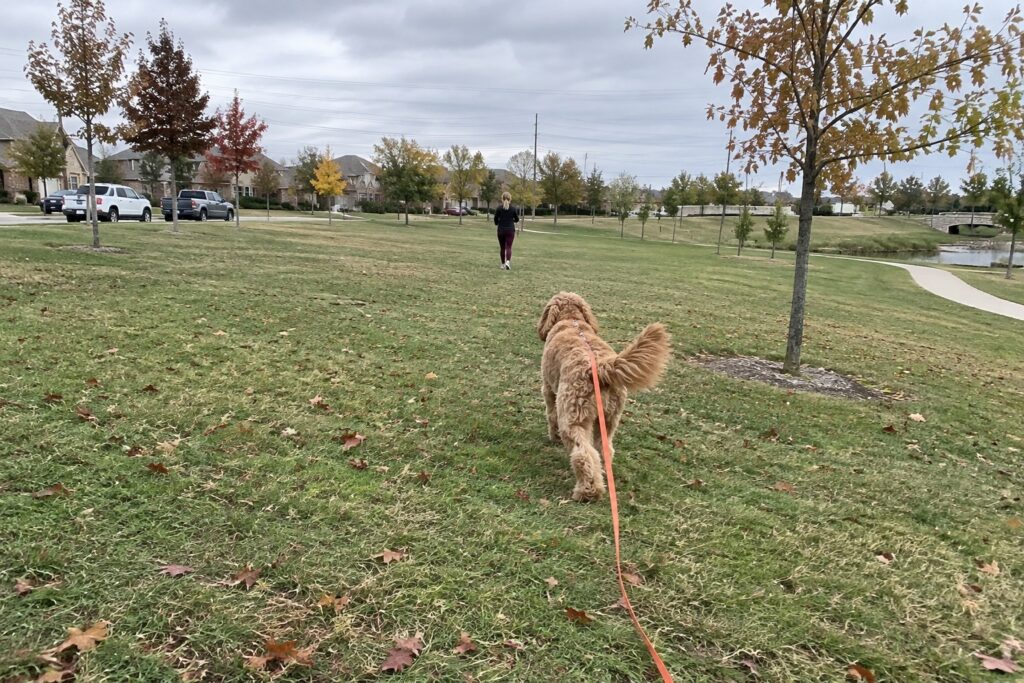
Doodles are rarely the dogs that disappear to hide, but they are often the dogs that happily sprint across a park to meet someone. A friendly dog that ignores “come” can still end up near traffic, in a neighbor’s yard, or in a tense meeting with a dog that does not want company. That is why recall deserves serious, ongoing practice.
Building Recall in Layers
Start indoors with no distractions and reward generously every time your dog comes. Move to the backyard, then to a long line in a quiet open area, and only then to busier places. Never call your dog to end something fun or to punish it, or you teach it that coming to you is a bad deal.
Our step-by-step guide on how to teach a dog to come when called in Frisco goes deeper into long-line work and proofing around distractions.
| Recall Stage | Environment | Goal Before Moving On |
|---|---|---|
| Stage 1 | Indoors, no distractions | Comes right away nearly every time |
| Stage 2 | Fenced backyard | Comes away from toys and smells |
| Stage 3 | Long line in a quiet park | Comes away from people at a distance |
| Stage 4 | Busier areas on a long line | Comes past dogs and moving activity |
Leash Laws and Real-World Safety
Even with great recall, follow posted leash rules in parks and trails, and use designated off-leash areas when you want your doodle to run. Good recall is your backup plan, not permission to skip the leash where it is required.
Choosing the Right Training Path for Your Doodle
Two-Week Board and Train
Our Board and Train program is our core offering and a strong fit for doodle owners who want a big step forward. Each placement begins with an individual assessment, and then your dog works with our trainers daily for the standard two-week program. Before your doodle comes home, you attend hands-on transfer sessions so you learn to use the same cues and handling our trainers used.
Board and Train graduates receive guaranteed results and lifetime support at no additional cost, and Affirm financing is available. For a closer look at the process, read what to expect from board and train programs in Frisco.
In-Home Private Lessons
Some doodle problems show up in very specific places, like the front door, the kitchen, or the backyard fence line. In-home dog training in Frisco lets a trainer work on those exact spots with you and your family, which helps everyone stay consistent. Private lessons also work well as follow-up support after a Board and Train stay.
| Option | Best For | What You Get |
|---|---|---|
| Two-Week Board and Train | Jumping, mouthiness, leash pulling, recall, and overall manners | Daily training, owner transfer sessions, guaranteed results, and lifetime support |
| In-Home Private Lessons | Household-specific problems and family consistency | One-on-one coaching where the behavior happens |
Not sure which option fits your doodle? Call us at (972) 573-1715 and we will help you choose a starting point.
About All Dogs Unleashed Dog Training Frisco
All Dogs Unleashed Dog Training Frisco helps Collin County families turn energetic, people-loving dogs like Goldendoodles and Labradoodles into calm, reliable companions. We accept every breed, and every Board and Train placement begins with an individual assessment so training fits your dog’s temperament. Our two-week program, in-home private lessons, and boarding give owners flexible options, and Board and Train graduates receive guaranteed results and lifetime support at no additional cost. We focus on real-world manners, from polite greetings to dependable recall.
Frequently Asked Questions
At what age should I start training my Goldendoodle?
You can start basic training the day your doodle comes home. Young puppies can learn their name, simple cues like “sit,” potty routines, and gentle handling in short, fun sessions. Structured programs often make the most sense once your puppy has settled in and your veterinarian confirms vaccinations. Starting early prevents habits like jumping and nipping from becoming ingrained.
Are Goldendoodles easy to train?
Doodles are usually smart and eager to engage, which helps them learn quickly. The challenge is that they learn bad habits just as fast, and their energy and social drive can make them hard to manage around distractions. With consistent rules, daily practice, and plenty of exercise, most doodles become very responsive and pleasant family dogs.
How do I stop my Goldendoodle from jumping on guests?
Choose one greeting behavior, usually “sit,” and only give attention when your dog offers it. Keep a leash on when guests arrive so you can guide your doodle instead of chasing it. Ask visitors to ignore jumping and greet only when all four paws are down. Consistency from every person matters more than any single technique.
Why does my Labradoodle keep biting my hands?
Most Labradoodles mouth hands because they have a retriever instinct to carry things and because mouthing earns attention. Offer a toy when teeth touch skin, pause play briefly if the grabbing continues, and reward gentle behavior. Teach “leave it” and “drop it” for control. If biting is hard, tense, or tied to handling, contact a professional trainer.
Can a Goldendoodle be trained to come when called off leash?
Many doodles can develop strong recall with patient, layered practice. Start indoors, then move to a fenced yard, then use a long line in quiet open areas before adding busier distractions. Reward generously and never call your dog for something unpleasant. Always follow local leash rules and use designated off-leash areas when your dog runs free.
Does Board and Train work for doodles?
Yes. Board and Train suits doodles well because they respond to structure and daily repetition. Our two-week program starts with an individual assessment, includes daily work with our trainers, and ends with hands-on transfer sessions so you can maintain the results at home. Graduates also receive guaranteed results and lifetime support at no additional cost.
Goldendoodle training pays off with a dog that greets politely, keeps its mouth to itself, holds still for care, and comes back when called. If you are ready for help, call (972) 573-1715 or reach out online, and visit our location at 6136 Frisco Square Blvd, Suite 400 to talk about your doodle’s goals.
Ready to Get Started with All Dogs Unleashed Dog Training Frisco?
Your doodle’s energy and friendliness are great qualities, and the right training helps them shine. Call us at (972) 573-1715 to talk with our team about the two-week Board and Train program or in-home private lessons.