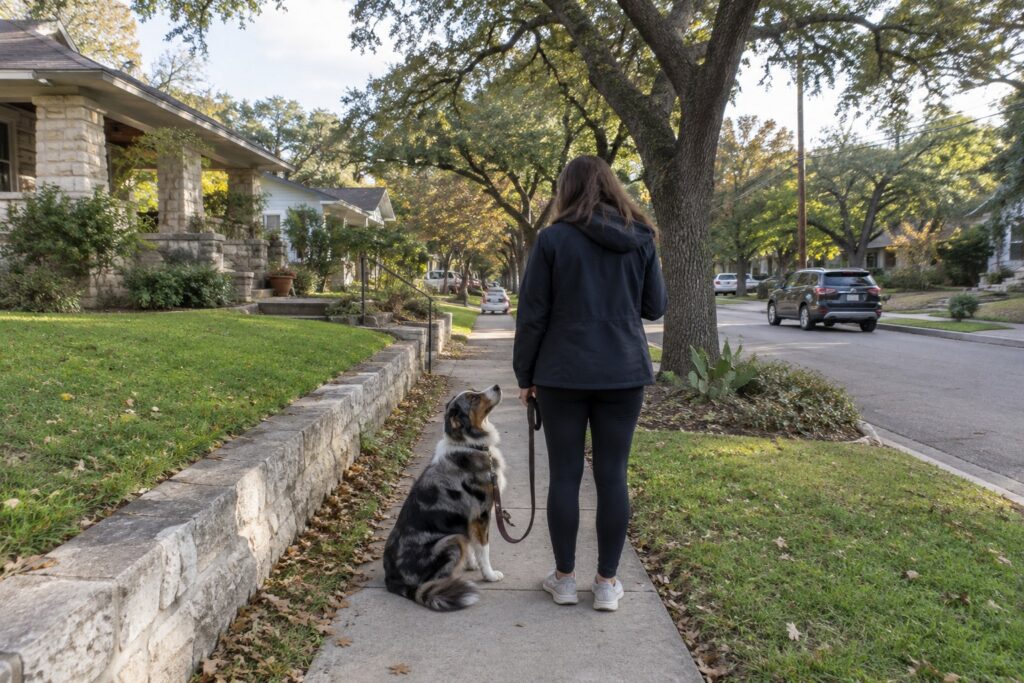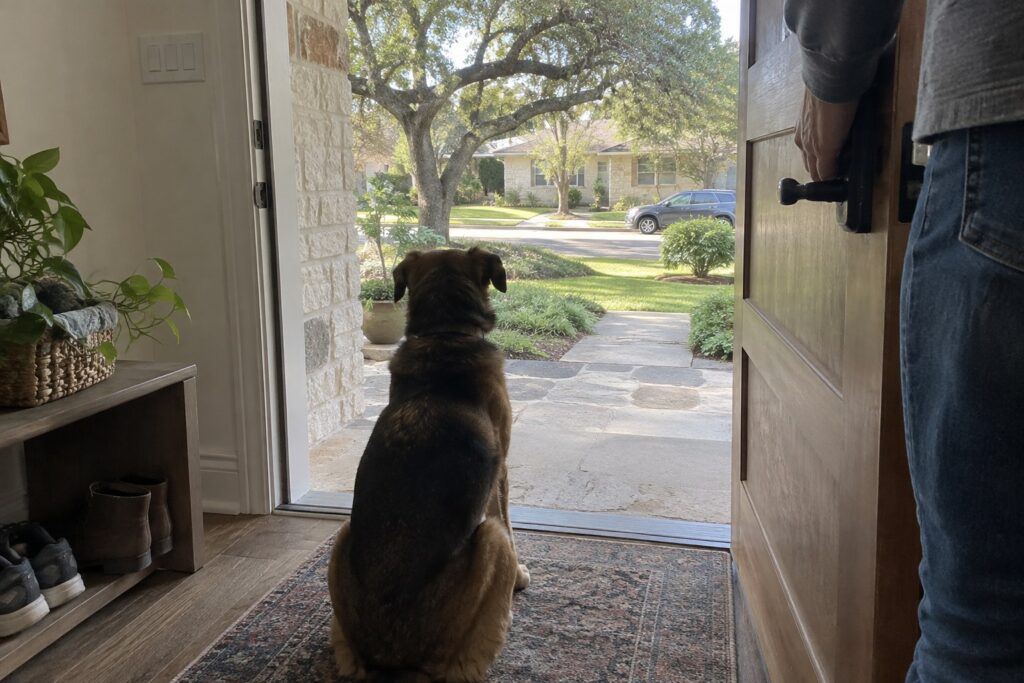

If you want to teach a dog to stay, October is the month to start. Halloween lands on Saturday, October 31, 2026, and that evening brings a steady stream of doorbells, knocking, costumes, and excited kids to front porches across Shreveport. A dog who holds a calm “stay” while you open the door is safer, less stressed, and far easier to live with.
At All Dogs Unleashed Dog Training Shreveport, we build “stay” in small, deliberate steps. Below you will find the exact progression we recommend, how to apply it at your front door, and the Halloween safety basics every owner should cover. If you would rather have professionals do the heavy lifting, our two-week Board and Train program builds reliable obedience in a structured setting.
Want help getting your dog ready before trick-or-treat night? Talk with our team today.
Key Takeaways
- Build “stay” with the three Ds, raising duration, distance, or distraction one at a time and never all three at once.
- A clear release word such as “okay” tells your dog exactly when the “stay” is over, which keeps the behavior honest.
- Practice door routines with a helper and the doorbell well before Halloween night on Saturday, October 31, 2026.
- Keep candy out of reach, since the ASPCA warns that chocolate and the sweetener xylitol are dangerous for dogs.
- Our fixed two-week Board and Train program includes guaranteed results and lifetime support at no additional cost for graduates.
Why “Stay” Matters So Much on Halloween
Most days, your front door opens a handful of times. On Halloween it can open again and again over a few hours, often to people wearing masks, capes, and costumes your dog has never seen. Every opening is a chance for a dog to bolt into the yard or the street, jump on a small child, or grab a piece of dropped candy.
The ASPCA recommends that all but the most social dogs spend peak trick-or-treating hours in a separate, comfortable room away from the front door. That is good advice, and we agree with it for many dogs. Still, a strong “stay” is valuable even when your dog is tucked away, because doors get opened by family members, guests arrive, and accidents happen.
What a Reliable “Stay” Actually Looks Like
A reliable “stay” means your dog holds a position, usually a “sit” or a “down,” until you give a release word. It does not mean your dog freezes in fear or stays only when you stare at them. The goal is a relaxed dog who understands the rule, even when something interesting happens nearby.
“Stay” Versus “Wait”
Some trainers use two separate cues. “Wait” often means a brief pause, such as before walking through a door or jumping out of the car, with the dog free to move after. “Stay” usually means hold this exact position until I come back or release you. Either approach works as long as you are consistent. Pick your words and have everyone in your home use them the same way.
Before You Start Teaching “Stay”
A few foundations make “stay” far easier. Your dog should already offer a solid “sit” and ideally a “down” on cue. If you have a young puppy who is still learning those first basics, start with our puppy training tips for new dog owners in Shreveport and come back to “stay” once those behaviors are consistent.
Choose a Release Word
The release word is the most overlooked part of teaching “stay.” Without it, your dog has to guess when the exercise ends, and most dogs guess early. Common choices are “okay,” “free,” or “break.” Say it in a cheerful tone, encourage your dog to get up, and move with them so the meaning is obvious.
Gather the Right Rewards
Use small, soft treats your dog loves, broken into pea-sized pieces. Keep sessions short, about three to five minutes, and end while your dog is still succeeding. You can run several short sessions a day. Consistency beats marathon sessions every time.
Pick a Quiet Starting Spot
Begin inside, in a room with few distractions. A living room or hallway works well. Save the front porch, the yard, and busier spots for later stages, once your dog understands the game.
How to Teach a Dog to Stay Using the Three Ds
Trainers break “stay” into three variables, often called the three Ds: duration, distance, and distraction. The key rule is simple. Only make one of the three harder at a time, and when you increase one, relax the others.
| The D | What It Means | How to Increase It | Sign You Moved Too Fast |
|---|---|---|---|
| Duration | How long your dog holds the position | Add a few seconds at a time | Dog pops up before the release word |
| Distance | How far you move away | Add one step, then return | Dog follows you as you step back |
| Distraction | What happens around your dog | Start with small movements and sounds | Dog breaks to investigate the distraction |
Step 1: Build Duration
Ask your dog to “sit.” Say “stay” once, with an open palm held briefly toward them if you like. Wait one or two seconds, feed a treat while your dog is still sitting, then say your release word. Repeat, slowly stretching the time to 5, 10, then 20 seconds. Feed a few treats during the hold to reward staying in place, not just getting up at the end.
Step 2: Add Distance
Once your dog can hold for about 20 to 30 seconds with you right there, drop the duration back down and take a single step away. Step back in, reward, and release. Add one step at a time. Always return to your dog to reward rather than calling them to you, because calling them out of a “stay” blurs the two behaviors.
Step 3: Introduce Distraction
Now shorten your distance and time again. Add mild distractions like shifting your weight, clapping softly, bouncing a ball once, or turning your back. If your dog holds, reward generously. If they break, calmly reset them to the original spot without scolding, and make the next attempt a little easier.
Step 4: Combine and Generalize
After each D is solid on its own, begin combining them slowly. Practice in different rooms, in the backyard, and on leash in front of the house. Dogs do not automatically generalize, so a “stay” that works in the kitchen may need rebuilding on the porch. That is normal and fixable.
Common Mistakes to Avoid
- Repeating “stay” over and over. Say it once and let your dog think.
- Forgetting the release word, which teaches your dog to self-release.
- Raising duration, distance, and distraction all at once.
- Punishing a break. A calm reset keeps your dog willing to try again.
- Practicing only when you need it. Short daily sessions build the habit.
Prefer to have a professional build this for you? Our Board and Train program gives your dog multiple structured training sessions every day, with trainers varying the exercise context so skills carry over to real life.
Applying “Stay” at the Front Door
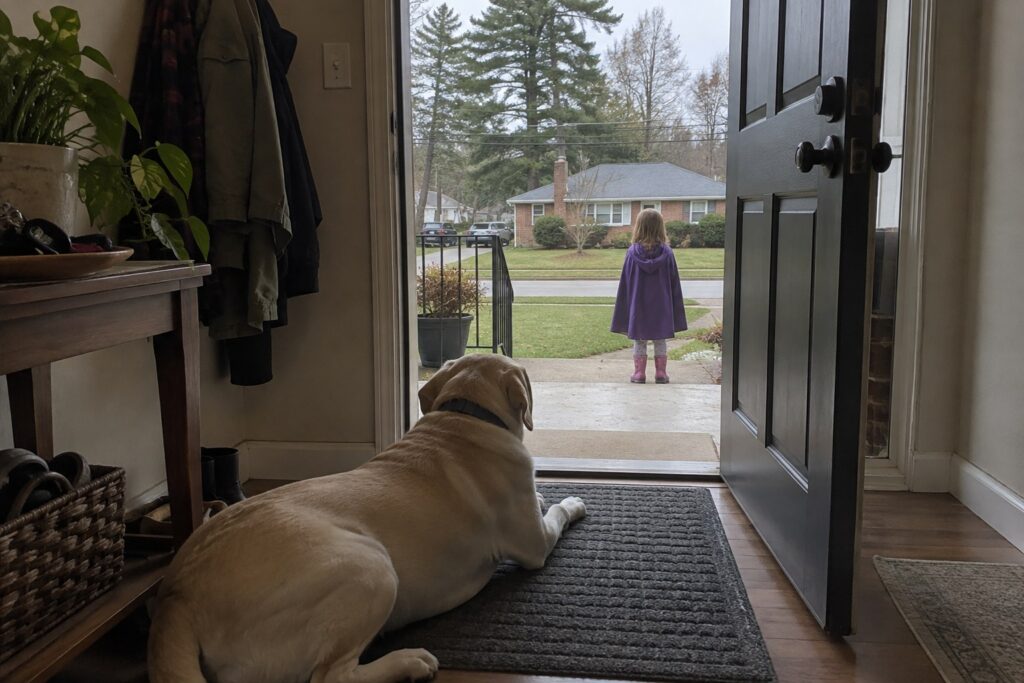
The front door is one of the hardest places for any dog to hold a “stay.” It combines a trigger sound, movement, new people, and often an open path to the outside. Treat door practice as its own mini-project, and start at least a couple of weeks before Halloween if you can.
Set Up a Door Station
Choose a spot a few feet back from the door where your dog can see but not reach it. Some owners use a mat or bed and teach “place,” which is a cue meaning go to this spot and settle. A defined station gives your dog a clear job instead of rushing forward. Pair it with “down” and “stay” for extra stability.
Desensitize the Doorbell
Ring the doorbell or knock yourself, or play a recording at low volume, while your dog holds a “stay” on the station. Reward calm behavior right away. Increase the volume and realism over several sessions. The aim is for the doorbell to become a signal to go to the station, not a signal to bark and charge.
Practice With Helpers and Costumes
Enlist a family member or neighbor to play trick-or-treater. Start with them simply standing outside, then knocking, then opening the door partway. Once your dog handles that, have your helper wear a hat, a cape, or a mask. Unfamiliar shapes can startle dogs, so let your dog observe from the station and reward relaxed looks.
| Practice Stage | Helper Action | Your Dog’s Job |
|---|---|---|
| 1 | Knocks, door stays closed | Hold “stay” on the station |
| 2 | Door opens a few inches | Hold “stay,” reward for calm |
| 3 | Door opens fully, helper talks | Hold “down” and “stay” |
| 4 | Helper in a simple costume | Observe calmly from the station |
| 5 | Helper holds a candy bowl | Hold “stay” until the release word |
Use a Leash or Barrier as a Backup
Even a well-trained dog can have an off moment. On Halloween night, keep a leash on your dog if they are near the door, or use a baby gate across the entry. Training and management work best together. For dogs who are nervous about strangers, our post on reactive dog training in Shreveport explains when extra help makes sense.
Halloween Safety Basics for Shreveport Dog Owners
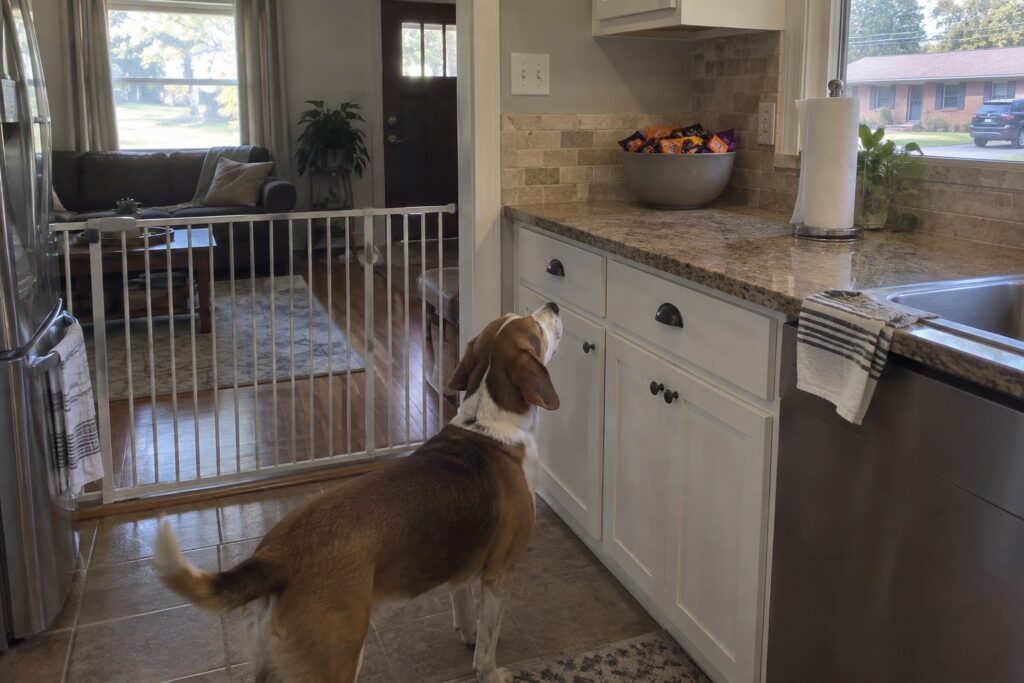
Training is only part of a safe Halloween. A few simple precautions help prevent common Halloween problems.
Keep Candy Out of Reach
According to the ASPCA’s Halloween safety tips, chocolate in all forms is dangerous for pets, with dark and baking chocolate being the most concerning. The ASPCA also warns that sugar-free candies and gum containing xylitol can be life-threatening for dogs, since xylitol can cause low blood sugar and possible liver damage. Store candy bowls up high and remind kids not to share treats. If you think your dog ate something toxic, contact your veterinarian or an animal poison control hotline right away.
Secure Your Dog and Check ID
The AVMA advises making sure pets have proper identification, such as a collar with tags and a microchip, in case they slip out. Check that the phone number on the tag is current and that your microchip registration has up-to-date contact details. A secure room or crate during peak hours is a smart choice for dogs who find the evening stressful. If your dog is still learning to relax in a crate, our steps for crate training a dog into a calm routine can help.
Think Carefully About Costumes and Decorations
If you put a costume on your dog, make sure it does not restrict movement, vision, breathing, or barking, and try it on ahead of time. Many dogs are happier without one. Keep candles, cords, and decorations away from curious noses and wagging tails.
| Halloween Risk | Simple Prevention |
|---|---|
| Chocolate and xylitol candy | Store candy up high, check wrappers on the floor |
| Door dashing | Practice “stay,” use a leash or gate at the door |
| Getting lost | Current ID tags and microchip registration |
| Stress from visitors | A quiet room or crate away from the door |
| Costume problems | Test fit early, skip it if your dog seems uncomfortable |
When to Get Professional Help With “Stay”
Some dogs pick up “stay” in a few calm sessions. Others struggle, especially energetic young dogs, dogs who bark at the door, or dogs who get overwhelmed by visitors. If progress stalls, or you simply do not have the time before Halloween, professional training can make a real difference.
Board and Train
Our Board and Train program in Shreveport is a fixed two-week program where your dog stays at our facility and works through multiple structured sessions each day. Trainers vary the exercise context to help skills generalize, and the final days include handler transition training so you learn to use the same cues at home. Board and Train graduates receive guaranteed results and lifetime support at no additional cost. To get ready, read how to prepare your dog for Board and Train in Shreveport.
In-Home Training
If your biggest challenge is the front door itself, in-home dog training in Shreveport lets a trainer work with you and your dog in the exact space where problems happen. You can also compare all of our dog training programs to see which fits your schedule.
| Option | Best For | Where Training Happens |
|---|---|---|
| DIY practice | Dogs with solid basics and owners with daily time | Your home |
| In-home training | Door manners and household routines | Your home, with a trainer |
| Board and Train | Busy owners who want structured daily training | Our facility, fixed two-week program |
Questions about which option is right before Halloween? Call us at (318) 593-7321 and we will help you choose.
About All Dogs Unleashed Dog Training Shreveport
All Dogs Unleashed Dog Training Shreveport helps dog owners across Northwest Louisiana build calm, reliable obedience, from a steady “stay” at the front door to polished manners around guests. Our fixed two-week Board and Train program gives dogs multiple structured sessions each day and ends with handler transition training, and graduates receive guaranteed results and lifetime support. We also offer in-home training, boarding, and refresh training for dogs who need a tune-up.
Frequently Asked Questions
How long does it take to teach a dog to stay?
It depends on your dog’s age, energy, and existing foundation. Many dogs understand a short “stay” within a few sessions, but a reliable “stay” with distance and distractions takes consistent practice over weeks. Keep sessions short, raise only one of the three Ds at a time, and practice in several places so the behavior holds up in real situations.
What is the difference between “stay” and “wait”?
Many trainers use “wait” for a brief pause, such as at a doorway or before getting out of the car, after which the dog can move on. “Stay” usually means hold the exact position until you return or give your release word. You can use one cue or both, as long as everyone in your household uses them the same way every time.
Why does my dog break the “stay” when I walk away?
Usually you have increased distance too quickly or combined it with more time or distraction. Go back to one step away, return quickly to reward, and release. Rewarding your dog in position, rather than calling them to you, teaches that staying put pays off. Add distance slowly, one step at a time, and relax duration while you do.
Should my dog be at the door on Halloween?
The ASPCA recommends that all but the most social dogs spend peak trick-or-treating hours in a separate, comfortable room away from the front door. If your dog handles visitors well and has a strong “stay,” a leash or baby gate adds a backup layer. Either way, make sure ID tags and microchip information are current before the evening.
What should I do if my dog eats Halloween candy?
Contact your veterinarian or an animal poison control hotline right away, and have the wrapper handy if you can. The ASPCA warns that chocolate, especially dark or baking chocolate, is dangerous for dogs, and that candy or gum containing xylitol can be life-threatening. Do not wait for symptoms to appear before calling a professional for guidance.
Can Board and Train help my dog learn “stay” before Halloween?
Our fixed two-week Board and Train program includes multiple structured training sessions every day, with trainers varying the context so skills carry over to home. The final days include handler transition training so you can use the same cues. Availability varies, so reach out early to our Shreveport team to discuss timing and whether it fits your goals.
When you teach a dog to stay with patience and clear steps, Halloween night becomes far less chaotic for everyone in your home. Start with duration, then distance, then distraction, and practice your door routine before October 31. If you want expert support, call (318) 593-7321 or reach out online, and visit our location at 1220 Shreveport Barksdale Hwy, Shreveport, LA 71105.
Ready to Get Started with All Dogs Unleashed Dog Training Shreveport?
Give your dog the skills to stay calm at the door this Halloween and all year long. Call (318) 593-7321 to talk with our team about Board and Train or in-home training.