
Senior dog exercise looks different at age 10 than it did at age 3, and getting it wrong can cause real joint pain or heat-related illness, especially during Fort Worth summers. At All Dogs Unleashed Dog Training Fort Worth, we work with dogs of all ages and temperaments, and we see older dogs thrive when their activity is matched to their current physical condition. This guide gives you practical, trainer-backed routines to keep your senior dog moving safely year-round.
Key Takeaways
- Senior dog exercise should be shorter, lower-impact, and scheduled around Fort Worth’s heat to protect aging joints.
- Soft surfaces like Trinity Trails are gentler on older dogs than concrete or hot asphalt sidewalks.
- Most senior dogs still need daily movement, just at a pace and duration matched to their current health.
- Obedience training and mental stimulation count as exercise and reduce stress on arthritic or slowing dogs.
- Always check with your vet before changing your senior dog’s exercise routine, especially if mobility has declined.
Why Fort Worth’s Climate Makes Senior Exercise Different
Your senior dog still wants to move. The routine just needs to match who they are now, not who they were at two years old. Getting that balance right matters more here than in most places.
Summers around Benbrook and Tanglewood bring triple-digit heat indexes and clay-heavy terrain that puts real stress on aging joints. Shaded, sun-exposed sidewalks heat up fast, and older dogs regulate their body temperature far less efficiently than younger ones. Senior dog health in Fort Worth has a local urgency that general advice from national websites simply misses.
Here is exactly what you need to know: when a dog crosses into senior territory, how much daily activity is appropriate, which exercises are safe, and which warning signs should stop you cold. If you want personalized guidance, schedule a training session with our team to build a routine that fits your dog.
When Is a Dog Considered Senior?
A dog is considered senior at different ages depending on size, ranging from age 5 to 6 for giant breeds all the way to age 10 to 12 for small breeds. There is no single birthday that flips the switch. Size is the biggest factor, and knowing where your dog falls helps you plan the right exercise for older dogs before problems show up.
- Small breeds (under 20 lbs): reach the senior stage around age 10 to 12
- Medium breeds (20 to 50 lbs): tend to enter their senior years around age 8 to 10
- Large breeds (50 to 90 lbs): often slow down around age 7 to 8
- Giant breeds (over 90 lbs): can be considered senior as early as age 5 to 6
Senior dog health in Fort Worth gets complicated by local conditions. The clay-heavy soil in neighborhoods like Hulen and Tanglewood creates uneven, hard terrain that puts extra stress on aging joints. Add in temperature swings from cold January mornings to July afternoons that push well past 100 degrees, and your dog’s body is working harder than it looks.
Physical Signs Your Dog Has Entered the Senior Stage
You do not need a vet visit to spot the first clues. These changes are normal transitions, not failures. Watch for them on your daily walks and in your dog’s routine at home.
- Greying muzzle, often the first visible sign, especially around the face and eyes
- Slower pace on walks, your dog hangs back instead of pulling ahead
- Stiffness after rest, takes a few steps to loosen up after lying down
- Reduced enthusiasm for play, still interested, but tires faster than before
- Longer recovery after activity, needs more rest the day after a longer outing
If you are also noticing confusion, disorientation, or changes in your dog’s awareness, that can signal something beyond normal aging. Talk to your vet about what to watch for and when to act, since cognitive decline in older dogs often responds better to early support. Catching these signs early gives you more options, both medically and through structured training support.
How Much Exercise Does a Senior Dog Actually Need?
Most senior dogs benefit from 30 to 60 minutes of low-to-moderate activity per day, split into two shorter sessions. That is the direct answer. The two biggest mistakes we see are treating a 10-year-old dog like a 2-year-old, and assuming old dogs just want to sleep all day. Both hurt your dog. Keeping senior dogs active at the right level protects their joints, weight, and mental sharpness.
Daily Duration by Size
Body size matters a lot here. Larger dogs carry more weight on aging joints, so they actually need more movement spread across the day, not less. Use these ranges as a starting point, and always check with your vet if your dog has arthritis, heart disease, or obesity.
- Small senior dogs (under 25 lbs): 20 to 30 minutes per day, split into two sessions of 10 to 15 minutes each.
- Medium senior dogs (25 to 60 lbs): 30 to 45 minutes per day, broken into two comfortable walks.
- Large and giant senior dogs (60 lbs and up): 45 to 60 minutes per day in two sessions, watching closely for fatigue, limping, or heavy panting.
These are starting points, not rules set in stone. A senior dog with managed arthritis may do better with three 10-minute walks than two longer ones. Supporting your dog’s activity level is about reading their body as much as watching the clock.
Fort Worth Heat and Timing
Timing your walks is just as important as duration. According to NOAA climate data, the Dallas-Fort Worth area averages 37 days above 100°F per year. From May through September, that heat makes midday walks genuinely dangerous for senior dogs. Walk before 8 a.m. or after 7 p.m. during those months. No exceptions for older dogs.
Pavement temperature is the hidden risk most owners miss. Asphalt on busy corridors like Camp Bowie Boulevard can reach 150°F on a 95°F day. Senior dogs already have sensitive paw pads, and burns happen fast. Use the 7-second pavement test before every walk: press the back of your hand to the pavement. If you cannot hold it there for 7 seconds, it is too hot for your dog’s paws. Soft, shaded paths like those along Trinity Trails near the Trinity River are a much better option on warm mornings.
Summer heat is already here, and midday walks are risky for aging dogs. Let a Fort Worth trainer help you build a safe, heat-smart routine.
The Best Low-Impact Exercises for Senior Dogs
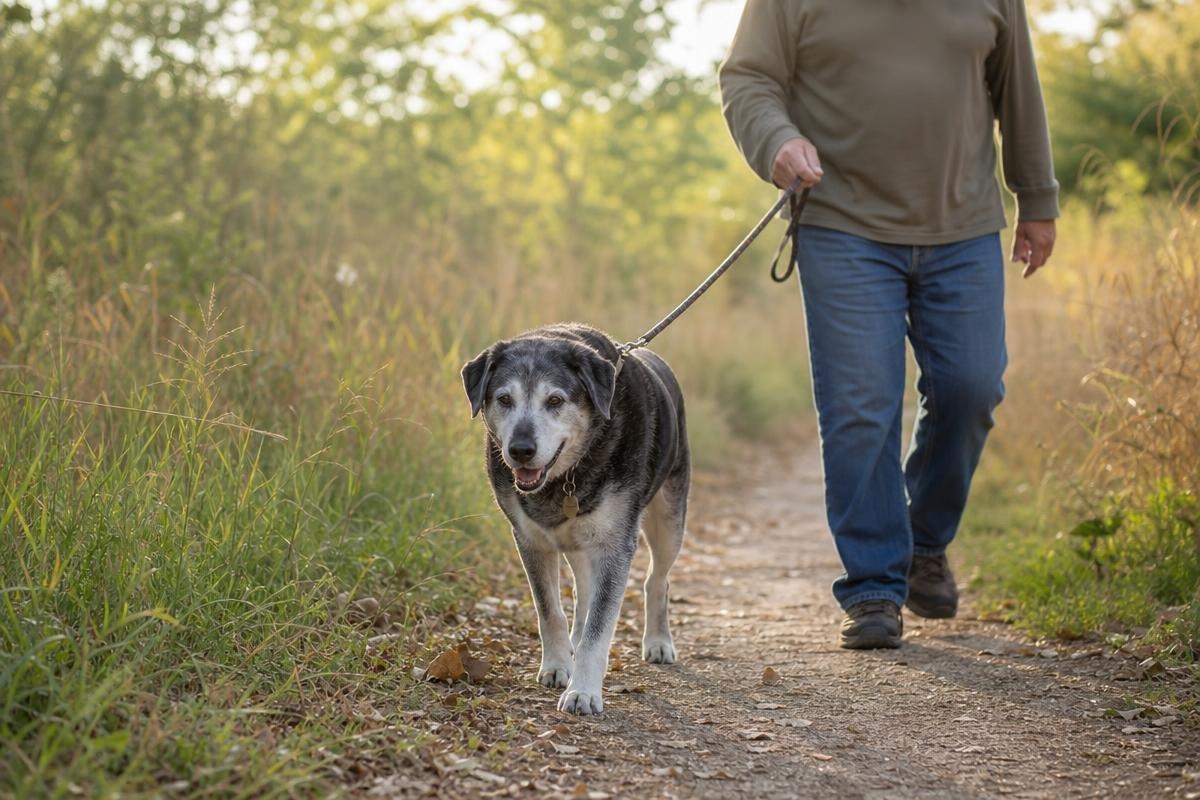
Maintaining mobility in aging dogs does not mean pushing them hard. It means choosing the right activities that protect aging joints while still giving your dog the physical and mental outlet they need. These three low-impact options work well for older dogs of all breeds and temperaments, and most can be done right in your backyard or neighborhood.
Leash Walks
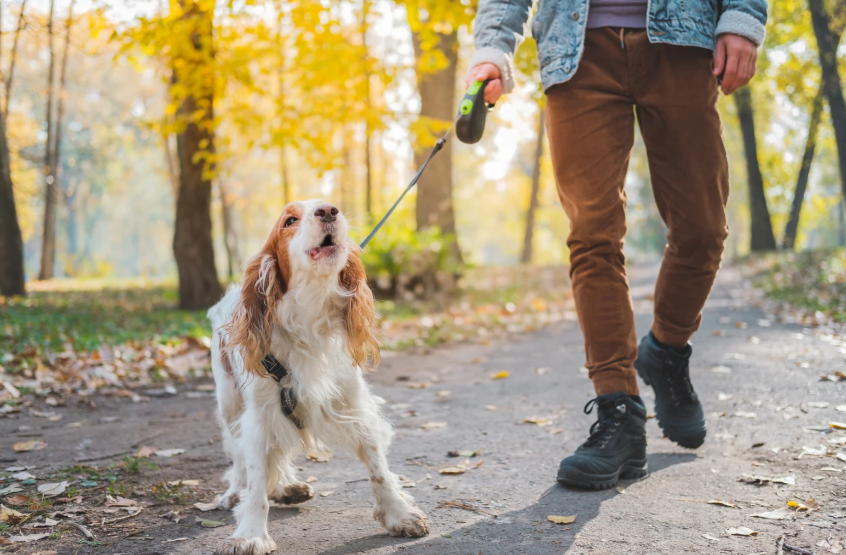
Short, structured walks are still one of the best forms of exercise for older dogs. Sniffing alone provides real mental stimulation, which tires a senior dog out in a healthy way. The key is keeping your dog in a loose-leash position so they are not torquing their hips and shoulders by pulling or surging forward.
Check out our loose-leash walking tips for Fort Worth dog owners if your senior dog still pulls on walks.
Check out our loose-leash walking tips for Fort Worth dog owners if your senior dog still pulls on walks.
Trinity Trails along the Trinity River is a great local option. The soft, packed-dirt paths are significantly easier on aging joints than concrete sidewalks. Convenient access points near the Clearfork district and Trinity Park give you shaded, tree-lined stretches that stay cooler in the morning. During summer months, stick to early morning or after sunset, since sun-exposed surfaces can burn paw pads fast.
- Short sniff walks: 10 to 15 minutes, let your dog set the pace
- On-leash neighborhood walks: 20 to 30 minutes at a slow, steady pace
- Structured heel work: 5 to 10 minutes of focused, slow-paced heel to engage the mind
Swimming
Water supports your dog’s body weight, which takes serious pressure off arthritic joints. A dog that struggles to trot around the block can often move freely in a pool. That is the real benefit here: range of motion without pain.
Several boarding and daycare facilities in the Tarrant County area offer private dog pools. Keep sessions short, especially for first-timers. Never force a dog into water. If your dog resists, a shallow wading option is a better starting point than a full swim.
- Start with 5 to 10 minutes of supervised water time
- Use a canine life vest for dogs with limited mobility
- Watch for fatigue signs: heavy panting, slow paddling, or reluctance to continue
Balance and Mobility Work
You do not need special equipment for this. Two simple exercises can be done at home and make a real difference in hip strength and body awareness.
- Weight shifting: Place your dog’s front paws on a low, stable surface like the bottom porch step. Encourage them to hold the position for 5 to 10 seconds. Repeat 3 to 5 times. This builds rear-end strength and improves balance.
- Slow cavaletti poles: Lay pool noodles or sticks flat on the ground, spaced about one body-length apart. Walk your dog over them slowly. This encourages deliberate foot placement and gentle hip flexion. Aim for 2 to 3 passes per session.
Both exercises engage the muscles that support aging joints. If you want to build these into a consistent routine, schedule a training session with our team and we can show you exactly how to run them safely.
Want help building a safe exercise routine for your senior dog? Our trainers work with older dogs of all breeds and temperaments. Call us at (817) 393-6224 to get started.
Warning Signs to Watch During and After Exercise
Keeping your older dog active is the goal. But knowing when to stop is just as important as getting out the door. Your dog cannot tell you when something hurts, so you need to read the signals.
Stop Immediately: Acute Warning Signs
These signs mean stop the session right now and call your vet. On the hard, uneven clay soil common across many Fort Worth neighborhoods, even a short stumble can turn into something serious.
- Labored breathing that does not slow within 2 minutes of rest
- Sudden limping or a three-legged gait mid-walk
- Collapse or inability to stand
- Excessive drooling or glazed, unfocused eyes
- Pale or white gums
Any one of these means the walk is over. Get your dog to shade, offer water, and contact your vet immediately.
Shorten Future Sessions: Chronic Signals
Chronic signals are subtler. They show up hours later or the next morning. They tell you the routine is too intense, not that exercise is off the table. Shorter sessions on softer surfaces like Trinity Trails can make a real difference in how your dog feels the next day.
- Stiffness that lasts more than 30 minutes after a walk
- Reluctance to head outside the following day
- Whimpering or struggling when rising from rest
- Decreased appetite after exercise sessions
If you notice these patterns, dial back the distance and intensity. Do not stop moving altogether. A 10-minute sniff walk is still a win for senior dog health. Consistent, gentle movement supports joints far better than rest followed by a long outing.
If chronic signals persist after you shorten sessions, loop in your vet. A trainer can also help you build a routine that fits what your dog can handle right now. You can schedule a training session with our team to talk through what a safe, adjusted routine looks like for your dog’s age and condition.
How Training Supports a Senior Dog’s Exercise Routine
Good obedience skills do more than make a dog pleasant to live with. For a senior dog, they are a genuine safety tool on every walk and every outing. A dog that responds reliably to your cues moves through the world with far less physical stress on aging joints.
Why Obedience Skills Make Every Walk Safer
Think about what a walk actually demands of a senior dog without training. You stop suddenly. The dog pulls. You correct. The dog strains against the leash. That back-and-forth puts real pressure on hips, elbows, and spines that are already working harder than they used to. A dog that walks in a reliable Heel moves at your pace, not its own. That one skill alone prevents overexertion on longer outings.
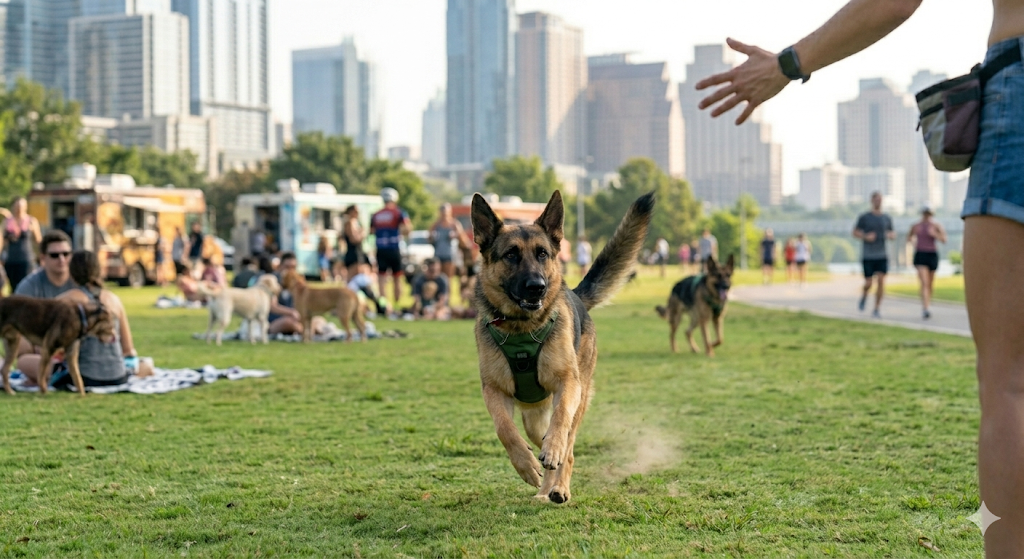
Recall matters just as much. The Clearfork area parks and other open green spaces around Tarrant County are great options for gentle senior dog exercise routines. But off-leash time is only safe when your dog comes back the first time you call. A dog that ignores recall can bolt toward uneven terrain, an aggressive dog, or a sun-baked surface before you can stop it.
- A dog that heels reliably lets you steer around hard, uneven ground without a physical struggle
- Solid recall lets you call your dog back before it overexerts on a warm afternoon
- A calm, focused dog is easier to read, so you catch early fatigue signals sooner
- On-leash manners reduce sudden lurching that can strain your dog’s neck and shoulders
All Dogs Unleashed Supports Senior Dogs
All Dogs Unleashed Dog Training Fort Worth works with dogs of all breeds, ages, and temperaments, including dogs well into their senior years. Our trainers Dana and Chloe are specifically mentioned in client reviews for their patience and clear communication with older dogs. Owners of 7-year-old Cane Corsos and 10-year-old French Bulldogs have seen real results here, dogs that walk calmly, respond reliably, and handle outings with far less stress on their bodies.
Our programs include lifetime support for the full life of your dog. That means if your senior dog’s needs shift as they age, you are not starting over. You call us, and we help you adjust. If you are ready to build a safer exercise routine around your older dog’s abilities, schedule a training session in Fort Worth or call us directly at (817) 393-6224. We have 112 five-star Google reviews from local dog owners who will tell you the same thing.
Frequently Asked Questions
How do I know if I’m exercising my senior dog too much?
Watch for stiffness that lasts more than 30 minutes after a walk, reluctance to go outside the next day, or any limping. Those are clear signs you pushed too far. Cut the walk duration in half and monitor your dog over three to five days before increasing again.
Can my senior dog go off-leash at Fort Worth parks?
Most city parks require dogs to stay leashed. Designated off-leash areas, including spots near the Clearfork district, are available for dogs with solid recall. Before removing the leash anywhere, your dog needs a reliable response to their name every single time. If that’s not consistent yet, work on recall before visiting an off-leash area.
What is the best time of day to walk a senior dog in Fort Worth?
Walk before 8 a.m. or after 7 p.m. from late spring through early fall. The summer heat index here regularly exceeds 105°F, and senior dogs regulate body temperature less efficiently than younger dogs. Pavement in sun-exposed areas can reach extreme temperatures that cause paw-pad burns fast. Timing is a safety issue, not just a comfort preference.
Is swimming better than walking for a dog with arthritis?
Swimming removes body-weight load from joints entirely, which makes it gentler for dogs with moderate to severe arthritis. Walking still matters because it supports bone density and mental stimulation. A combination of both is ideal when your dog tolerates water and has vet clearance for the activity.
Should I change my senior dog’s diet when I adjust their exercise routine?
Yes, especially if your dog is carrying extra weight. Excess weight accelerates joint deterioration, so exercise changes and diet changes often need to happen together. Ask your vet about transitioning to a senior-formula food that includes joint-supporting nutrients like glucosamine.
When should I start adjusting my dog’s exercise routine as they age?
Start evaluating the routine at the breed-appropriate senior threshold. That can be as early as age five or six for giant breeds and age seven or eight for large breeds. Proactive adjustment prevents injury. Do not wait for visible decline before making changes.
Your senior dog still has good years ahead. The key is building a routine that matches where they are right now. If you want help making every walk safer and more structured, call our Fort Worth team at (817) 393-6224 or get a free training quote from All Dogs Unleashed Fort Worth. We work with dogs of every age, including seniors who need a patient, individualized approach.
Ready to Get Started with All Dogs Unleashed Dog Training Fort Worth?
Call (817) 393-6224 to speak with our team directly. We’re ready to answer your questions, walk you through your options, and help you find the right solution for your needs. Whether you’re just starting to plan or ready to move forward, we’ll make the process simple and stress-free.
Reach out today and let’s talk about how we can help.