
Barking in a single-family home is annoying. Barking in a Denver apartment is a tenancy issue. Lease violations, formal complaints, fines, and in extreme cases eviction notices follow from persistent barking. The thin walls of older Capitol Hill walk-ups, the surprisingly conductive ductwork of LoDo high-rises, and the shared hallways throughout the city’s apartment stock all mean one dog’s barking quickly becomes every neighbor’s problem.
The good news is that most apartment barking is solvable. The solutions are different from what suburban training advice typically suggests. Apartment dog owners need a tighter, more deliberate approach: diagnose the trigger, manage the environment, build the right replacement behavior, and address the underlying causes.
The guide below covers what actually works for apartment dogs: identifying the type of barking, reducing triggers, building real exercise into the routine, teaching reliable quiet behavior, and the apartment-specific tactics that suburban training rarely addresses.
Why Dogs Bark in Apartments More Than in Houses
Apartments concentrate barking triggers in ways single-family homes don’t. Hallway noise creates dozens of trigger events per day from footsteps, voices, elevator dings, and door closings. Other dogs in the building can trigger sympathetic responses. Deliveries and visitors are constant. Less outlet for stimulation means the barking concentrates on what comes through windows or doors. Smaller spaces amplify reactivity with fewer options to decompress.
The Six Most Common Types of Apartment Barking
- Alert barking. Triggered by sounds, sights, or motion. The dog is announcing something. Brief and event-linked. The most common type.
- Demand barking. Directed at the owner. The dog wants attention, food, a walk, or access to something.
- Boredom barking. Sustained, low-intensity barking with no clear trigger. The dog isn’t aroused, they’re under-stimulated.
- Separation anxiety barking. Begins shortly after the owner leaves and continues for extended periods. Often paired with destructive behavior. Different from boredom barking, this is a clinical issue requiring different treatment.
- Reactive barking. Sharp, intense, often accompanied by lunging or stiff body language. Builds quickly and is hard to interrupt once started.
- Frustration barking. The dog wants to engage with something they can see or hear but can’t access. Common at windows, balconies, and doors.
Diagnosing which type your dog is exhibiting matters because the solution changes meaningfully between them. Most chronic apartment barkers display two or three types simultaneously.
Step 1: Identify What Your Dog Is Actually Barking At
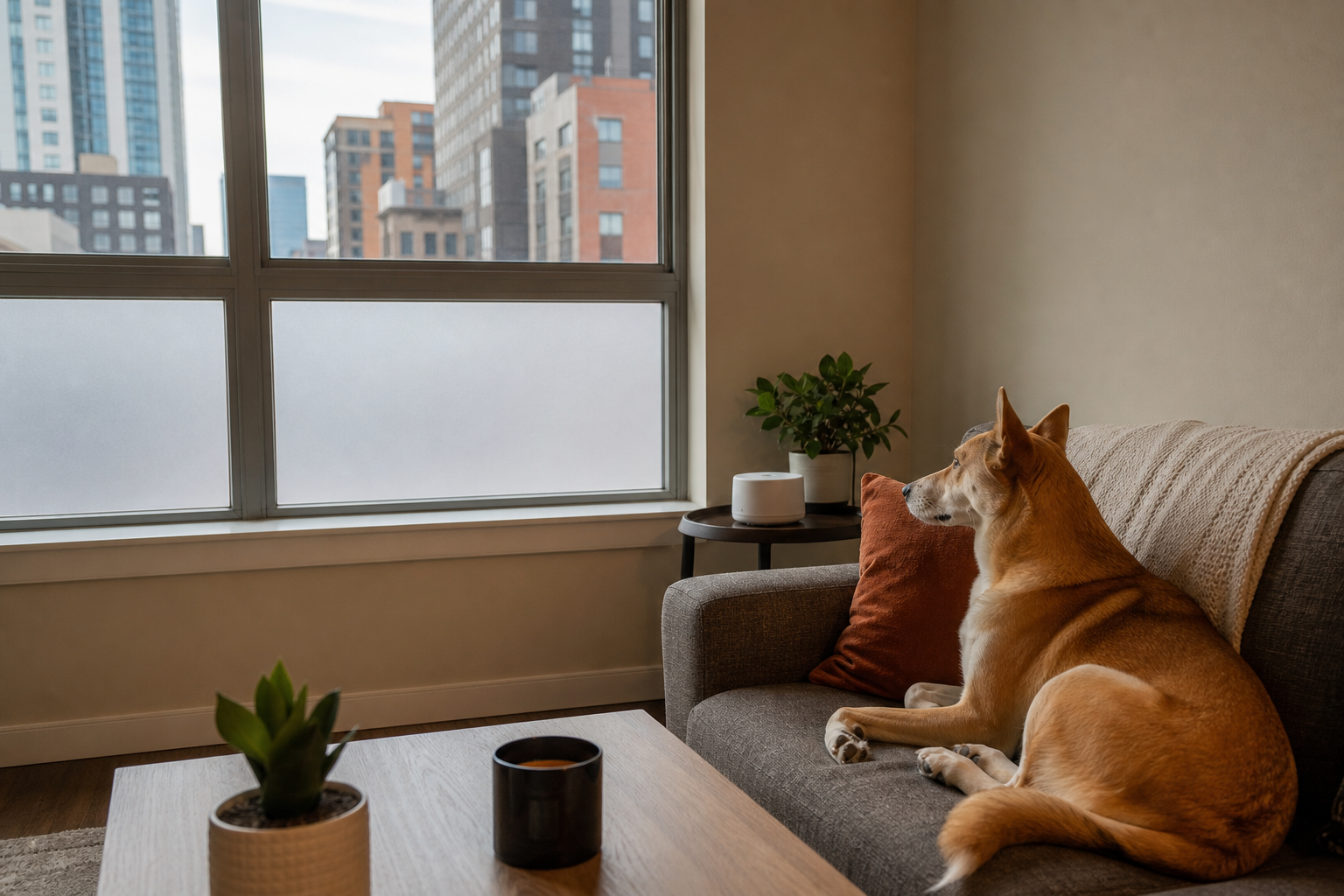
Most owners try to apply generic “stop barking” training without knowing what’s triggering the barking. Spend a week logging the barking: when it happens, where the dog is, what preceded it, how long it lasted, and what ended it. A week of this data usually reveals the dominant pattern. From there, the right intervention becomes obvious.
Step 2: Reduce or Eliminate the Trigger When Possible
Environmental management does half the work for most apartment barkers.
- Visual triggers. Apply privacy film to the lower portion of windows the dog can reach. The dog can still see sky and movement but can’t track specific people, dogs, or cars.
- Auditory triggers. Run a white noise machine in the room where the dog spends most of their time. Position it between the dog’s resting space and the hallway wall or door.
- Door triggers. Move the dog’s bed or default resting space away from the entry door. Many apartment dogs bark from a resting position simply because they’re stationed at the trigger point.
- Delivery triggers. During peak delivery windows, give the dog a long-duration chew in a quieter room. The dog can’t bark and chew at the same time.
Step 3: Address Under-Exercise and Under-Stimulation
A tired dog is a quiet dog. Most chronic apartment barkers are under-exercised, under-stimulated, or both. Physical exercise minimums: low-energy breeds 30-45 minutes per day, medium-energy breeds 60-90 minutes, high-energy breeds 90+ minutes. Mental enrichment options include puzzle feeders, frozen Kongs, snuffle mats, scent games, and training sessions.
For working professionals with high-energy dogs, periodic dog daycare often resolves barking issues that exercise alone can’t address. A tired dog who’s had 6-8 hours of structured social interaction sleeps the rest of the day rather than barking at every hallway sound.
Step 4: Teach the Quiet Command
The single most useful training command for apartment dogs. The structure: let the dog bark briefly, the moment the dog stops barking (even for a half-second) mark it and reward immediately, repeat dozens of times across multiple sessions until the dog reliably pauses, then add the verbal cue “quiet” the moment they stop barking, and gradually extend the duration of quiet required before the reward.
Common mistakes: saying “quiet” repeatedly while the dog continues barking (this pairs the cue with barking), or yelling “quiet” loudly (from the dog’s perspective, this sounds like the owner joining in). The quiet command takes 2-4 weeks of consistent practice to install reliably.
Step 5: Manage Window and Door Barking Specifically
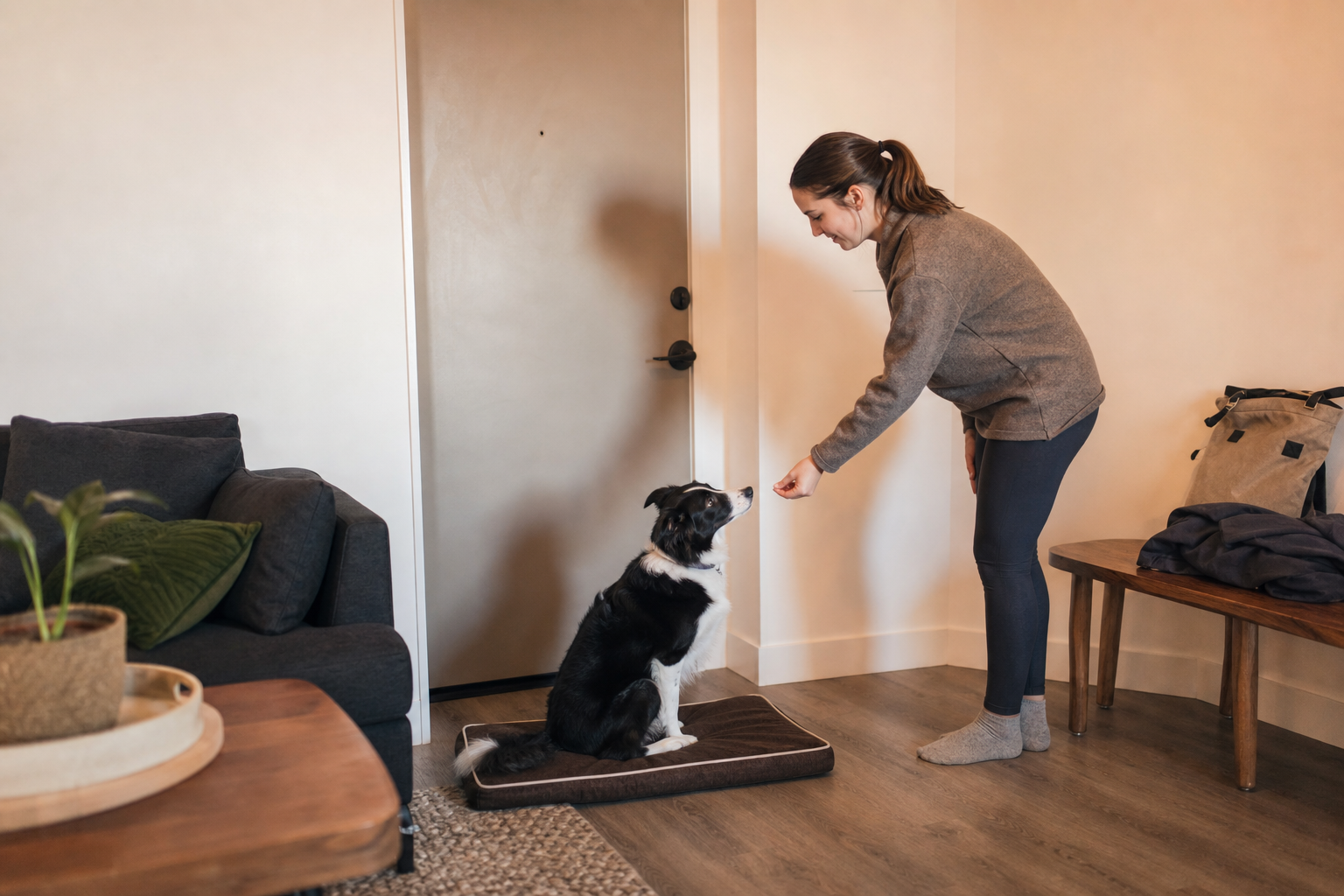
Window barking. Privacy film blocks the trigger. Train a “go to your spot” command where the dog goes to a designated bed away from the window when triggered. Two to four weeks of structured work usually produces reliable response.
Door barking. Build a “go to mat” behavior by practicing having someone knock while you guide the dog to the mat and reward heavily for staying there. Start with low-intensity knocks and short stays, building up to realistic knock intensity and longer durations. During the building phase, manage real-world door triggers by keeping the dog on a leash or in another room when visitors are coming.
Step 6: Handle Alone-Time Barking
Barking when the owner is gone requires careful diagnosis.
Boredom barking starts gradually, often after 30-60 minutes. Responds to more physical exercise before the owner leaves, long-duration chews, puzzle feeders set out before departure, and doggy daycare 1-3 days per week.
Separation anxiety barking begins within minutes of the owner leaving. Intense, often paired with pacing, drooling, destructive behavior, accidents, or self-injury. This is a clinical anxiety condition, not boredom. It requires structured treatment, often including veterinary consultation, a professional trainer or veterinary behaviorist, and a systematic desensitization protocol. Trying to fix separation anxiety with general “barking solutions” doesn’t work and often makes the underlying condition worse.
What Not to Do for Apartment Barking
- Yelling at the dog. From the dog’s perspective, yelling sounds like joining the barking.
- Bark collars. They suppress the behavior without addressing the cause. Dogs who are barking from anxiety often become more anxious when punished, producing worse behavior over time.
- Letting the dog “bark it out.” This isn’t extinction training, it’s practice. Every minute the dog barks at a trigger without intervention strengthens the association.
- Inconsistent responses between household members. Two people giving different responses teaches the dog that the rules are negotiable.
When Neighbors Are Complaining
If complaints have started, the situation is time-sensitive. Communicate proactively, document your training efforts, and consider daycare during peak work hours. If the barking happens primarily during your work hours, daycare 2-5 days per week often resolves the immediate complaint while you continue training at home. The cost is significant but typically less than the cost of moving.
When to Bring in a Professional
Bring in a trainer if barking has escalated rather than improved over 4-6 weeks of consistent intervention, separation anxiety symptoms are present, reactive barking includes lunging or aggression, formal complaints have been filed, or your stress level has reached a point that’s affecting how you interact with the dog. Professional support pays for itself quickly when the alternative is moving, eviction, or rehoming the dog.
Frequently Asked Questions
Do bark collars work for apartment barking?
Bark collars vary in effectiveness and have meaningful drawbacks. They suppress barking without addressing the underlying cause, which often means the dog finds another outlet for the anxiety or arousal driving the original behavior. The cases where bark collars are appropriate are narrow and best identified with professional guidance.
How long does it take to stop apartment barking?
Most apartment barking improves significantly within 4-6 weeks of consistent training and environmental management, with major patterns largely resolved by 2-3 months. Separation anxiety takes longer, often 3-6 months of structured work. The variable is consistency.
What’s the difference between separation anxiety and boredom barking?
Separation anxiety starts within minutes of the owner leaving and often includes other distress signals like pacing, drooling, or destructive behavior. The dog doesn’t settle even with high-value chews. Boredom barking starts more gradually, doesn’t include physical distress signals, and typically responds to exercise and enrichment. A pet camera revealing what happens after you leave is the fastest way to identify the pattern.
Are some breeds prone to apartment barking?
Yes. Breeds bred for alerting (most terriers, herding breeds, guardian breeds) bark more readily than breeds bred for quiet work. This doesn’t mean these breeds can’t live in apartments, many do successfully, but they typically need more exercise, more enrichment, and more deliberate training than naturally quieter breeds.
About All Dogs Unleashed Denver
All Dogs Unleashed works with apartment owners across Denver on the full range of city-dog issues, with barking among the most common. Our work focuses on the actual environments dogs live in, apartments, lobbies, elevators, sidewalks, and shared spaces. Beyond core training, our Denver location also offers in-home dog training, board and train, dog boarding, and dog daycare for apartment owners who need full-service support.
Visit us at 2301 Blake St, Denver, CO 80205, or call (720) 310-7337 to learn more about how our trainers can help you and your neighbors get the quiet you need.
Ready to Get Your Apartment Quiet?
Apartment barking is solvable, but the path to a quiet dog usually involves more than a single technique. Our Denver dog training programs build the calm, structured behavior that makes city life manageable for both you and your neighbors. We offer in-home dog training so we can identify exactly what’s driving the barking in your actual apartment, and board and train for accelerated results when patterns need to shift quickly. Contact us or call (720) 310-7337 to get started.