
Dallas has become one of the most dog-friendly cities in the country, and the explosion of patios, breweries, and outdoor restaurants reflects that. Katy Trail Ice House, Truck Yard, Mutts Canine Cantina, Community Beer Co., and dozens of patios across Deep Ellum, Bishop Arts, and the Design District all welcome dogs. The temptation to bring your pup along for a Saturday afternoon is real, and so is the embarrassment of showing up with a dog who isn’t ready for it.
A well-behaved patio dog isn’t born that way. The dog who lies quietly at your feet while you finish a beer was trained for that exact scenario through specific skills, gradual exposure, and honest assessment of when they were ready. Dog friendly patios in Dallas reward dogs who arrive prepared and humble owners who learn the hard way that good behavior at home doesn’t always translate to a busy patio at 6:00 PM on a Friday.
Why Public Space Training Matters in Dallas
The Dallas dog culture is welcoming, but tolerance among other patrons isn’t unlimited. A dog who barks at every passerby, lunges at other dogs, or climbs onto chairs creates a stressful experience for everyone within earshot. Worse, repeated bad behavior in public spaces has led some venues to tighten their policies or revoke dog-friendly status altogether.
The gap between a dog who behaves well at home and one who handles a brewery isn’t small. Home is predictable: same smells, same people, same sounds. A patio at Whistle Britches on a sunny Saturday is the opposite. Unfamiliar people, strange dogs, food on every table, traffic noise, music, kids running between tables, and waitstaff darting around. A dog who’s never trained for that environment will react to all of it.
Public space training isn’t about teaching dogs to ignore their surroundings. It’s about giving them the skills and confidence to be calm in stimulating environments, plus the relationship with you that lets them check in when something unexpected happens.
Is Your Dog Actually Ready for a Patio?
Honest self-assessment saves embarrassment. Before your dog joins you at a patio, they should reliably do all of the following:
- Hold a settle or down-stay for 20+ minutes in moderately distracting environments
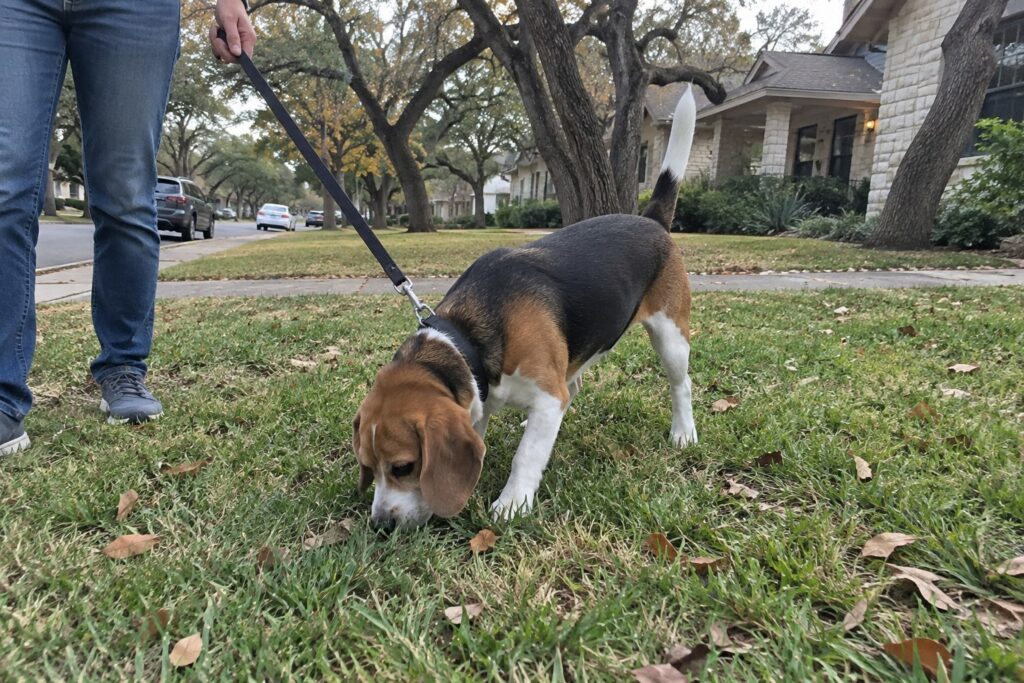
- Walk on a loose leash through crowded sidewalks without pulling
- Pass other dogs at close range without lunging, barking, or fixating
- Take treats gently from your hand even when excited
- Recover quickly from startling sounds or sudden movements
- Stay calm when approached by friendly strangers, including children
If your dog struggles with more than one of these, they’re not ready yet. That’s not a failure, it’s information about what to work on. Vaccinations should be fully up to date as well, since patios put dogs in close contact with many unfamiliar animals.
Age matters here too. Most puppies under 6 months don’t have the impulse control for a busy patio, regardless of how cute they look in a Mutts Canine Cantina photo. Wait until basic training is solid before testing in high-stimulation environments.
Foundation Skills Every Public Space Dog Needs
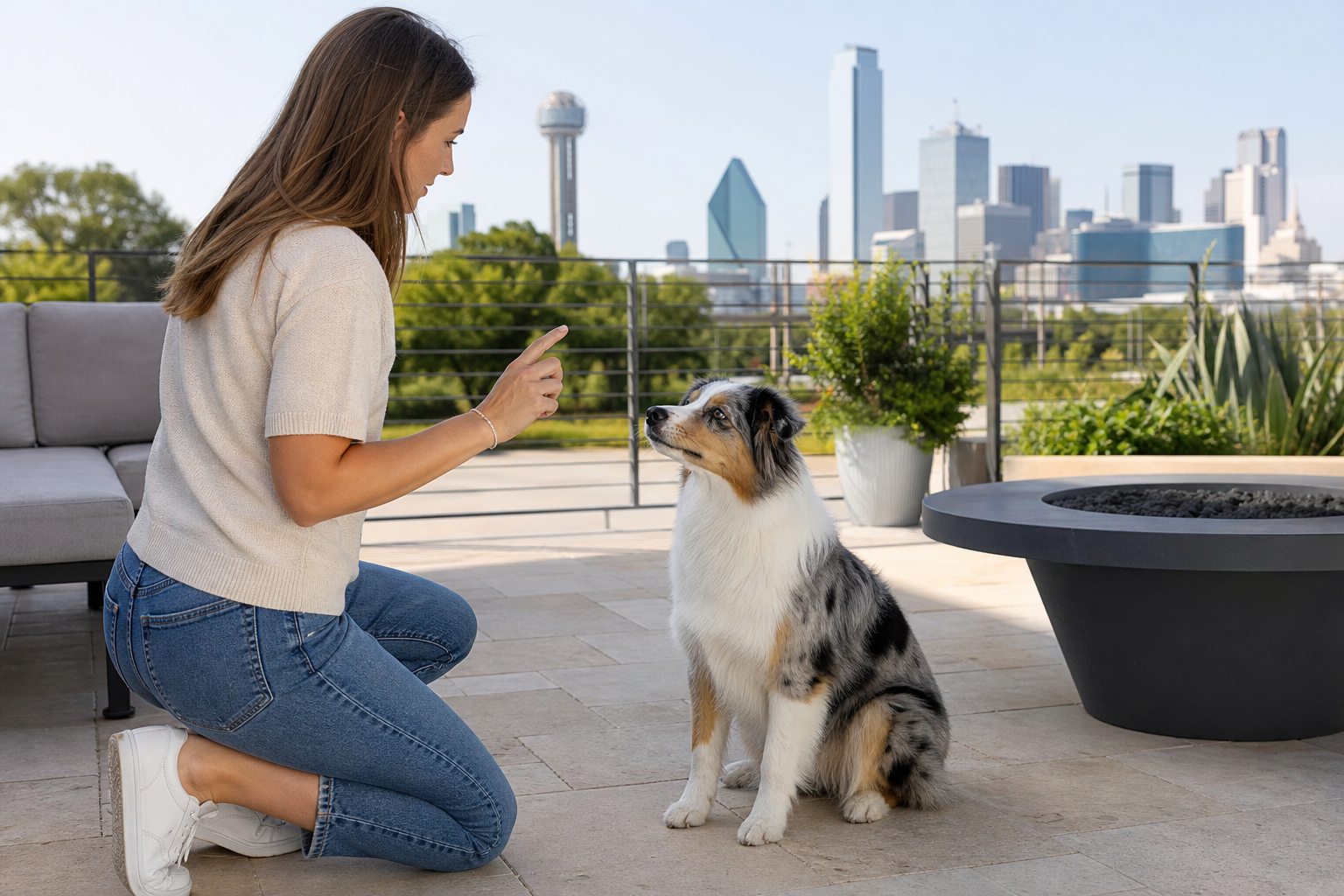
Five core skills carry your dog through almost any patio scenario.
Settle or place command is the most important. Your dog needs to lie down and stay relaxed for extended periods while life happens around them. A dog who’s mastered settle can rest at your feet while you eat, drink, and chat for an hour or more.
Leave it prevents disasters when food drops or another patron’s plate ends up within snout range. A reliable leave-it cue is the difference between a polite patio dog and one who steals a kid’s chicken tender.
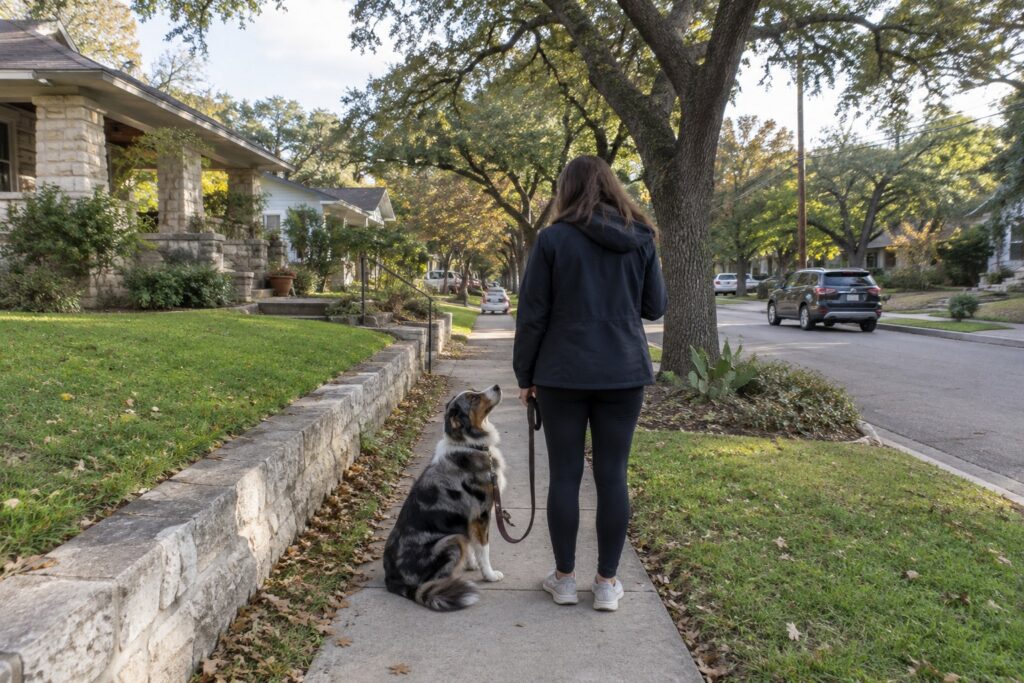
Loose-leash walking under distraction gets you to and from the patio without being dragged. Pulling on a busy sidewalk in Bishop Arts or Lower Greenville is dangerous for everyone, including your dog. Solid leash training basics are non-negotiable.
Watch me or check-in redirects your dog’s attention back to you when something interesting passes by. A passing dog, a server with a tray, a kid on a scooter, anything can trigger over-arousal without a reliable focus cue.
Down-stay during transitions keeps your dog grounded when the server approaches the table, when another party sits down nearby, or when you need to step inside briefly. These are the moments most patio failures happen.
Our overview of training commands every dog should know covers the foundation work that supports every one of these skills.
Teaching the Settle Command at Home
Settle is more than a down-stay. It’s teaching your dog to actively relax, not just hold a position. Build this skill at home before you ever attempt it in public.
Start in a quiet room. Sit on the couch with your dog on leash and step on the leash so they have just enough slack to lie down comfortably but not get up. Don’t say anything. Don’t give treats for activity. Wait for your dog to settle on their own.
The moment they lie down and exhale, mark it with a calm “good” and place a treat between their front paws on the floor. The placement matters: dropping the treat on the floor reinforces lying down, while tossing it to their mouth often gets them up.
Build duration gradually. Five minutes the first session, 10 the next, then 15, then 20. Add mild distractions once your dog can settle for 20 minutes at home: the TV on, family moving around, food being prepared. When your dog can settle through household chaos, you’re ready to take it outside.
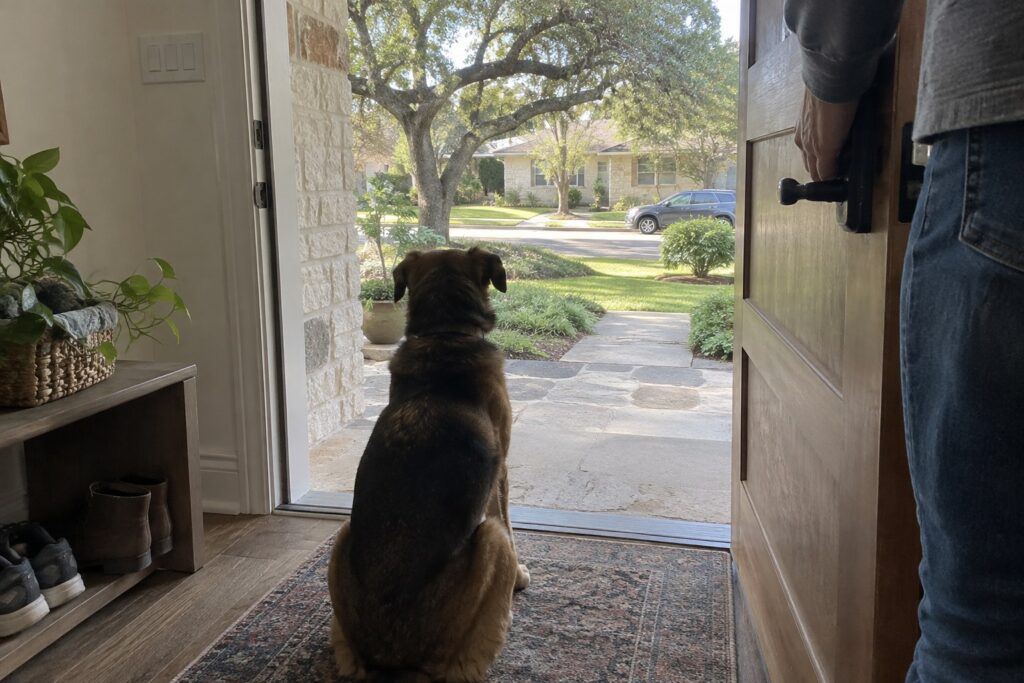
The next progression is your front porch, then your driveway, then a quiet park, then a coffee shop patio in the off-hours. Each step is a smaller difficulty jump than the last.
Building Up to the First Patio Visit
Don’t make a busy Saturday brewery your dog’s first patio experience. Start with a quiet coffee shop patio on a weekday morning when foot traffic is light. Order something quick, settle in for 20 minutes, and leave on a good note.
Once your dog can handle a low-key coffee patio reliably, try a small restaurant patio at off-peak hours, like 2:00 PM on a Tuesday. The next progression is a weekend brunch patio with moderate energy, then a brewery patio during quieter hours, then peak weekend evenings.
Each successful visit builds your dog’s confidence and your read on what they can handle. A short successful trip is always better than a long failed one. If things start to unravel, leave before the situation escalates. Pulling your dog out of a hard situation before they melt down preserves the training, while letting them fail teaches them that patios mean stress.
Practice the “leaving on a good note” habit early. Don’t push for one more drink when your dog is showing fatigue signs like restlessness, panting, or constant scanning.
What to Bring to a Dallas Patio or Brewery
A prepared patio bag makes the difference between a smooth outing and a scramble.
- A flat 6-foot leash, not a retractable
- A portable water bowl and water bottle
- A medium-difficulty chew like a bully stick or stuffed Kong
- A small mat or towel for your dog to settle on
- High-value treats for reinforcement, kept in a pouch
- Waste bags
- A clean-up cloth for water spills
The chew or stuffed Kong is the secret weapon. A dog with a job to do, in this case working on a long-lasting chew, settles much faster than one expected to just lie there bored. Set them up with the chew within the first few minutes of sitting down.
Skip food bowls. Patio staff don’t appreciate dog dishes underfoot, and most dogs don’t need to eat during a one-hour visit anyway.
Handling Common Patio Problems
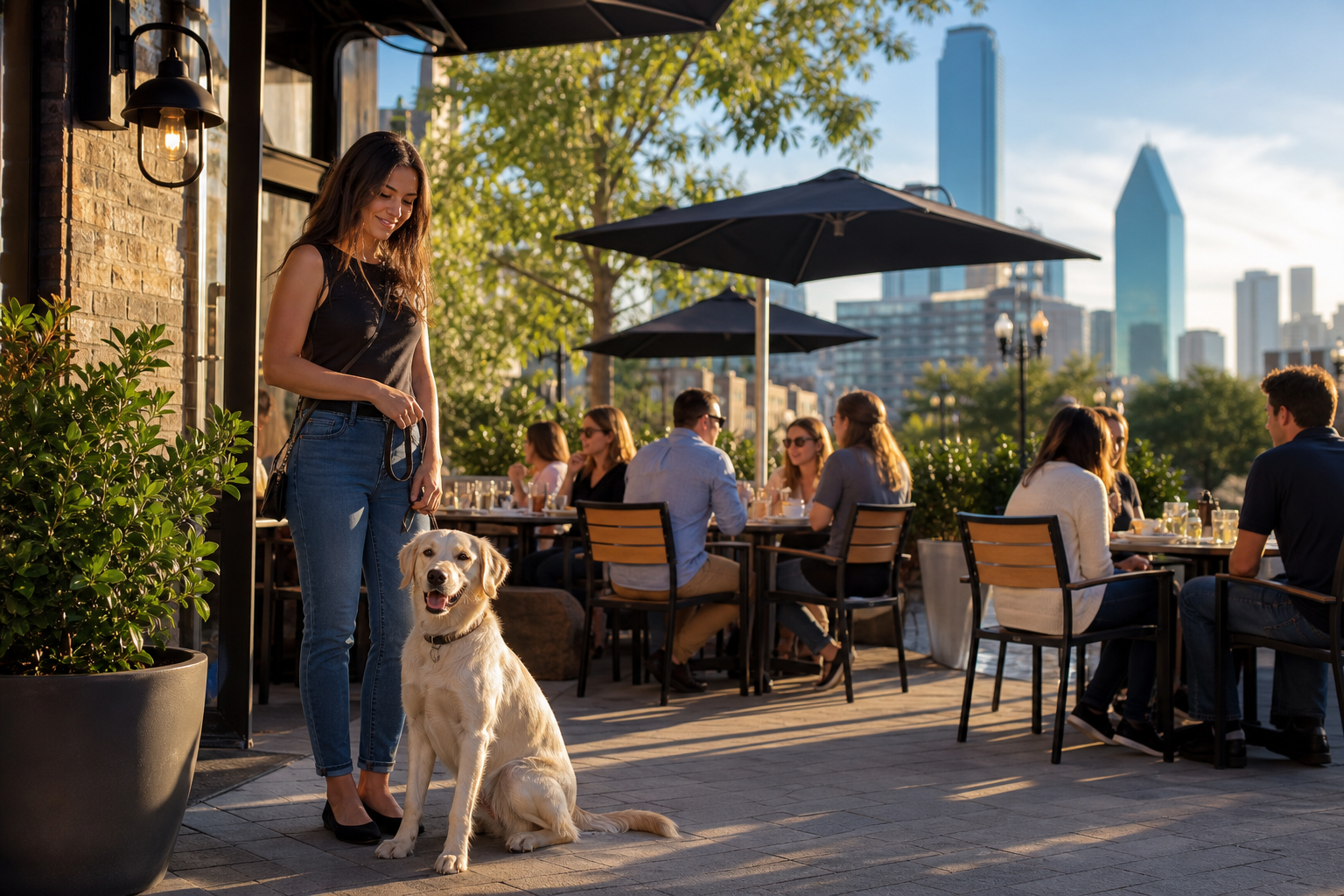
Even well-prepared dogs have rough moments. Knowing how to respond keeps small issues from becoming big ones.
Reactivity to passing dogs is the most common patio problem. If your dog fixates on every dog walking by, you have a few options. Position your table so your dog faces away from the main walkway. Block their view with your chair or a planter. Use treats to reinforce calm behavior when other dogs approach. If reactivity is significant, address it in dedicated training before returning to patios. Our guide on leash reactivity signs and solutions breaks down where to start.
Food stealing happens when low tables put plates within easy reach. Train a strong leave-it at home with food on the floor and on low coffee tables. In public, keep your dog on the side of your chair away from the table. Never feed your dog from your plate at a patio, since this teaches them that human food is fair game.
Barking at servers usually comes from overexcitement, not aggression. Most dogs are friendly but unable to control their excitement when someone new approaches. Practice calm greetings with friends at home, redirecting your dog to a settle position when guests arrive. Read more on curbing overexcitement in your dog for the foundation work.
Marking on patio furniture is mortifying for owners and frustrating for venues. Walk your dog before arriving and let them empty their bladder fully. If your dog is intact or has a marking habit, work on it separately before patio outings.
Dallas-Specific Considerations
Dallas weather drives a lot of patio decisions. From mid-May through mid-September, midday patios are too hot for most dogs. Concrete surfaces hold heat well into the evening, and pavement temperatures can burn paws even at 7:00 PM in July. Plan summer patio visits for after 8:00 PM or stick to shaded venues with grass surfaces.
Popular dog-friendly neighborhoods each have their own personality. Bishop Arts patios tend to be smaller and quieter, making them good practice spots for newer patio dogs. Deep Ellum is louder and more crowded, better suited to confident dogs who handle stimulation well. The Katy Trail strip is heavily dog-populated, which is great for socialized dogs but overwhelming for reactive ones. Lower Greenville sits somewhere in the middle, and Trinity Groves offers a more open layout that lets dogs space themselves out.
Peak times to avoid for newer patio dogs include Saturday brunch at popular spots (10:00 AM to 1:00 PM), weekday happy hour (5:00 PM to 7:00 PM), and any patio with live music. Once your dog has 10 to 15 successful patio visits under their belt, those higher-energy times become manageable. For more on managing dogs in dense urban environments, our apartment living etiquette in DFW guide covers related skills.
Summer planning deserves extra care; review our advice on protecting your dog through North Texas summers before any warm-weather outing.
Patio Etiquette: What You Owe Other Patrons
The dog-friendly culture in Dallas exists because owners maintain it. Bad behavior, both from dogs and people, erodes the tolerance that makes these spaces possible.
Keep your dog under your table, not in the walkway. Servers carrying full trays should never have to step over a sprawled-out dog. Pick up any accidents immediately and notify staff so they can sanitize the area. If your dog barks repeatedly, take them for a short walk to reset, and if it continues, head home.
Don’t let strangers, especially children, approach your dog without your invitation. Even friendly dogs can react unpredictably in busy environments. A polite “she’s working on her manners today” deflects most well-meaning approaches.
Most importantly, know when to leave. A dog who’s done is done. Forcing another 30 minutes when your dog is at their limit guarantees a regression and makes the next outing harder.
Frequently Asked Questions
How old should my dog be before I take them to a patio?
Most dogs are ready around 8 to 12 months, once basic training is solid and impulse control has developed. Younger puppies typically can’t handle the stimulation.
Can I bring my dog inside a Dallas restaurant?
With limited exceptions for service animals, Texas health code prohibits dogs inside restaurants. Patios, breweries with outdoor-only food service, and dog-specific venues like Mutts Canine Cantina are the main options.
What if my dog is reactive to other dogs on leash?
Start with reactivity training before attempting patios. Choose patios where you can sit at the edge with a barrier between your dog and others. Some dogs are happier at dog-friendly parks with more space than crowded patios.
Are there leash requirements at Dallas patios?
Yes. Almost all dog-friendly venues require dogs to remain leashed at all times. Retractable leashes are typically not allowed.
How do I introduce my dog to a brewery environment specifically?
Breweries tend to be louder, more crowded, and longer-stay than restaurants. Build up gradually. Visit during a Tuesday afternoon before tackling a Saturday taproom event.
Can I leave my dog at the patio table while I use the restroom?
Never. Always take your dog with you or have a trusted person at the table. An unsupervised dog can panic, slip a leash, or react badly to a passing stranger.
My dog does well at home but loses focus at patios. Why?
The environment is doing the heavy lifting in failed training. Dogs can perform a 95% reliable settle at home and 30% at a busy brewery. The gap closes through gradual exposure to progressively harder environments, not by hoping they’ll figure it out.
About All Dogs Unleashed Dog Training Dallas
All Dogs Unleashed trains dogs for real-world Dallas environments, not just controlled classroom settings. Our programs build the impulse control, focus, and settle skills that turn family dogs into great patio companions. Whether your dog needs foundation training or targeted work on public space behavior, we tailor every program to where you actually live and where you want to go.
Get Help Training Your Dog for Dallas Public Spaces
Bringing your dog to your favorite Dallas patio should be enjoyable, not stressful. If your dog isn’t quite there yet, we can help bridge the gap. Reach out to our team to learn about our training programs in Dallas and how we build the public-space manners your dog needs. Call our Dallas N Ervay location at (214) 807-1462 or our Carrollton location at (972) 484-3647 to schedule a consultation today.