
German Shepherd training done right starts with understanding what makes this breed different. GSDs are intelligent, high-drive dogs that need structure, consistency, and a trainer who knows how to work with their instincts rather than against them. At All Dogs Unleashed Dog Training Fort Worth, based at 4011 Benbrook State Rte in west Fort Worth, we work with German Shepherd owners across the area every day.
Our structured, individualized approach means we assess your dog's drive level, your experience as a handler, and the specific behaviors you need to fix before recommending any program. Guaranteed results, lifetime support. Ready to see real results with your German Shepherd? Let's build a plan that works.
Key Takeaways
- German Shepherd training requires structure and consistency from day one to help prevent problem behaviors from taking hold.
- GSDs thrive with off-leash control as a training goal, not just basic commands on a leash.
- Puppy and adult German Shepherds need different approaches based on age, drive level, and handler experience.
- Fort Worth's heat means outdoor training sessions should happen before 9 a.m. or after 7 p.m. in summer months.
- Lifetime support means ongoing help for the full life of your dog, with no expiration date.
Why German Shepherds Require a Breed-Specific Training Approach
German Shepherds can have individual training needs shaped by temperament, age, history, and environment. A thoughtful plan should account for those needs rather than rely on a one-size-fits-all approach.
These dogs read their handler constantly. A GSD that senses uncertainty or inconsistency will start testing limits. This behavior can have several causes, including stress, inconsistent expectations, or a need for clearer training. Once you understand that, the breed-specific approach makes immediate sense: clear structure, consistent expectations, and a handler who projects calm confidence.
The Intelligence and Drive That Make GSDs Different
GSDs need a job. Without one, they invent their own, and it is rarely something you will enjoy. Their working-dog instincts demand mental stimulation alongside physical exercise. A long walk does not satisfy a GSD the way a structured training session does. German Shepherd training should be adapted to each dog’s individual needs.
We assess each dog's drive level and handler experience before recommending any program. That is what an individualized approach actually means: not a one-size-fits-all curriculum, but a plan built around your specific dog's temperament, energy, and your real-world goals.
How Age Shapes Your German Shepherd's Training Needs
Age matters a great deal with this breed, and the priorities shift significantly between puppies and adult dogs.
- Puppies: Socialization is the top priority. Early puppy socialization is time-sensitive, so thoughtful exposure to people, sounds, and varied environments matters. The west side neighborhoods near Benbrook and the busier commercial corridors closer to downtown both offer ideal socialization settings if you use them early. Our puppy training fort worth is structured specifically around this window, pairing socialization with foundation commands before habits form.
- Adult dogs: The focus can shift to impulse control, off-leash reliability, and addressing established problem behaviors. Adult GSDs absolutely can be trained effectively. The myth that older dogs cannot change is simply wrong, and we see it disproven regularly.
In hot weather, plan outdoor German Shepherd training around current conditions, provide water, and watch for signs of heat stress.
The 5 Foundation Commands Every German Shepherd Needs
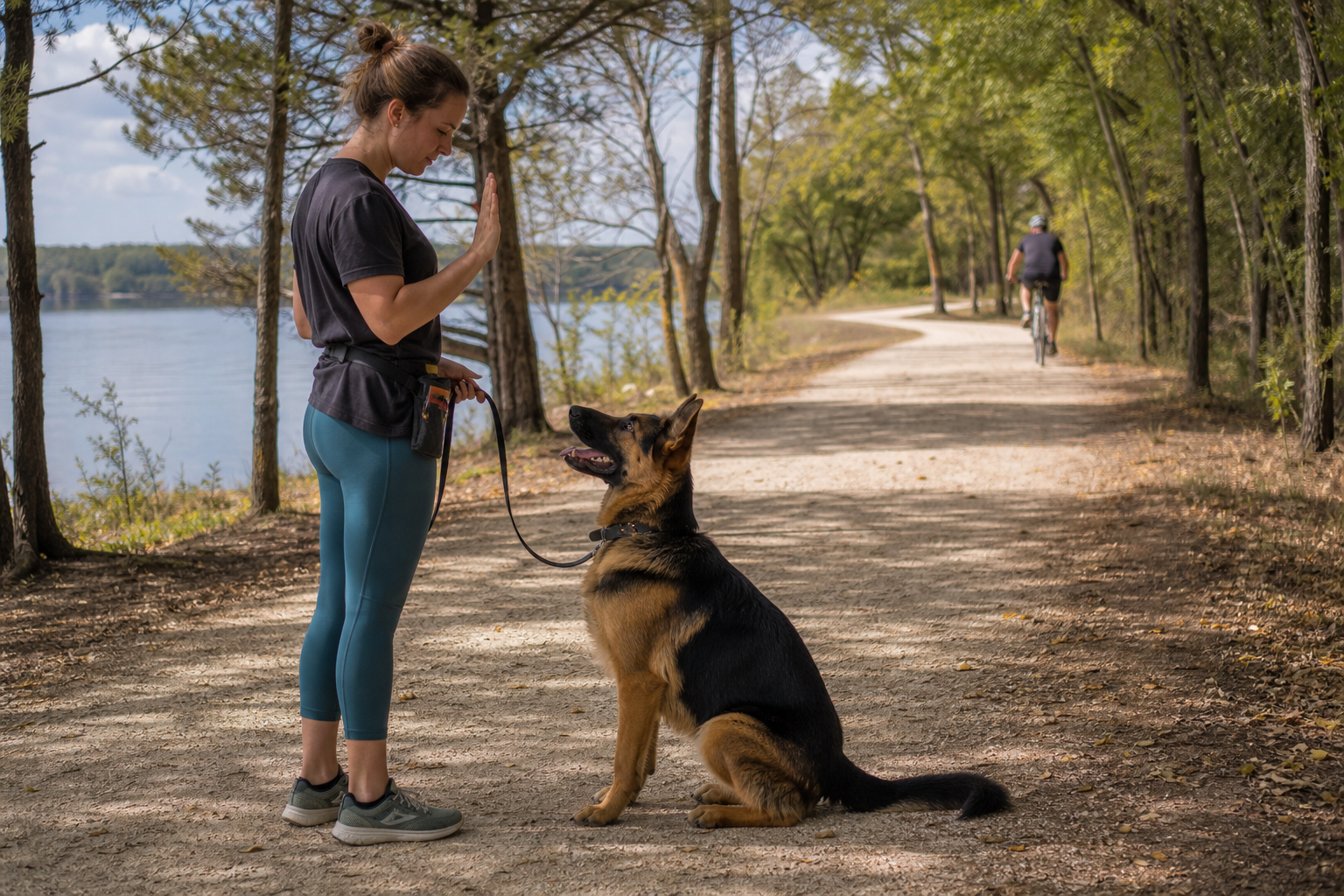
The five foundation commands every GSD needs are sit, stay, down, come, and leave it. These are non-negotiable, regardless of your dog's age or temperament. Skip any one of them and you will feel it later, especially on a busy trail near Benbrook Lake where wildlife, cyclists, and off-leash dogs appear without warning.
- Sit
- Stay
- Down
- Come
- Leave It
Sit, Stay, and Down: Building Impulse Control
Impulse control is the real skill these three commands build. High-drive dogs act on instinct fast. Sit, stay, and down teach your dog to pause and defer to you before reacting. That pause is everything.
Use marker-based training to teach them. A verbal "yes" or a clicker marks the exact moment your dog performs the behavior, then reward immediately.
This precision matters more with high-drive breeds than with lower-energy dogs because the reward window is smaller. Keep sessions appropriately brief and adjust them to your dog’s age, focus, and comfort. Consistency across every family member is critical. GSDs notice when rules change between people, and they will test those gaps.
We assess each dog's drive level and handler experience before recommending a program, so the approach fits your specific dog rather than a generic template. That is what a structured, individualized approach actually means in practice.
Come and Leave It: The Commands That Keep Your Dog Safe
Come is the most important safety command you will ever teach. It is also the gateway to reliable off-leash German Shepherd training later on. A GSD with a solid recall has earned the freedom to work at a distance. One without it stays on leash indefinitely.
Leave it is the impulse-control companion to come. On trails near the Trinity Trails along the Cultural District or open spaces around Benbrook, your dog will encounter squirrels, joggers, and other dogs in seconds. Leave it gives you a verbal interrupt before the chase begins. Owners who skip this command early spend months undoing leash reactivity later. Build recall progressively in low-distraction environments before introducing busier parks.
If you are starting with a puppy, our puppy training fort worth program builds all five of these commands from the ground up with lifetime support for the full life of your dog.
How to Handle German Shepherd Reactivity and Protective Instincts
Reactivity is one of the most common issues we see from GSD owners in Benbrook, North Richland Hills, and across the west side of Tarrant County. The good news: it is very treatable. It is not a personality flaw, and it does not mean your dog is dangerous.
Understanding the Difference Between Reactivity and Aggression
Reactivity means your dog overreacts to a stimulus, such as another dog, a bicycle, or a loud truck, with barking, lunging, or hard pulling. Aggression involves intent to harm. These are not the same thing, and confusing them leads owners to either panic or ignore a real problem. Understanding the difference can help owners respond appropriately.
Some GSDs can be especially alert to their surroundings. Without thoughtful socialization and structure, that alertness can contribute to reactivity on walks. It is a training problem, and it responds well to consistent work.
Practical Steps to Reduce Reactive Behavior on Walks
Owners in areas like Benbrook and North Richland Hills deal with a real mix of environments, quiet residential streets, busy commercial corridors, and shared trail systems. All of those environments create triggers. Here are five steps that work in the real world:
- Find the threshold distance. This is the point where your dog notices a trigger but has not yet reacted. Training happens in that gap. Stay below threshold every session.
- Counter-condition before the reaction starts. The moment your dog notices the trigger, deliver a high-value treat. You are building a new association before the bark or lunge fires.
- Practice "watch me" eye contact. A dog focused on you cannot fixate on a trigger. Build this in low-distraction settings first, then carry it into walks.
- Never flood your dog. Forcing close proximity with a trigger does not build confidence. It makes reactivity worse. Increase distance, then close it slowly over many sessions.
- Build loose-leash skills first. A dog that already pulls makes reactivity work nearly impossible. Build loose-leash skills before tackling trigger work.
For severe reactivity, professional help is the practical call, not a last resort. The longer reactive behavior repeats without intervention, the more ingrained it becomes. If you are not making progress on your own, contact us and we will map out a plan.
Off-Leash Training: A Realistic Goal for German Shepherds
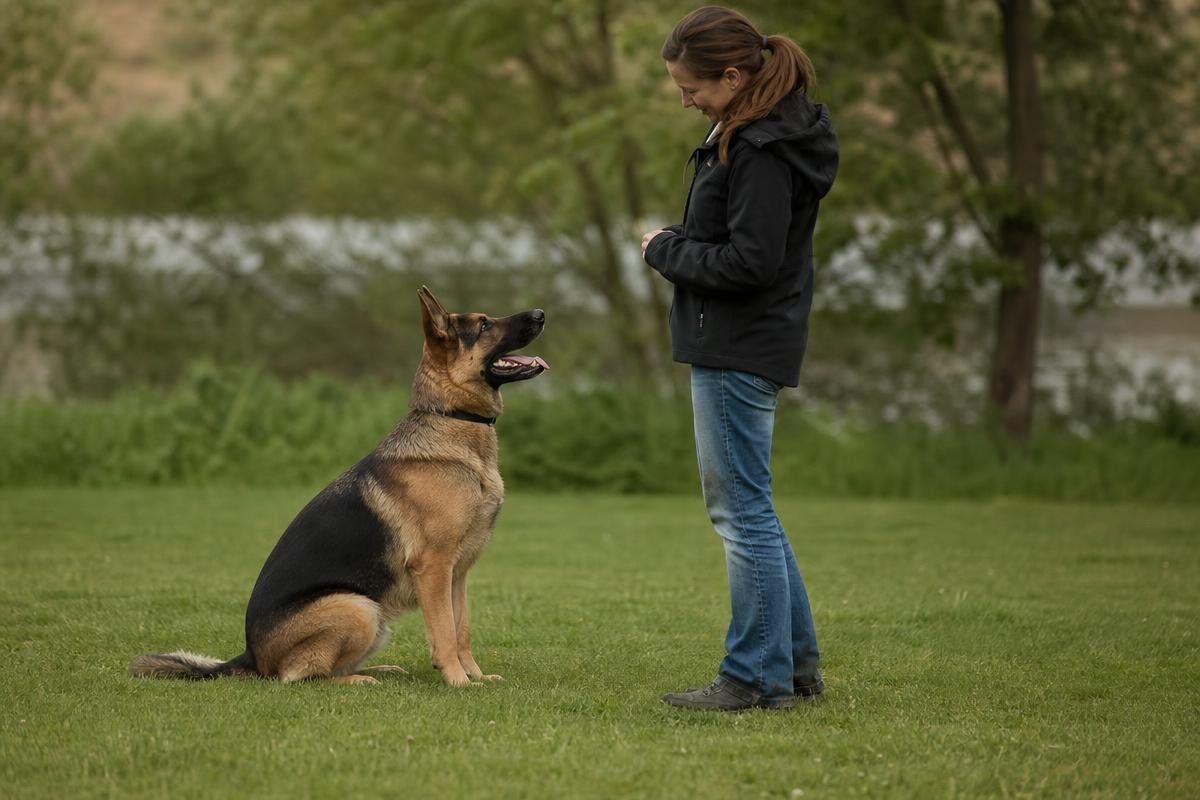
Reliable off-leash control is one of the most achievable outcomes for a well-trained GSD, and one of the most rewarding. Picture your dog responding to commands at a distance, ignoring distractions, and returning immediately on recall, whether you're in your backyard, on a trail near Benbrook Lake, or at one of the busier parks on the west side of the city. That outcome is real. It takes a structured progression to get there, but it is absolutely within reach.
The most common mistake owners make is granting off-leash freedom before the dog has earned it. When a GSD gets to run free before recall is solid, it practices self-rewarding behaviors: chasing, running off, ignoring you. Every repetition of that pattern makes the next training session harder.
What Off-Leash Control Actually Looks Like
True off-leash control means your dog responds the first time, every time, regardless of what's happening around it. Not sometimes. Not when there are no distractions. Consistently. That standard is what separates a dog that's "pretty good off-leash" from one you can genuinely trust in real-world environments, from quiet Benbrook residential streets to a crowded weekend park.
Our programs are built around that standard. We work with dogs of all breeds, ages, and temperaments, and we see GSDs reach reliable off-leash control regularly when the progression is followed correctly.
The Training Progression That Gets You There
Off-leash German Shepherd training follows a clear, non-negotiable sequence. Skipping steps is the fastest way to stall progress.
- Master all five foundation commands on-leash with zero distractions.
- Add distance on a long line, starting at 10 feet, then 20, then 30.
- Introduce distractions gradually while still on the long line.
- Proof recall across multiple environments, from your backyard to a quiet park to a busier one.
- Transition off-leash only after demonstrating consistent reliability on the long line under distraction.
This process typically takes weeks to months depending on the dog's age, history, and how consistent training is between sessions. Board and train programs can compress that timeline significantly for owners who want faster results. If you're looking for a starting point, our puppy training fort worth covers this full progression with lifetime support for the full life of your dog, meaning help is always available when you need it, whether that's a quick phone call, a follow-up session, or a video check-in. No expiration date, no upsell.
Ready to work toward reliable off-leash control with your GSD? Call us at (817) 393-6224 and we'll map out the right progression for your dog.
Training German Shepherds in Fort Worth: What Local Owners Should Know
Training in Fort Worth comes with real environmental factors that affect your sessions. We work with GSD owners across zip code 76116 and surrounding communities every week, and the local climate and terrain shape how we structure outdoor work. Our team is based at 4011 Benbrook State Rte, Fort Worth, TX 76116, which puts us right in the middle of the west Fort Worth neighborhoods where many of our clients live.
Fort Worth's Climate and Environment as Training Factors
Summers here are brutal. Temperatures regularly exceed 100°F from June through September. High-energy working breeds overheat fast, and a dog that's heat-stressed cannot focus or retain commands. Schedule outdoor sessions before 9 a.m. or after 7 p.m. during those months. Know the signs of heat stroke in Fort Worth dogs so you can act quickly if something goes wrong.
Backyard training surfaces are another factor most owners overlook. Clay-heavy soil near Benbrook and White Settlement turns slick and muddy after rain. Asking your dog to hold a down-stay or pivot on wet clay is a setup for frustration. After heavy rain, move sessions to a covered surface or a dry patch of grass before resuming footwork drills.
Where Fort Worth GSD Owners Train and Socialize Their Dogs
Location variety is one of the best tools for proofing commands. Quiet residential streets in Keller and North Richland Hills are great for early distraction work. Busier commercial corridors in Southlake push your dog to hold focus around foot traffic and noise. Our puppy training fort worth helps owners build that distraction progression systematically, not randomly.
For socialization, the Fort Worth German Shepherd Dog Club hosts breed-specific events that give your dog structured exposure to other GSDs and handlers. Pair that with visits to dog-friendly spots in Fort Worth like the trails near Benbrook Lake, and you have a solid real-world training circuit without leaving Tarrant County.
When to Call a Professional German Shepherd Trainer in Fort Worth
Signs Your GSD Needs More Than YouTube and Treats
Some behaviors are simply beyond what self-directed training can reliably fix. That is not a reflection of you as an owner. It is just the reality of working with a high-drive, highly intelligent breed that can develop complex behavioral patterns quickly.
Here are the signals that tell us a structured, individualized approach is the right next step. We assess drive level, handler experience, and specific problem behaviors before recommending any program, so nothing is one-size-fits-all.
- Persistent leash reactivity despite consistent work
- Resource guarding directed at family members, not just strangers
- Fear-based behaviors like cowering, snapping, or freezing when approached
- Separation anxiety causing destructive behavior every time you leave
- A dog that missed socialization past 6 months and struggles with new environments
- Any behavior that has escalated in intensity over time rather than leveling off
These are not signs of a bad dog. They are signs of a dog that needs the right structure and the right hands.
What to Expect from Professional German Shepherd Training
We offer two primary formats. In-home training brings our trainer directly into your dog's real environment. For owners in west-side suburban neighborhoods where reactive triggers like mail carriers, street traffic, and neighboring dogs are right outside the front door, this format makes an immediate, practical difference. Board and train is the better fit for complex cases that need intensive daily structure and faster results.
Our team serves GSD owners across the Tarrant County area, including Keller, White Settlement, and the communities surrounding our location at 4011 Benbrook State Rte in the 76116 zip code. If you have a younger dog just starting out, our puppy training fort worth builds that foundation early before problem behaviors take hold.
Structured training can help owners understand and maintain their dog's learned behaviors after pickup. That does not end at pickup. Lifetime support means a phone call, a follow-up session, or a video check-in whenever you need it. No expiration date. No upsell. If you are seeing any of the warning signs above, contact us at (817) 393-6224 and we will map out a plan together.
Frequently Asked Questions
How long does it take to train a German Shepherd?
Timeline depends on age, history, and consistency. Some dogs show foundation progress within weeks, while dogs with established behavior concerns may need a longer, individualized plan. Board and train compresses that timeline significantly because your dog works through structured sessions every single day.
Can you train an adult German Shepherd, or is it too late?
It is never too late. Adult dogs can learn new behaviors and unlearn old ones. The process takes more patience than starting with a puppy, but the results are just as real. We work with dogs of all ages, including older dogs with years of reinforced problem behaviors.
What is the best age to start training a German Shepherd puppy?
Start foundational training when your puppy comes home, using age-appropriate guidance. The early socialization period is important, so thoughtful exposure to people, sounds, and environments matters. In a city with varied neighborhoods, busy streets, and public parks, that early exposure pays off for years. Our puppy training fort worth program is built around this critical developmental window.
How do I stop my German Shepherd from jumping on people?
Remove the reward the instant the jumping starts. Turn away, cross your arms, and give zero eye contact until all four paws are on the floor. Then reward immediately. Every person in your household must respond the same way, every time. One person who lets it slide undoes the work of everyone else.
Is board and train a good option for German Shepherds?
Board and train is an excellent fit for this breed, especially for reactivity, off-leash reliability, or complex behavior issues. Your dog receives structured obedience training every day, not just a few hours a week. Owners consistently describe their dogs returning with behaviors that are demonstrated and fully explained at pickup so you can maintain them at home.
How much does German Shepherd training cost in Fort Worth?
Program pricing varies based on your dog's age, behavior history, and the format that fits your situation best. Call All Dogs Unleashed Dog Training Fort Worth directly at (817) 393-6224 for current program details. We will walk you through the options and help you find the right fit before you commit to anything.
What commands should a German Shepherd know first?
Start with sit, stay, down, come, and leave it. These five build impulse control and establish you as the authority figure this breed needs. Without that foundation, everything else is harder. With it, you have a dog that listens under pressure, not just in your living room.
Your dog is capable of more than you might think. This breed was built for structure and purpose. With consistent guidance and a trainer who understands how these dogs actually think, reliable off-leash control is an achievable goal, not just for other people's dogs. Call (817) 393-6224 to talk through your dog's specific situation. We work with dogs of all ages across Keller, Southlake, White Settlement, and the surrounding communities, and we back every program with lifetime support for the full life of your dog.
Ready to Get Started with All Dogs Unleashed Dog Training Fort Worth?
Call (817) 393-6224 to speak with our team directly. We're ready to answer your questions, walk you through your options, and help you find the right solution for your needs. Whether you're just starting to plan or ready to move forward, we'll make the process simple and stress-free. Reach out today and let's talk about how we can help.