
Resource guarding in dogs is one of the most common calls we get from Bossier City owners, and it almost always shows up the same way: a stiff body over a bowl, a low growl near a bone, or snapping when someone walks past the couch. At All Dogs Unleashed Bossier City, we work with Bossier City families to fix this behavior at the root, not just manage it. Our Board and Train and In-Home Training programs are built around your dog’s individual needs, so you get real results that stick.
Ready to stop the growling and guarding for good? Call our Bossier City team today at (318) 562-6536.
Key Takeaways
- Resource guarding in dogs is a learned behavior, not a personality flaw, and it can be trained out with the right plan.
- Bossier City owners often see guarding around food bowls, bones, toys, sleeping spots, and even people.
- Management tricks like trading treats help short-term, but professional training fixes the root cause.
- Our Board and Train program in Bossier City gives your dog structure, clear rules, and a stronger bond with you.
What Resource Guarding Looks Like and Why It Matters
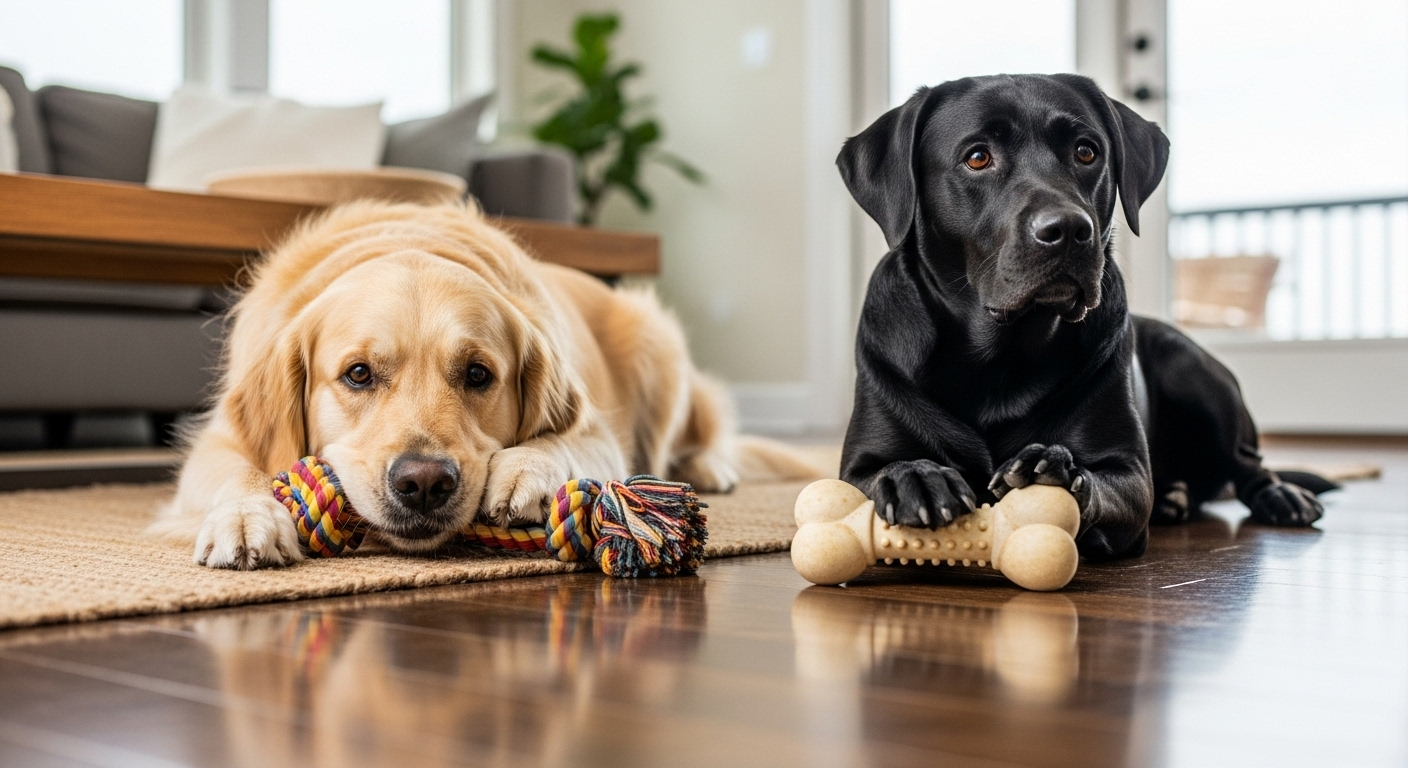
Resource guarding in dogs is when your dog growls, snaps, stiffens, or bites to protect food, toys, bones, beds, or even a person. It’s a fear-based behavior. Your dog thinks something valuable is about to be taken away. It shows up at the food bowl, on the couch, or over a stolen sock.
Good news for Bossier City dog owners: this is one of the most common issues we see, and it’s fixable with the right plan. Our full lineup ofdog training programs is built to handle behavior cases exactly like this one.
Can you fix it at home? Often, yes, if you catch it early and read the warning signs correctly. Serious cases need a pro.
This guide covers:
- Early warning signs most owners miss
- A step-by-step training plan you can start today
- When to call us instead of going it alone
What Is Resource Guarding and Why Do Dogs Do It?
Resource guarding is when your dog protects something it values, like food, a toy, a spot on the couch, or even a person. It is a normal survival instinct, not proof your dog is mean or broken. It becomes a real problem when the target is a kid, a guest, or another pet in your Bossier City home.
The Instinct Behind the Behavior
Dogs guard because their brain says, “this is mine and I might lose it.” That is hardwired. So when you ask, “why does my dog guard his food bowl?” the short answer is: he thinks something good is about to be taken away.
Is resource guarding a sign of aggression? Not by itself. Possessive aggression in dogs is one branch of guarding, but most cases start small. Watch for early signals:
- Freezing or going stiff over a bowl or chew
- Hard stare, whale eye, or ears pinned
- Low growl, lip lift, or air snap
- Eating faster when you walk by
Ignore those signs and the behavior usually grows into snapping or biting.
What Dogs Guard: Food, Toys, Spaces, and People
A dog guarding the food bowl is the classic example, but the list is longer than most owners think:
- Food bowls and dropped scraps
- Bones, bully sticks, and chews
- Toys, especially new ones
- Couches, beds, and crates
- Doorways or a specific room
- A favorite person in the family
Multi-pet homes and families with young kids in Bossier City see this most. More bodies, more competition, more chances for a flare-up.
How to Read the Early Warning Signs Before a Bite Happens
Almost every “out of nowhere” bite has a trail of warnings the owner missed. Your dog is talking. You just have to learn to read the signals. Bossier City owners who catch this early have the best outcomes by far.
The Resource Guarding Ladder
Possessive aggression in dogs almost always climbs a predictable ladder. Catching it at step 1 or 2 is far easier than fixing a step 4 or 5 dog.
- Body stiffens or freezes over the item
- Hard stare or "whale eye" (whites of the eyes showing)
- Low growl or lip curl
- Snap or air bite as a warning
- Contact bite
Most dogs give every one of these signals before they ever make contact. Owners get “surprised” because they missed steps 1 through 3.
Reading Your Dog's Body Language Around Valued Items
Watch your dog the next time they have a bone, bully stick, or favorite toy. Dog aggression over toys shows up in small body shifts long before a growl.
Look for these signals when you walk near:
- Eating faster the closer you get
- Hovering low over the item with a stiff back
- Turning their body to shield the object from you
- Lip curl or a quick flash of teeth
- Ears pinned, tail tucked or held unnaturally still
- That hard, unblinking stare
“Whale eye” means your dog turns their head away but keeps eyeballing you, showing the whites. It’s a clear “back off” signal.
If you see two or more of these, don’t wait. Reach out to our dog trainers in Bossier City and let us assess where your dog sits on the ladder.
A Step-by-Step Plan to Reduce Resource Guarding at Home
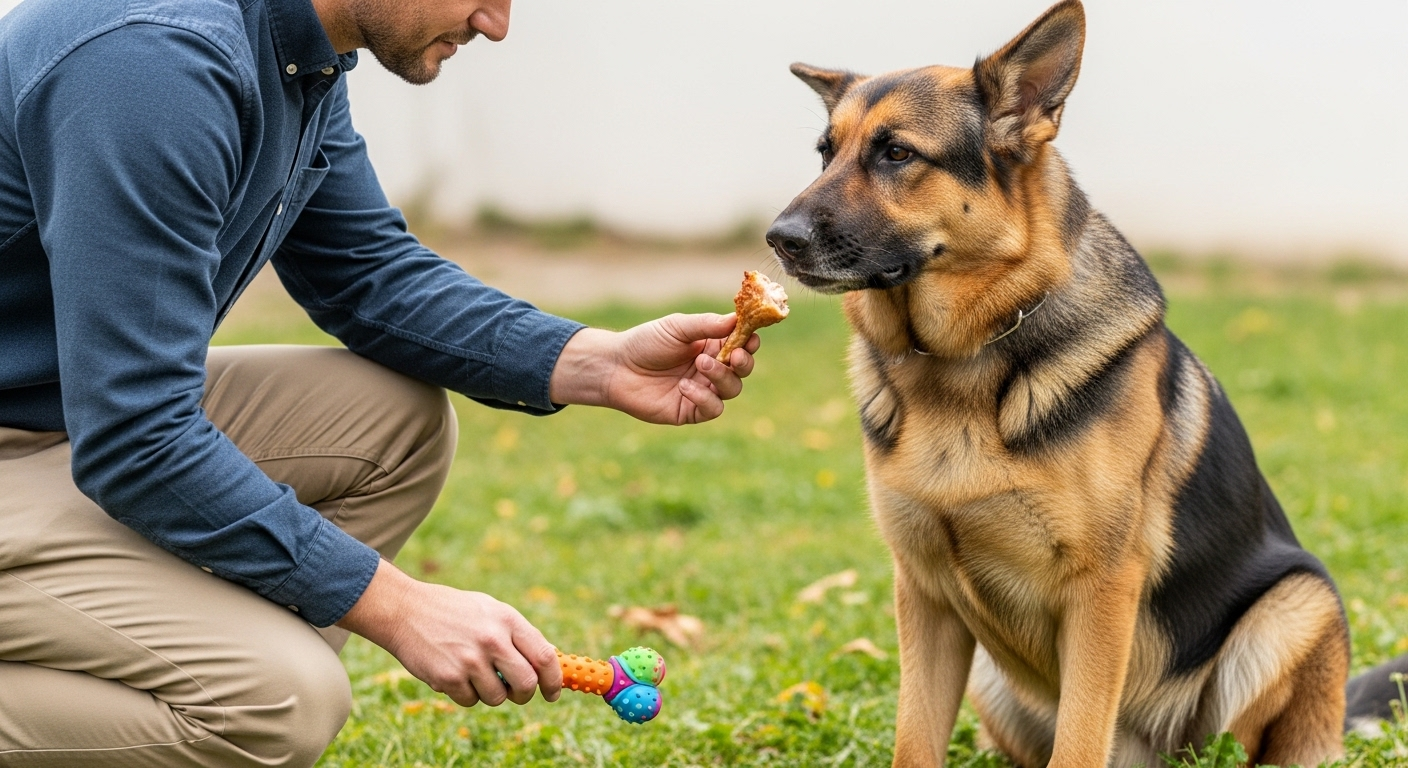
Here is the at-home plan we give Bossier City owners. Run these drills daily for 5 to 10 minutes. Pair them with basic obedience for the fastest results.
Step 1: Stop Punishing the Growl
No. Do not punish a growl. A growl is your dog telling you he is uncomfortable, and that warning is valuable information.
Punish it and you teach your dog to skip the warning. The next stage is often a bite with no growl first. Thank your dog for the warning, calmly create space, and start the work below.
Step 2: Trade-Up and Approach Drills
The trade-up technique is the core of how to stop resource guarding in dogs. You teach your dog that hands coming near his stuff means something better is on the way.
Run the drill like this:
- Approach calmly with a high-value treat like real chicken or cheese.
- Say "trade" and offer the treat.
- Take the item while he eats.
- Give the item back.
- Repeat 5 to 10 times per session.
For a dog guarding food bowl behavior, walk past the bowl mid-meal and drop a piece of chicken in. Then keep walking. You become the treat fairy, not the threat.
Step 3: Building Positive Associations Through Repetition
Short daily reps beat one long weekend session. Layer in “leave it,” “drop it,” and “sit” so your dog has clear obedience cues to fall back on. OurIn-Home Dog Training in Bossier City builds this foundation in your own kitchen and living room, where the guarding actually happens.
Need hands-on help with food bowl or toy guarding? Call our team at (318) 562-6536 to set up in-home training in Bossier City.
When Home Training Is Not Enough: Recognizing the Limits
Some resource guarding cases are too far along for at-home fixes. If your dog has already bitten someone or is escalating week over week, you need professional help. Possessive aggression in dogs gets worse with the wrong reps, not better.
Signs the Behavior Has Escalated Beyond DIY
Stop and call us if you see any of these red flags in your Bossier City home:
- Your dog has made contact and broken skin, even once
- The guarding is getting worse despite your at-home work
- Your dog guards multiple categories: food AND toys AND spaces AND people
- The guarding is directed at children or elderly family members
- Another dog in the home has been injured in a fight over a resource
Any one of these means the risk is too high to keep practicing on your own. Yes, resource guarding is fixable, but the dog needs structured work from a skilled trainer.
How Board and Train Works for Resource Guarding Cases
OurBoard and Train program for dogs in Bossier City puts your dog with certified trainers full-time at our Benton Road facility, just a short drive from anywhere in Bossier. Kelvin, Kelden, and the rest of the team run real-world reps all day, not staged drills once a week.
That immersion is why dog training for resource guarding moves faster here than weekly group classes. The rules stay consistent, the reps stack up, and your dog learns a new pattern around food, toys, and space.
Our 5.0-star rating across 257 reviews speaks for itself. One owner told us we “changed my dog out with someone else’s.” That is the kind of turnaround a serious guarding case needs.
Resource Guarding Between Dogs: What Bossier City Multi-Pet Households Should Know
Two or more dogs under one roof changes the math. Food bowls, bully sticks, the spot on the couch, even you walking through the door, any of it can become a flash point. In Bossier City homes with multiple pets, we see possessive aggression in dogs flare up fast when nobody set clear ground rules from day one.
Why Multi-Dog Homes Are Higher Risk
Dog-to-dog guarding is normal canine communication. A lip lift over a bone is one dog telling another to back off. It only becomes dangerous when you have a size mismatch, a prior injury between the two dogs, or a feeding setup that puts them nose to nose.
Watch for “trigger stacking.” A dog who is tired from the heat, anxious from a thunderstorm, or sore from yesterday’s walk will guard harder than usual. Dog aggression over toys often spikes on the worst day, not the average day.
Practical Management Steps While You Train
Management keeps everyone safe while real training happens. It does not fix the behavior on its own.
- Feed in separate rooms or crates, every meal, no exceptions.
- Pick up high-value chews when both dogs are loose.
- Use two water bowls in different spots so nobody crowds.
- Supervise all toy play until guarding is resolved.
Read how to set up your yard for a multi-dog household in Bossier City so outdoor space does not become the next trigger. If you need a fully supervised environment for one of the dogs during the toughest weeks of training, ourdog boarding facility gives you that option without forcing both dogs to share resources at home.
Can dog-to-dog guarding be trained out? Yes, in most cases. Our team evaluates the dynamic between your dogs and builds the fix into the program.
Local Context: Why Bossier City Dog Owners Encounter This More Than They Expect
Louisiana heat changes everything about a dog’s day. From late May through September, most dogs in Bossier City are stuck inside with the AC running. Walks get shorter. Yard time gets cut. That pent-up energy has to go somewhere, and for dogs already prone to guarding, it shows up as a tighter grip on the food bowl, the favorite chew, or the spot on the couch. Boredom and confinement do not cause resource guarding in dogs, but they crank up the volume on it.
Family households are the other piece. A lot of homes around here have young kids and dogs sharing the same living room. Guarding around a child is the scenario we treat most urgently. Kids move fast, drop food, and reach for things without warning. A dog that freezes over a bone when a toddler walks by is telling you something serious. Do not wait that one out. That is a call-a-trainer situation, every time.
Rescue and shelter adoptions are common in our area too. Dogs who spend time competing for food or comfort often arrive with scarcity habits already baked in. They also often arrive needing a real bath and coat reset before training even starts, which is where ourdog grooming team comes in. The good news: with a structured plan, these dogs respond well. Patience alone is not the fix, but the right program is.
If the behavior is getting worse, do not wait for the first bite. Call our team at (318) 562-6536 or reach the All Dogs Unleashed team in Bossier City to talk through what you are seeing.
Frequently Asked Questions
Can Resource Guarding Be Completely Cured, or Is It Just Managed?
Most dogs show significant, lasting improvement with consistent training, but the underlying instinct never fully disappears. The realistic goal is to reduce the intensity and frequency of guarding behavior to a point where it no longer poses a safety risk. All Dogs Unleashed Bossier City typically frames success as a dog that reliably tolerates approaches and trades items without escalating, rather than a dog with zero guarding instinct at all.
How Long Does It Usually Take to See Real Progress?
Mild cases handled consistently at home often show noticeable improvement within two to four weeks of daily drills. More established or intense guarding, especially cases involving snapping or biting, can take several months of structured work before reliable change holds across different environments. Board and train programs tend to accelerate timelines because the dog practices new behaviors dozens of times per day under professional guidance.
Is Resource Guarding More Common in Certain Breeds?
Any breed can develop resource guarding, but dogs bred for independent work, such as herding breeds and terriers, may show it more readily because self-reliance was historically rewarded in those lines. Size is not a reliable predictor, and small dogs are frequently underdiagnosed because owners dismiss warning signs as cute or harmless. Breed alone should never be used to dismiss or catastrophize the behavior before a proper assessment is done.
What Should I Do If My Dog Guards Resources Only Around Strangers, Not Family Members?
Context-specific guarding is still a safety concern because visitors, children, or service workers can unknowingly trigger a bite. The training approach stays largely the same, but desensitization work needs to include unfamiliar people as part of the drills rather than limiting practice to household members. All Dogs Unleashed Bossier City recommends addressing stranger-specific guarding proactively rather than waiting for a high-stress incident to force the issue.
Could My Dog's Resource Guarding Be Linked to a Medical Issue?
Pain conditions, thyroid imbalances, and neurological changes can lower a dog’s threshold for defensive behavior, sometimes causing guarding to appear suddenly in a previously relaxed dog. If your dog’s guarding started abruptly or intensified quickly without an obvious environmental trigger, a veterinary exam should happen before or alongside any behavior training. Ruling out physical causes ensures the training plan targets the actual root of the problem.
Is It Safe to Have Children in the Home While Working Through Resource Guarding?
Children can remain in the home, but strict management protocols must be in place throughout the training process, not just when sessions are actively happening. This means no unsupervised access between the child and the dog around food, toys, or favored resting spots until reliable new behaviors are confirmed. All Dogs Unleashed Bossier City strongly advises families with young children to consult a professional trainer before attempting trade-up drills on their own with a dog that has already snapped or bitten.
Will Spaying or Neutering Reduce Resource Guarding?
Spaying or neutering has little to no direct effect on resource guarding because the behavior is rooted in learned and instinctive patterns rather than sex hormones. Owners sometimes notice a general reduction in reactivity after the procedure, but guarding of food or objects typically persists unchanged without targeted training. Relying on surgery as a solution to guarding behavior delays the structured intervention that actually produces lasting results.
Ready to Get Started with All Dogs Unleashed Bossier City?
Call (318) 562-6536 to speak with our team directly. Reach out today and let’s talk about how we can help.