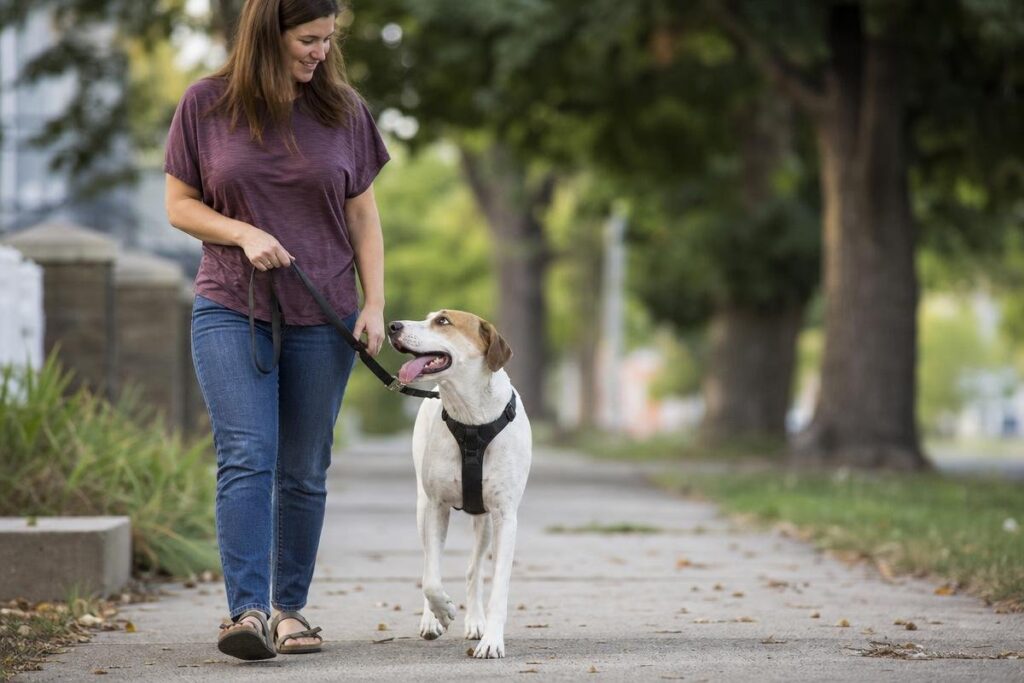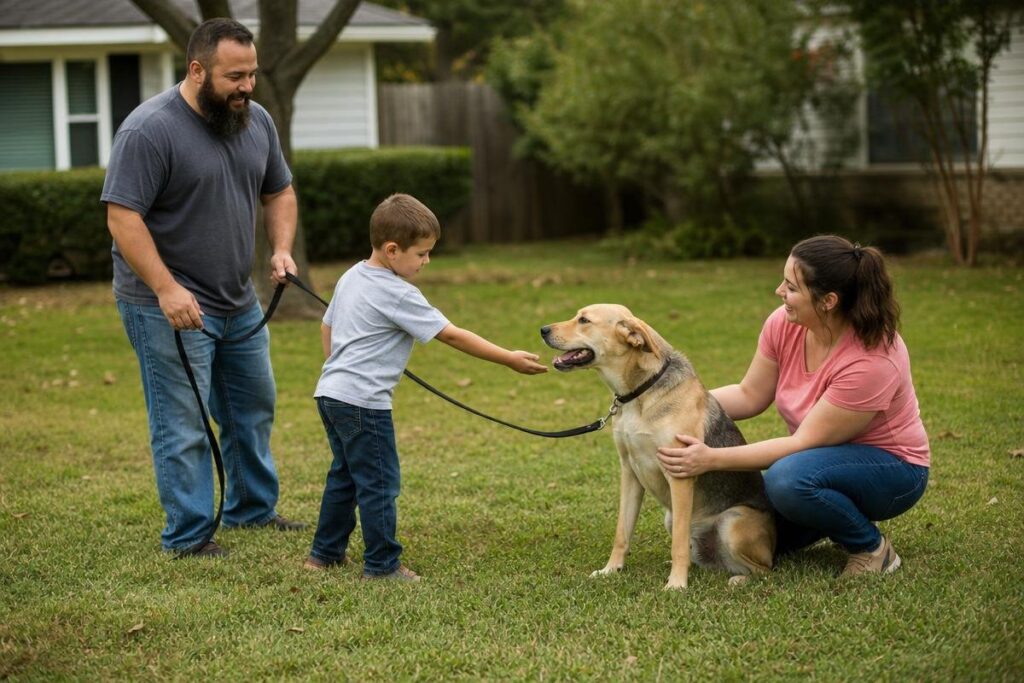

Leash reactivity in dogs is one of the most common behavioral complaints we hear from Oklahoma City owners, and one of the most misunderstood. A dog that barks, lunges, or fixates on passing dogs and joggers is not simply misbehaving; the behavior follows a predictable pattern that structured training can interrupt and correct.
At All Dogs Unleashed Dog Training OKC, we work with reactive dogs daily, applying individualized techniques that build reliable responses in real-world environments, backed by guaranteed results and lifetime support. Ready to take back your walks? Our team can help your dog respond reliably, even in high-traffic areas.
Key Takeaways
- Leash reactivity in dogs is a trainable behavior pattern, not a permanent personality trait.
- Threshold management is the foundational skill every reactive dog owner must learn before anything else.
- High-traffic OKC locations like the Lake Hefner Loop require specific distance and desensitization strategies to be safe training environments.
- Consistent, structured daily routines reduce a reactive dog’s baseline arousal and accelerate training progress.
- Professional guidance can help owners apply a more consistent plan when self-directed management is not enough.
What Is Leash Reactivity in Dogs, and Why Does It Happen?
On-leash reactive behavior is an overreaction to specific environmental stimuli while your dog is on leash. The cause is typically barrier frustration, fear, or prior negative associations, not true aggression. Your dog perceives the leash as a constraint that prevents normal social or escape responses, and the resulting tension escalates into lunging, barking, or growling directed at the trigger.
The Difference Between Reactivity and Aggression
Reactivity and aggression are not the same behavioral pattern, and the distinction matters for how training is structured. A dog lunging on leash toward another dog, then greeting that same dog calmly off leash, is the diagnostic tell for barrier frustration rather than predatory or dominance-driven aggression. Fear-based reactivity in dogs follows a similar pattern: the behavior is a distance-increasing response, not an attack sequence.
Our dog training programs in Oklahoma City address both presentations, but the protocols differ, and accurate identification determines which approach applies to your dog.
Common Triggers Oklahoma City Dogs Encounter
Oklahoma City’s most-used walking environments concentrate multiple triggers in tight corridors with limited room to create distance. The Lake Hefner Loop carries consistent cyclist, jogger, and off-leash dog traffic across its nine miles of paved trail. Scissortail Park’s narrow paths and dense pedestrian flow reduce a handler’s ability to manage sub-threshold distance.
Skateboarders near the Plaza District, delivery trucks, lawn equipment, and children on bikes round out the most common trigger categories our team sees in this area. Oklahoma City has an active shelter and rescue community, and some adopted dogs may need help with fear-based reactivity.
Fix 1: Establish a Threshold-Based Management Protocol Before Any Training Begins
Every effective behavior modification plan for leash reactivity in dogs starts in the same place: identifying and respecting your dog’s reaction threshold. Attempting counterconditioning or desensitization while your dog is already over threshold is not just ineffective, it actively reinforces the reactive pattern. Elevated cortisol and arousal block learning entirely, so the environment must be controlled before any training technique can take hold.
How to Identify Your Dog’s Reaction Threshold
Your dog’s threshold is the distance at which the first pre-reactive signals appear, before the barking or dog lunging on leash begins. Walk toward a known trigger and watch for ears rotating forward, body stiffening, a hard stare, or a sudden slowing of gait. The moment you observe any of these signals, stop. That distance is your current working boundary, and all training must begin below it, not at it.
Most owners make the mistake of closing distance, assuming their dog needs repeated exposure to “get used to it.” This approach typically worsens reactivity over time. Sub-threshold distance is where the nervous system remains calm enough for learning to occur.
Why Distance Is the Most Underused Tool in Reactive Dog Management
Increasing distance from a trigger reduces arousal immediately and creates the physiological state where behavior change is possible. Cross the street, turn down a side street, or execute a U-turn before your dog locks onto the trigger. In narrow environments like the Bricktown Canal walk, where creating distance is structurally limited, threshold identification becomes even more critical because you have fewer options once a trigger appears.
One practical adjustment for these confined corridors is timing: walking on weekday mornings before the canal fills with foot traffic gives you the working room that midday and evening crowds erase. Knowing your dog’s threshold in advance allows you to make proactive decisions rather than reactive ones. Owners managing multiple co-occurring behavior problems alongside leash reactivity may benefit from dog training programs at All Dogs Unleashed that address the full behavioral picture from the start.
All Dogs Unleashed serves Oklahoma City and surrounding communities including Edmond, Yukon, and Moore. Our trainers use individualized protocols rather than one-size-fits-all obedience. To speak with a trainer directly, call (405) 299-3386.
Fix 2: Build a Reliable Attention Cue That Interrupts the Trigger-Reaction Chain
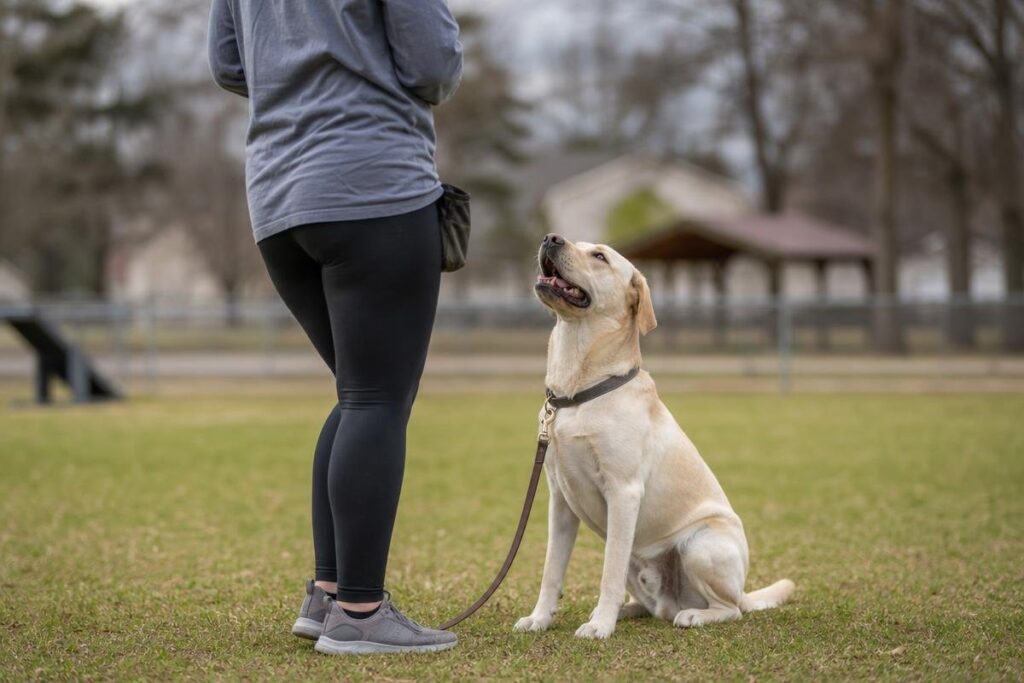
 A reactive episode requires your dog to orient toward the trigger. If you can redirect your dog’s gaze to you before that orientation locks in, you interrupt the chain at its earliest link. An attention cue conditioned to a high-value reinforcer gives you that interruption point, but only if the cue is reliable before you need it near a real trigger.
Teaching the Watch Me or Name-Response Cue
Begin in the lowest-distraction environment available, typically your living room or backyard. Present a high-value treat, mark the instant your dog makes eye contact, and reward immediately. Repeat this sequence 20 to 30 times per session across multiple sessions before advancing the location.
Our in-home dog training services in Oklahoma City allow this foundational conditioning to begin in your dog’s actual environment, which is the most relevant starting point for on-leash reactive behavior. The cue must produce an automatic, consistent response indoors before it has any value outdoors near a trigger.
Proofing the Attention Cue in Progressive Distraction Environments
Proofing follows a distraction ladder, not exposure therapy. Your dog must succeed at each level before advancing. A practical sequence for reactive dog training in Oklahoma City moves from a quiet residential street to the Taft Stadium area during off-peak hours, then to the NW 23rd Street corridor during moderate foot traffic, and finally to the Lake Hefner Loop on a weekend morning when cyclists and joggers are at their heaviest.
Each environment adds a layer of competing stimuli. Your dog should respond to the attention cue reliably at each stage before the next level is introduced. Advancing too quickly produces failure, and repeated failure erodes the cue’s conditioned value.
Fix 3: Apply Systematic Desensitization and Counterconditioning to the Specific Trigger
Systematic desensitization and counterconditioning work together to change your dog’s emotional response to a trigger, not simply suppress the visible behavior. Telling your dog to sit when another dog appears is an operant countercommand. It may interrupt the lunge, but it does not alter the underlying conditioned emotional response driving the on-leash reactive behavior.
Desensitization paired with counterconditioning rewires the association at the classical conditioning level, so the trigger itself becomes a predictor of something your dog values rather than a signal for alarm.
The Mechanics of Counterconditioning for Leash Reactivity
The protocol follows a straightforward classical conditioning principle. The moment your dog detects the trigger, whether a cyclist on the Bricktown Canal walk or another dog on a busy park path, a high-value food reward appears. The trigger predicts the reward. Over repeated sessions, the emotional state shifts from arousal or fear-based reactivity in dogs to anticipation.
This is especially relevant for Oklahoma City’s large rescue dog population, where adopted dogs frequently arrive with established fear histories. Our training programs in Oklahoma City address this conditioned fear response directly, rather than working around it.
Setting Up a Controlled Exposure Session
Each session requires your dog to remain below threshold throughout. Use a helper with a neutral dog positioned at a fixed distance your dog can tolerate without reacting. The moment the trigger appears, deliver the high-value treat. Do not wait for your dog to react first. Keep sessions to five to ten minutes maximum. Fatigue accelerates reactivity, and OKC’s summer heat compounds that risk significantly. Measurable improvement in dog lunging on leash typically requires consistency across multiple sessions.
Our board-and-train program in Oklahoma City provides the controlled repetition this protocol demands when self-directed sessions plateau. Not sure which trigger to work on first? Book a reactivity assessment and we’ll map your dog’s specific threshold and trigger list.
Fix 4: Introduce Structured Leash Pressure and Directional Control
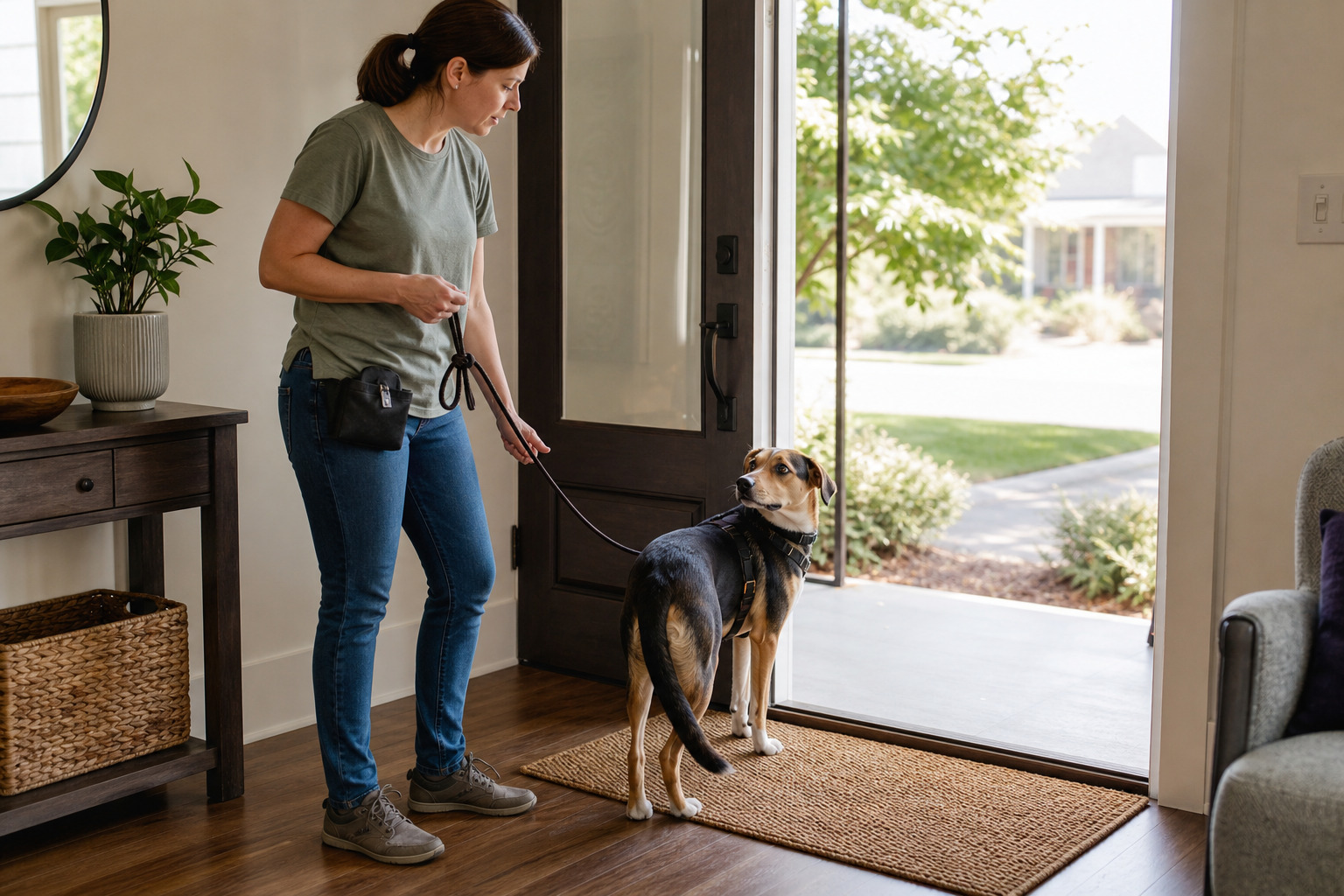
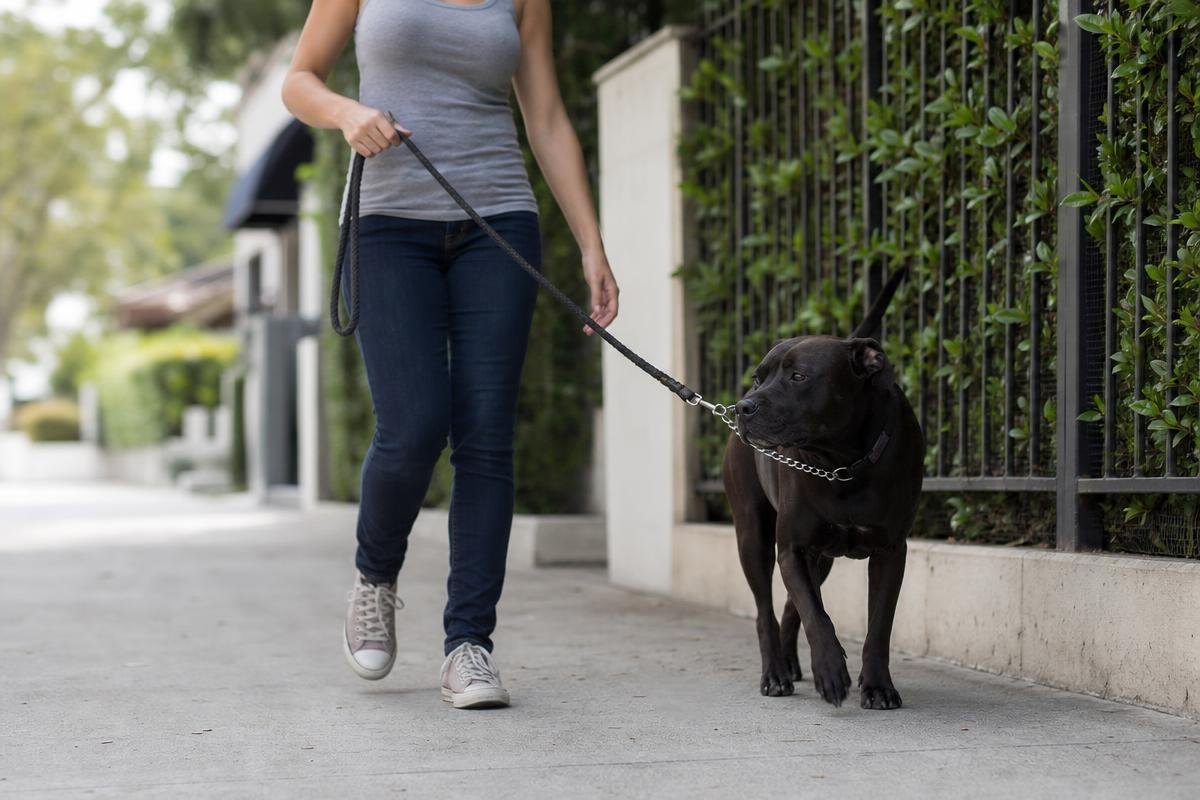
Many reactive dogs have never learned that the leash carries directional information. If the leash is tight from the moment your dog leaves the front door, it receives no meaningful signal until it is already barking and lunging. Establishing leash pressure as a clear, consistent directional cue gives you a tool to redirect your dog before the threshold is crossed, which is the only moment redirection is effective.
Why Loose-Leash Foundation Work Reduces Reactive Episodes
A dog that is constantly pulling is already in an elevated arousal state before any trigger appears. That elevated state lowers the threshold at which a reaction occurs. Loose-leash walking is not a cosmetic goal; it is a prerequisite for handler influence near specific triggers.
A dog walking on a loose leash is calmer, more attentive to directional cues, and more responsive when you need to move away from an oncoming jogger or off-leash dog on a crowded trail. Our structured training programs build this foundation before introducing any trigger-based work.
The U-Turn and Parallel Walking Techniques
The U-turn protocol is practiced first in a neutral environment without triggers present. Your dog learns that leash pressure to one side means turn and move with the handler. Once that response is reliable, you apply it proactively the moment a trigger appears at a distance, before your dog reacts. Tight urban corridors like the Plaza District’s sidewalks leave little room for distance management, so a fast, practiced U-turn becomes a critical tool.
Parallel walking is not casual socialization. It involves walking in the same direction as a neutral dog at a controlled distance, removing the head-on confrontation dynamic that triggers most reactive responses. It is a structured exposure tool. Our board-and-train program in Oklahoma City accelerates both skills because your dog practices leash-pressure responses daily across varied real-world environments.
Ready to give your dog reliable directional control on leash? Call our team at (405) 299-3386 to discuss the right training format for your dog.
Fix 5: Implement a Consistent Structured Routine That Reduces Baseline Arousal
How Predictable Daily Routines Lower a Reactive Dog’s Stress Baseline
Your dog’s daily routine directly affects how reactive it is on walks. Dogs with chronically elevated baseline arousal reach their reactive threshold faster and with less provocation. A structured environment, meaning consistent wake times, feeding schedules, exercise windows, and rest periods, reduces the neurological vigilance your dog maintains throughout the day. When your dog can predict what happens next, its nervous system does not need to stay on alert. That lower vigilance state raises the functional threshold at which leash reactivity in dogs becomes triggered.
Clear household rules reinforce this effect. Consistent boundaries around furniture access, door thresholds, and owner behavior all signal predictability. Unpredictable owner responses, even well-intentioned ones, keep arousal elevated between walks. Our in-home dog training services in Oklahoma City address these household-level variables directly, because what happens inside the home shapes how your dog responds outside it.
Mental Enrichment as a Complement to Physical Exercise
A physically tired dog is not automatically a calm dog. Mental under-stimulation maintains elevated arousal even after adequate exercise. Food puzzles, structured training sessions, and decompression sniff walks on a long line each reduce arousal through cognitive engagement. A decompression walk is not an obedience walk. It allows your dog to sniff freely, which is neurologically calming, rather than requiring the focused attention a structured walk demands. These serve different purposes and should not replace each other.
During the OKC metro’s summer months, when temperatures regularly exceed 95°F and outdoor windows shrink, indoor enrichment protocols become the primary tool for managing fear-based reactivity in dogs. Our dog training programs include guidance on building these indoor routines so progress does not stall between sessions.
Fix 6: Work with a Professional Trainer When Self-Directed Fixes Plateau
These approaches can help with mild-to-moderate leash reactivity when applied consistently. Some behavioral presentations require professional assessment from the start.
Signs That Leash Reactivity Requires Professional Behavior Modification
Specific escalation signals indicate that self-directed management has reached its limit. These include a dog that redirects onto the handler during a reactive episode, a threshold that has decreased over time rather than improved, reactivity that appears in multiple contexts beyond on-leash walks, and any history of contact biting.
If your dog has reacted toward family members or you cannot maintain sub-threshold exposure due to unpredictable trigger environments, professional assessment is the appropriate next step. Dogs with fear-based reactivity, which is especially common among adopted companions in the OKC metro, often require individualized techniques through in-home dog training that address the underlying anxiety driving the behavior, not only the surface response.
What to Expect From a Structured Reactive Dog Training Program in Oklahoma City
Our team provides in-home dog training services and a board-and-train program for reactive dogs in Oklahoma City. Both deliver individualized attention, structured daily routines, and progressive skill-building calibrated to your dog’s specific triggers and threshold. Our programs are backed by guaranteed results and lifetime support. Reach our team at (405) 299-3386 to schedule an assessment, and we’ll build the plan around your dog’s triggers.
Why Leash Reactivity Is Especially Common Among Oklahoma City Dogs
Several factors in the OKC metro can make leash reactivity harder for owners to manage. The trail infrastructure, rescue intake volume, and breed demographics here each compound the problem in distinct ways.
High-Traffic Walking Environments in OKC That Amplify Trigger Exposure
The Hefner Loop’s nine miles of paved trail draw cyclists, joggers, and off-leash dogs in high concentrations, placing reactive dogs within threshold distance of multiple triggers before a handler can redirect. Downtown’s canal and park corridors present a different challenge: their narrow layouts remove the distance-management options that Fix 1 depends on entirely.
Residential sidewalks in Edmond and Yukon carry similarly dense foot traffic, with high dog-ownership rates and frequent unannounced encounters at close range. These environments do not give reactive dogs the controlled exposure they need; they deliver unpredictable, high-intensity trigger sequences that reinforce reactive patterns instead of resolving them.
Breed Prevalence and Rescue Adoption Patterns in the Oklahoma City Area
Oklahoma has an active shelter and rescue community. Rescue dogs frequently arrive with unknown socialization histories, and fear-based reactivity in dogs with incomplete early exposure is a predictable outcome. Our in-home dog training services in Oklahoma City regularly address this presentation in newly adopted dogs whose triggers were never identified before placement.
Beyond rescue populations, German Shepherds and Dobermans appear frequently in OKC households, and both breeds carry elevated arousal baselines that make reactive responses more pronounced without structured intervention. Our board-and-train program is structured to address the intensity these breeds bring to reactive behavior patterns.
Frequently Asked Questions
Can leash reactivity be fully resolved?
Many dogs achieve reliable, calm leash behavior with consistent training. The ceiling depends on severity, history, and owner consistency. Dogs with deep-seated fear-based reactivity, including many rescue dogs drawn from the metro’s high-intake shelter population, may reach a managed rather than fully neutral state. That outcome is still functional, safe, and a genuine improvement in quality of life.
How long does it take to see improvement in a reactive dog?
Progress varies with the dog’s history, severity, environment, and owner consistency. A board-and-train program provides daily professional practice rather than periodic sessions.
Is leash reactivity more common in certain breeds?
Some herding, working, and terrier breeds can be more prone to high arousal or environmental sensitivity. Heightened environmental sensitivity and arousal drive that pattern. Any breed can develop reactivity given genetics, socialization gaps, or a difficult environmental history.
Should I use a prong collar, head halter, or harness for a reactive dog?
Equipment selection depends on your dog’s size, reactivity severity, and your handling ability. A head halter reduces pulling force but requires conditioning to prevent neck strain. A front-clip harness reduces forward momentum without that risk. No piece of equipment replaces training. Each tool is a management aid, not a solution.
Can a board-and-train program address leash reactivity?
Board-and-train is well-suited for leash reactivity because your dog receives daily structured exposure and skill-building across varied environments under consistent professional guidance. Our board-and-train program in Oklahoma City includes guaranteed results and lifetime support.
When should I consult a veterinarian about my dog’s reactivity?
Veterinary consultation is warranted when reactivity appears suddenly in a previously calm dog, since pain or illness can present as behavioral change. Generalized anxiety outside leash contexts and any reactivity that has escalated toward handler-directed aggression also require a veterinary assessment. A veterinary behaviorist may recommend pharmacological support alongside behavior modification for severe cases.
Ready to Get Started with All Dogs Unleashed Dog Training OKC?
Call (405) 299-3386 to speak with our team directly. We’re ready to answer your questions, walk you through your options, and help you find the right solution for your needs. Whether you’re just starting to plan or ready to move forward, we’ll make the process simple and stress-free. Reach out today and let’s talk about how we can help.