
Dog aggression is one of the most serious behavioral issues Frisco owners face, and it rarely resolves without targeted intervention. At busy locations like Frisco Commons Park, reactive and aggressive dogs create dangerous situations that demand more than basic obedience training. All Dogs Unleashed Dog Training Frisco delivers structured protocols designed to address the underlying triggers of aggression, not just the surface symptoms.
Our professional trainers use structured protocols to address aggression triggers, and our programs are backed by guaranteed results and lifetime support. Aggressive behavior can become more difficult to manage without appropriate intervention. Take the first step toward a safer dog today.
Key Takeaways
- Dog aggression has identifiable underlying triggers, including fear, resource guarding, and prey drive, each requiring a different protocol.
- Knowing how to stop dog aggression starts with correctly reading your dog's warning signals before a bite occurs.
- Systematic desensitization and counter-conditioning are commonly used techniques for addressing aggressive responses over time.
- Frisco's high-traffic parks and dense residential neighborhoods create frequent trigger exposure that untrained dogs cannot manage safely.
- Professional guidance can help owners apply structured training safely in real-world environments.
Dog aggression is not a personality trait. It is a behavioral symptom with real legal and safety consequences for owners in the Dallas-Fort Worth area. An aggressive dog can expose you to bite liability, restrict your access to public spaces like Frisco Commons Park, and create daily safety risks for your family, neighbors, and other animals.
This article outlines 10 systematic approaches that focus on potential triggers, not only surface symptoms. If you are still determining whether your dog's behavior qualifies as aggression, start by reviewing the warning signals covered on our Frisco dog training overview before applying any structured protocol. For owners who need professional intervention, All Dogs Unleashed Dog Training Frisco is located at 6136 Frisco Square Blvd, #400, Frisco, TX 75034, and offers targeted programs for aggression cases.
What Causes Dog Aggression? Understanding the Root Triggers
The most common and costly owner mistake is treating aggression as a fixed character flaw, which typically leads to the wrong intervention and reinforces the behavior rather than resolving it. Accurate dog aggression rehabilitation begins with identifying the specific trigger driving the response, then classifying it correctly before any protocol is chosen.
Fear and Anxiety-Based Aggression
Fear aggression occurs when a dog perceives a threat it cannot escape, triggering a fight-or-flight cascade that resolves into a forward, intense display. This pattern is routinely misread as dominance because the dog does not retreat. Trigger stacking, where multiple low-level stressors accumulate within a short window, pushes the dog past its threshold before the owner recognizes any warning signs.
Fear aggression in dogs requires systematic desensitization below the dog's threshold, not correction at the moment of reaction. Correcting above threshold deepens the association between the stimulus and a negative outcome.
Resource Guarding and Territorial Behavior
Resource guarding and territorial aggression are distinct behavioral patterns that require separate desensitization protocols. Resource guarding covers food, toys, resting spaces, and access to specific humans. Territorial aggression targets property perimeters, vehicles, and crates, and is driven by a different motivational system than guarding a food bowl.
Applying a territorial protocol to a resource-guarding dog, or the reverse, produces no measurable improvement and can escalate the behavior. Correct classification is the first step in any targeted intervention.
Prey Drive and Dog-on-Dog Aggression
High prey drive can contribute to unsafe behavior around other dogs or moving stimuli in high-stimulus environments. Multi-use corridors such as the Star District place reactive dogs in close proximity to cyclists, strollers, and off-leash dogs, elevating arousal baselines before any direct encounter occurs. Dog-on-dog aggression training addresses the arousal state, not just the moment of contact.
Owners who regularly use high-traffic public parks should read our guidance on managing reactive dogs in those environments before the next outing.
Pain-Induced and Redirected Aggression
Undiagnosed orthopedic, dental, or neurological pain can produce sudden aggression with no identifiable behavioral trigger. Redirected aggression occurs when the dog cannot reach the original stimulus and bites the nearest available target, which is frequently the handler. When aggression onset is sudden and unprovoked, a veterinary evaluation should precede any training protocol.
Our board and train services in Frisco include an intake assessment that screens for redirected and pain-induced aggression patterns before any training plan is assigned. Not sure which trigger is driving your dog's behavior? Our trainers can pinpoint it during a hands-on evaluation.
How to Stop Dog Aggression: 10 Systematic Solutions
To stop dog aggression, identify the specific trigger type, build foundational obedience, then apply desensitization and counter-conditioning in sequence. Stopping aggression requires this sequenced approach, not a single technique applied in isolation. The following ten solutions represent the protocols our trainers apply to aggression cases throughout Frisco and the surrounding communities. Work through them in order. Each step builds the foundation the next one requires.
1. Document Triggers with a Behavioral ABC Log
Owners cannot address what they have not accurately identified. The ABC log records the Antecedent (what occurred immediately before the aggressive response), the Behavior itself, and the Consequence that followed. Three to five documented incidents reveal the specific trigger pattern driving your dog's aggression and allow for targeted intervention rather than guesswork.
2. Build Foundational Obedience First
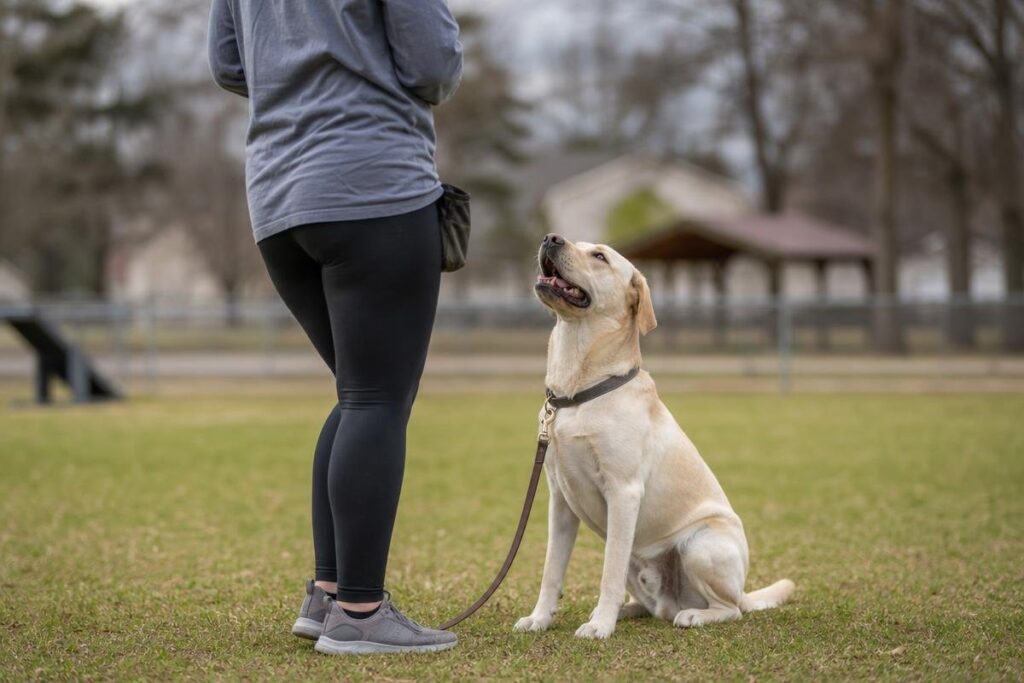
A dog without reliable sit, down, stay, and recall cannot be effectively counter-conditioned. Foundational obedience creates the communication channel required for all subsequent training work. Without it, the owner has no mechanism to interrupt the arousal cycle before it escalates.
3. Apply Desensitization and Counter-Conditioning Simultaneously
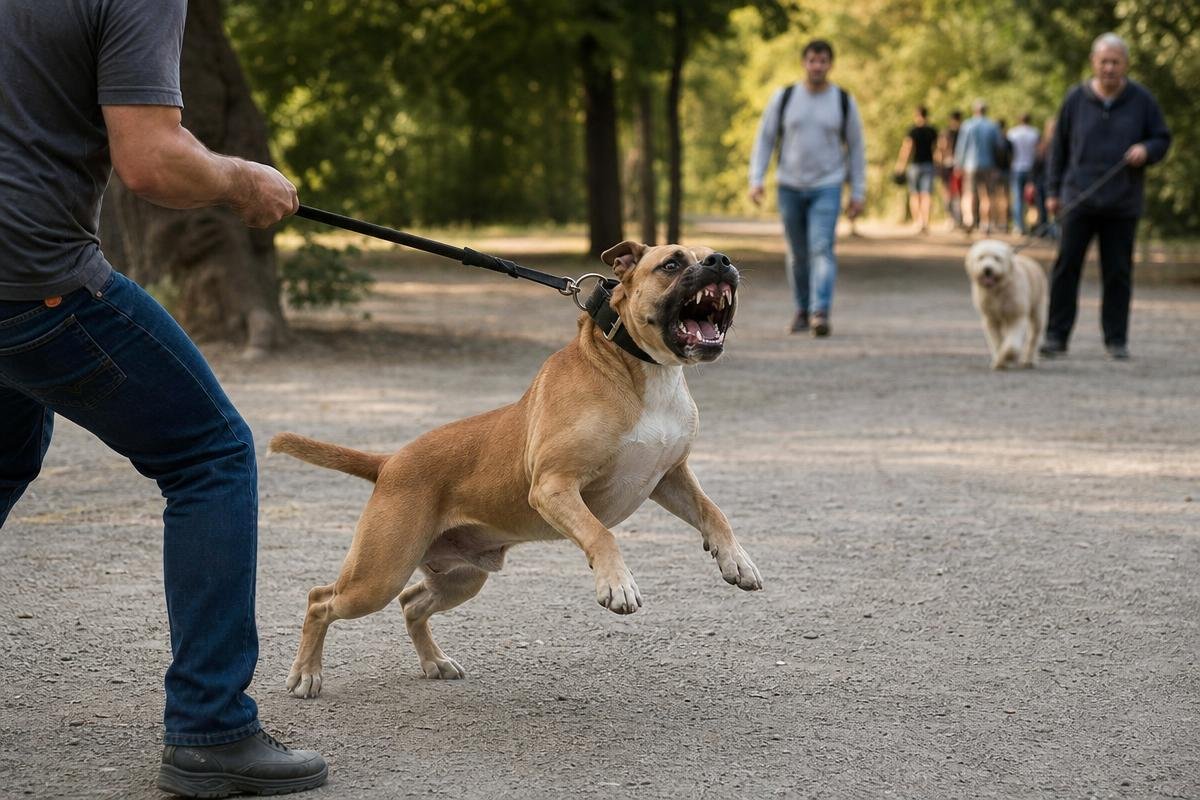
Desensitization means exposing your dog to the trigger at a sub-threshold intensity, progressively increasing exposure as the dog demonstrates neutral responses. Counter-conditioning pairs each trigger exposure with a high-value reinforcer to shift the emotional association from threat to neutral or positive. Both protocols must run at the same time. Running one without the other produces incomplete results.
4. Train at and Below Threshold
Threshold is the distance or stimulus intensity at which your dog first notices the trigger without reacting. All productive training occurs at or just below that point. High-traffic environments like Frisco Commons Park routinely push dogs past threshold before training can occur, which is why controlled setups are necessary before moving to real-world exposure.
5. Use Structured Leash Control Techniques
Leash tension transmits the handler's anxiety directly to the dog and escalates reactivity. Directional control commands and position changes interrupt the arousal cycle before the aggressive display occurs. Structured leash work addresses the pre-aggression window, which is where behavior change is actually possible.
6. Implement the Resource Guarding Trade-Up Protocol
Resource guarding escalates when owners attempt to remove items by force. The trade-up protocol presents a lower-value item, asks for a drop, then immediately delivers a higher-value reinforcer. This rewires the guarding response by associating human approach with gain rather than loss. Punishment during resource guarding modification reliably worsens the behavior.
7. Build Confidence Through Structured Engagement
Fear-based aggression decreases as the dog's capacity to tolerate environmental pressure increases. The place command, controlled heel work, and structured problem-solving exercises build that capacity systematically. Dogs in newer residential developments like Edgewood, where construction noise and new-neighbor dog introductions are frequent, benefit significantly from this work.
8. Eliminate Inadvertent Reinforcement
Pulling the dog away, speaking in a soothing tone, or removing the trigger after an aggressive display teaches the dog that aggression produces results. Owners must learn to read and respond to pre-aggression signals, not the aggressive behavior itself. Responding to the display reinforces it.
9. Use Management Tools Correctly During Active Training
Basket muzzles, head halters, and management gates prevent rehearsal of the aggressive behavior while training is in progress. These tools do not modify the underlying behavior. They protect people and other dogs during the period when the structured protocol is being established.
10. Enroll in a Professional Behavior Rehab Program
Self-directed training reaches its limit with moderate to severe dog aggression cases. When the behavior involves contact, escalating intensity, or multiple triggers, professional intervention is the appropriate next step. Our board and train services in Frisco place your dog in a structured, distraction-controlled environment for accelerated behavior rehab. For dogs better addressed in their home environment, our in-home dog training services in Frisco bring the same systematic protocols directly to the contexts where the aggression occurs. Both programs are backed by guaranteed results and lifetime support.
Ready to move from managing the behavior to resolving it? Our board and train and in-home programs are built for aggression cases.
How to Stop Dog Aggression Towards Humans Specifically
Human-directed aggression carries a higher legal and physical risk than dog-on-dog aggression. A bite incident involving a person can result in liability claims, mandatory quarantine, and in severe cases, euthanasia orders. Prompt professional evaluation is important.
Stranger-Directed Aggression
Stranger-directed aggression typically develops when a dog receives insufficient socialization during the critical 3-to-14-week developmental window. Fear aggression in dogs toward unfamiliar people is one of the most common presentations our trainers assess. The protocol begins with controlled introductions at sub-threshold distance: the stranger ignores the dog entirely, and the dog is permitted to initiate any approach on its own terms.
Our in-home dog training services apply this desensitization sequence in the exact environment where the behavior occurs most frequently.
Handler-Directed Aggression
Dogs that growl or snap during grooming, nail trimming, or restraint are not displaying dominance. This response is typically a conditioned avoidance behavior, often rooted in pain or prior aversive handling experiences. The counter-conditioning program begins with non-aversive touch at low-pressure points, then progressively increases duration and physical contact as the dog's tolerance builds. Misreading this behavior as a dominance challenge and applying force-based corrections will accelerate the aggression rather than reduce it.
Child-Directed Aggression
Child-directed aggression is a high-risk scenario that requires professional assessment before any in-home protocol begins. Children move unpredictably, produce high-pitched vocalizations, and approach dogs in ways that activate fear or prey responses. Immediate physical separation and management barriers are required the moment this behavior is identified.
Our board and train services provide a controlled environment where aggressive dog training in Frisco, TX can be conducted safely, away from the household's children, until reliable behavioral thresholds are established. Do not attempt to manage child-directed aggression through informal correction alone.
How to Deal with Dog-On-Dog Aggression
Dog-on-dog aggression is frequently misclassified, and the wrong classification leads directly to the wrong protocol. Before any training plan is designed, the distinction between reactivity and true aggression must be established.
On-Leash Reactivity vs. True Dog Aggression
On-leash reactivity is barrier frustration combined with arousal, not aggression. A dog that lunges and barks at other dogs on leash may be perfectly social in an off-leash setting. Behavior that creates a credible risk of harm requires prompt professional assessment, and that distinction determines the next training decision.
Our team systematically evaluates each dog's behavior across multiple contexts before assigning a protocol. Misreading reactivity as aggression often results in suppression-based corrections that increase underlying tension rather than resolve it.
Multi-Dog Household Conflicts
Dogs that previously coexisted without conflict sometimes begin fighting as one or both dogs reach social maturity, typically between 18 months and 3 years. This pattern is common in households with multiple large-breed dogs in newer developments like Richwoods, where smaller home footprints and ongoing construction activity elevate spatial tension and arousal baselines.
Resource-based conflicts involving food proximity, owner attention, or space respond well to parallel feeding routines, structured entry and exit protocols, and individual obedience training for each dog. Our in-home dog training services address multi-dog household dynamics directly in the environment where the conflict occurs.
Controlled Introduction Protocols
Rushed introductions are the most common owner error in dog-on-dog aggression training cases. The parallel walk protocol, two dogs walked side by side at distance with gradual proximity reduction across multiple sessions, is a foundational intervention. Introductions should always occur in neutral territory, never in either dog's home space. For identifying appropriate outdoor locations for parallel walk exercises, our team recommends reviewing available resources on board and train services where structured, neutral-environment introductions are conducted under direct supervision.
If your dogs are fighting or your dog reacts aggressively toward other dogs on walks, our team can assess the root cause and apply the correct protocol. Call us at (972) 573-1715 to schedule an evaluation.
How Anxiety and Aggression Overlap in Dogs
The Anxiety-Aggression Connection
Anxiety and aggression are not separate behavioral problems. They are frequently co-occurring conditions driven by the same underlying emotional state, and treating them as independent issues produces incomplete outcomes.
A chronically anxious dog operates with a compressed threshold. It reaches the aggressive response faster and with less provocation than a calm dog, because anxiety reduces the dog's capacity to process environmental information before reacting. Fear aggression in dogs is among the most commonly misread presentations our trainers encounter, precisely because owners address the aggressive display while the anxiety driving it goes unresolved.
Training intervention for anxious dogs must address both conditions concurrently. The extended hot summers across the Collin County area compound this problem directly. Compressed outdoor exercise windows leave dogs under-exercised with elevated arousal baselines, which lowers aggression thresholds further in dogs already predisposed to anxiety. Our board and train services are structured to address both arousal regulation and anxiety-driven reactivity within the same protocol.
Recognizing Anxiety-Driven Aggression Before It Escalates
Intervention at the pre-aggression signal stage is exponentially more effective than intervention after an aggressive display. Owners consistently miss early warning signals: lip licking out of context, displacement yawning, whale eye (visible white sclera), stiff body posture, low tail carriage, and piloerection along the dorsal line.
These signals appear before any growl or snap. Reading them accurately allows for targeted intervention before the dog crosses its threshold. Our in-home dog training services systematically train owners to identify and respond to these pre-aggression indicators within the dog's actual environment, where the triggers occur.
Aggression Training in Frisco: Why Local Conditions Matter
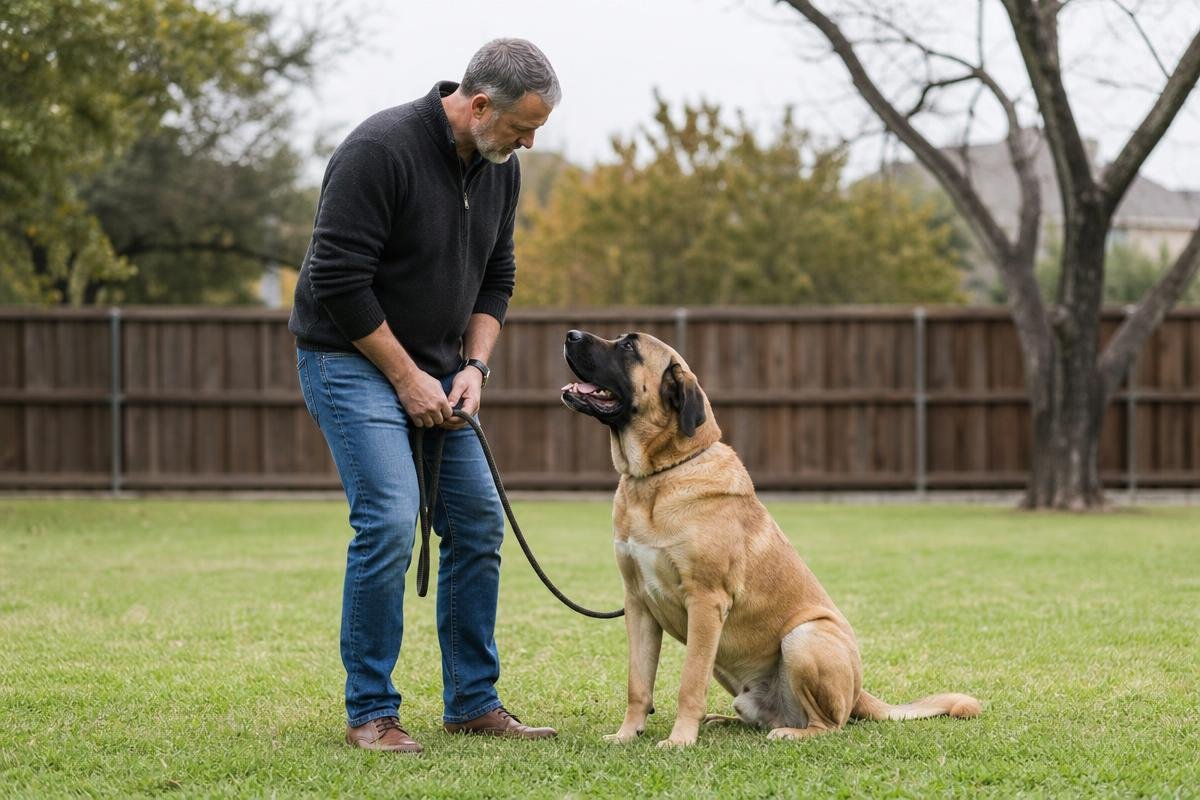
This city presents a specific set of environmental conditions that compound aggression risk in ways a generic online program cannot account for. The Star District and surrounding pedestrian corridors expose dogs to cyclists, strollers, and off-leash dogs at close range and without warning. In newer developments like Edgewood, ongoing construction noise and a steady rotation of unfamiliar dogs moving into adjacent properties create near-constant trigger exposure for dogs with unmanaged reactivity.
High-Stimulus Environments in Frisco
The city's extended hot summers compress outdoor exercise windows significantly. Dogs that cannot complete adequate daily exercise accumulate elevated arousal baselines, and elevated arousal directly lowers the threshold at which aggression is triggered. A dog that manages adequately in October may become dangerously reactive by July under the same training plan, if exercise deficits are not factored into the program.
How Our Team Addresses Aggression in Frisco Dogs
Our trainers design protocols around the specific trigger environments your dog encounters locally, not generalized scenarios.
For dogs with serious aggression histories, our board and train programs provide controlled, distraction-proofed immersion, while in-home training sessions address aggression within the environment where it most often occurs. All Dogs Unleashed Dog Training Frisco is located at 6136 Frisco Square Blvd, #400, Frisco, TX 75034.
Frequently Asked Questions
Can dog aggression be permanently stopped through training?
Most dogs with aggression achieve significant, lasting behavioral improvement through systematic modification. Prognosis depends on the root cause, the dog's history, and the owner's consistency in applying protocols after training ends. Our programs include lifetime support, which means behavioral gains do not erode because you have access to guidance whenever new challenges arise.
How long does behavioral modification for aggression take?
Mild reactivity can show measurable improvement within 4 to 8 weeks of consistent training. Moderate to severe cases with long reinforcement histories typically require 3 to 6 months. Intensive, distraction-controlled environments accelerate the initial phase considerably compared to once-weekly sessions.
Is board and train effective for aggressive dogs?
Board and train is highly effective for aggression cases because it removes your dog from the environment where the behavior has been rehearsed and reinforced. Our board and train program addresses behavioral patterns systematically in a controlled setting. The owner training session at program completion is critical; without it, behavioral gains do not transfer reliably to the home environment.
What is the difference between aggression and reactivity in dogs?
Reactivity is an exaggerated emotional response, including lunging, barking, and spinning, without intent to harm. Aggression involves intent to harm: hard staring, stiff posture, a low growl, or a bite. Misclassifying one as the other leads to the wrong protocol and slower outcomes.
Should I use punishment to stop my dog's aggressive behavior?
Punishment during an aggressive display suppresses visible warning signals without addressing the underlying emotional state. It can increase anxiety and make risk assessment more difficult. This outcome is more dangerous, not less.
At what point should I contact a professional dog trainer for aggression?
Professional intervention is warranted at the first bite that breaks skin, any aggression directed at a child, escalating frequency or intensity, or when you cannot identify the trigger. Early intervention produces faster and more complete outcomes in aggressive dog training cases. Aggression does not improve with time or patience alone. If your dog has bitten, is escalating, or you cannot identify what triggers the behavior, contact our team through our in-home dog training services or call (972) 573-1715.
You can also visit All Dogs Unleashed Dog Training Frisco at 6136 Frisco Square Blvd, #400, Frisco, TX 75034. Our board and train and in-home programs are built for exactly these cases, backed by guaranteed results and lifetime support.
Ready to Get Started with All Dogs Unleashed Dog Training Frisco?
Call (972) 573-1715 to speak with our team directly. We're ready to answer your questions, walk you through your options, and help you find the right solution for your needs. Whether you're just starting to plan or ready to move forward, we'll make the process simple and stress-free. Reach out today and let's talk about how we can help.