
The first 16 weeks of a puppy’s life set the foundation for everything that follows. The habits, skills, and associations your puppy builds during this window shape the kind of adult dog it becomes. Miss it, and you spend months or years correcting problems that didn’t have to develop. Hit it right, and you raise a dog that’s confident, responsive, and genuinely enjoyable to live with.
Des Moines puppy owners have a real advantage here. The city’s trail systems, farmers’ markets, pet-friendly patios, and neighborhood variety give you no shortage of environments to expose your puppy to new experiences. The key is knowing what to focus on and when. Here’s a week-by-week puppy training schedule built around the seven milestones that matter most.
Key Takeaways
- Puppy training starts the day you bring your puppy home, not after a vaccination series is complete
- Name recognition and voluntary eye contact are the foundation for every cue and command that follows
- House-training is a management problem first and a training problem second; the crate is the most effective tool you have
- Bite inhibition must be taught during the mouthing phase because the window for learning pressure control closes early
- The socialization window (8 to 14 weeks) is the most time-sensitive milestone on this list; positive exposure during this period shapes your puppy’s lifelong comfort with the world
- Basic commands and leash skills build on each other and should be introduced gradually, not crammed into a single week
Milestone 1: Name Recognition and Attention (Weeks 8–9)
Before your puppy can learn anything else, it needs to learn one thing: that its name means “look at me.” Name recognition is the gateway skill for every command, every recall, and every redirection you’ll ever need.
The exercise is simple. Say your puppy’s name once in a clear, upbeat tone. The moment the puppy looks at you, mark it with a “yes” and deliver a small treat. Repeat this throughout the day in short bursts of five to ten repetitions. Practice in the kitchen, the living room, the backyard, and on the front porch. Each new environment reinforces that the name means the same thing everywhere.
What you’re actually building here is voluntary attention. A puppy that hears its name and automatically checks in with its owner has the foundation for sit, come, stay, and every other skill on this list. A puppy that hears its name and ignores it will struggle with every training milestone that follows.
Common mistakes at this stage include repeating the name multiple times before the puppy responds (which teaches the puppy to ignore the first three repetitions), using the name in a negative context (which creates a negative association), and expecting attention in distracting environments before the skill is solid at home.
Milestone 2: House-Training Routine (Weeks 8–10)
House-training is less about training and more about management. Puppies between 8 and 10 weeks old have very small bladders and very little control. They need to go outside after every meal, every nap, every play session, and roughly every 30 to 45 minutes during active waking hours. The goal isn’t to teach the puppy to hold it. The goal is to create so many opportunities to eliminate outside that the puppy develops a strong preference for it.
A reliable house-training schedule looks like this:
- First thing in the morning: Straight outside, no detours
- After every meal: Within five minutes of finishing food
- After every nap: Puppies often need to go the moment they wake up
- After every play session: Physical activity stimulates the bladder and bowels
- Every 30–45 minutes during active time: Set a timer if you need to
- Last thing before bed: Final trip outside before crate time
When your puppy eliminates outside, mark it immediately (“yes”) and reward with a treat. When accidents happen inside, and they will, clean them up with an enzymatic cleaner and adjust your supervision. Punishment after the fact does nothing. The puppy cannot connect a correction to an accident that happened five minutes ago.
The crate is your most valuable house-training tool because most puppies naturally avoid soiling their sleeping space. Our guide on crate training walks through how to build a positive crate association that supports house-training, sleep, and settling.
Milestone 3: Crate Comfort (Weeks 8–11)
A puppy that’s comfortable in a crate has a safe space to rest, a reliable house-training tool, and a skill that transfers directly to boarding, travel, and veterinary visits for the rest of its life. Crate training isn’t confinement. It’s giving your puppy a structured space that it chooses to relax in.
The conditioning process follows a clear progression:
- Days 1–3: Feed meals inside the crate with the door open. Toss treats inside and let the puppy enter and exit freely.
- Days 4–7: Begin closing the door for short periods (30 seconds to 2 minutes) while the puppy eats or chews a Kong. Open the door before the puppy shows any distress.
- Week 2: Gradually increase closed-door time to 10, then 20, then 30 minutes. Stay in the room initially, then begin stepping out briefly.
- Week 3: Build toward full nap-length crate sessions (1 to 2 hours) and overnight sleeping in the crate.
Expect some vocalization during the first few nights. A puppy whining in the crate at 2 a.m. is usually communicating a need to eliminate, not a protest. Take the puppy out for a quiet, boring bathroom trip and return it to the crate without fanfare. Our post on managing a puppy sleep schedule covers the overnight logistics in more detail.
Milestone 4: Bite Inhibition (Weeks 9–13)
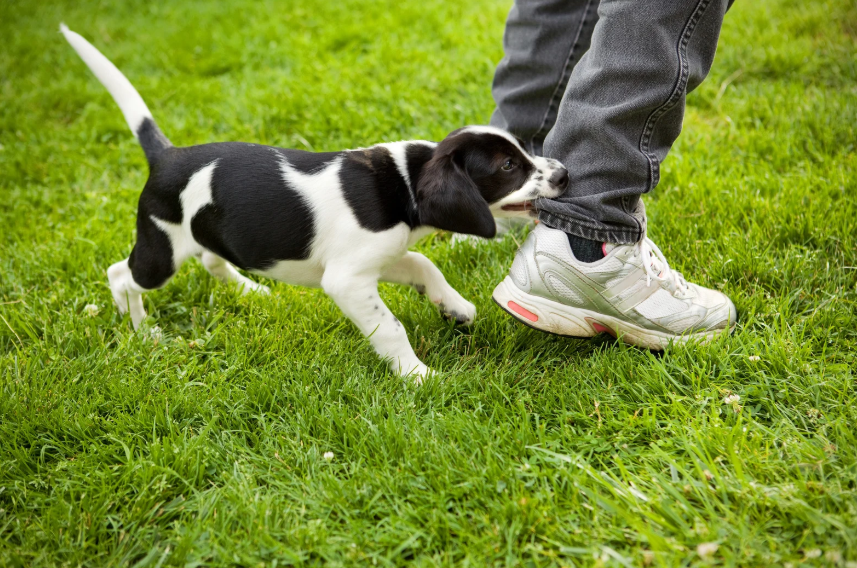
Every puppy mouths. It’s how they explore, play, and learn about the world. But there’s a critical difference between a puppy that mouths gently and one that bites down hard, and the window for teaching that distinction starts closing around 14 to 16 weeks.
Bite inhibition is the ability to control jaw pressure. Puppies learn it naturally from littermates: when one bites too hard during play, the other yelps and stops playing. You replicate this process at home. When your puppy’s teeth make contact with skin, all interaction stops immediately. No yelping (which can excite some puppies), no pushing the puppy away (which becomes a game), no scolding. Just a calm withdrawal of all attention for 10 to 15 seconds. Then resume play. The puppy learns that gentle mouths keep the game going and hard mouths end it.
The reason this milestone has a deadline is developmental. Puppies that don’t learn pressure control during the mouthing phase grow into adult dogs with hard mouths, and an adult dog that doesn’t know how to moderate its bite force is a liability in any interaction. For a broader look at mouthing behavior alongside jumping, our post on nipping and jumping covers both patterns and the training approach for each.
Redirect your puppy’s chewing to appropriate items, like frozen Kongs, rubber toys, and braided rope, so it always has an approved outlet for the urge to bite and chew.
Milestone 5: Socialization Exposure (Weeks 8–14)
Socialization is the most time-sensitive milestone on this list. The window between 8 and 14 weeks is when your puppy’s brain is wired to absorb new experiences and file them as normal. What your puppy encounters during this period, and how those encounters feel, shapes its lifelong comfort with the world.
Effective socialization means positive exposure to a wide variety of:
- People: Men, women, children, people in hats, sunglasses, uniforms, people using walkers or wheelchairs, people with beards, people carrying umbrellas
- Surfaces: Grass, gravel, metal grates, tile, wood decking, wet pavement
- Sounds: Traffic, sirens, thunder, construction, doorbells, vacuums, fireworks (recordings at low volume)
- Environments: Busy sidewalks, quiet parks, parking lots, outdoor patios, pet supply stores, car rides
Des Moines gives you plenty of options. The Downtown Farmers’ Market on Saturday mornings is a controlled-chaos environment full of new people, sounds, and smells. The Riverwalk near Principal Park provides moderate foot traffic. Neighborhood walks through the East Village or Sherman Hill expose your puppy to different architectural textures, street sounds, and pedestrian patterns. Outdoor patios on Ingersoll Avenue let your puppy practice settling in a busy environment.
The key word is positive. Socialization that overwhelms or scares the puppy does more harm than no socialization at all. Watch your puppy’s body language. If it’s loose, wiggly, and approaching new things with curiosity, you’re on track. If it’s cowering, freezing, or trying to retreat, you’ve gone too far too fast. For a detailed look at the most common early training errors, our guide on puppy training what not to do covers the mistakes that undermine socialization specifically.
Milestone 6: Basic Commands: Sit, Down, Come (Weeks 10–14)
Once your puppy reliably responds to its name and offers voluntary attention, you can begin introducing formal commands. Start with sit, down, and come, which are the three skills that form the backbone of every obedience program.
Sit: Hold a treat just above your puppy’s nose and move it slowly backward over the head. As the puppy’s nose follows the treat upward, its rear naturally drops into a sit. The moment the rear touches the floor, mark with “yes” and deliver the treat. After several successful repetitions, add the verbal cue “sit” just before the lure motion.
Down: From a sit position, move a treat from the puppy’s nose straight down to the floor between its front paws, then slowly slide it forward. The puppy should fold into a down to follow the treat. Mark and reward the instant the belly touches the ground.
Come: Start in a small, enclosed space. Say your puppy’s name, show a treat, and take a few steps backward. As the puppy moves toward you, say “come” and reward the moment it arrives. Build distance gradually and always make coming to you the best decision your puppy can make.
Keep sessions short, between three and five minutes for young puppies, and end on a success. Puppies at this age have limited attention spans, and pushing past their focus threshold creates frustration for both of you. Our guide on how to teach your dog obedience commands covers the full command progression beyond these three foundational skills.
Milestone 7: Leash Introduction and Loose Leash Walking (Weeks 12–16)

Leash skills come last on this list because they build on everything before them. A puppy that responds to its name, offers attention, and knows basic commands has the tools to walk on a leash. A puppy without those foundations will pull, wander, and ignore every attempt at communication.
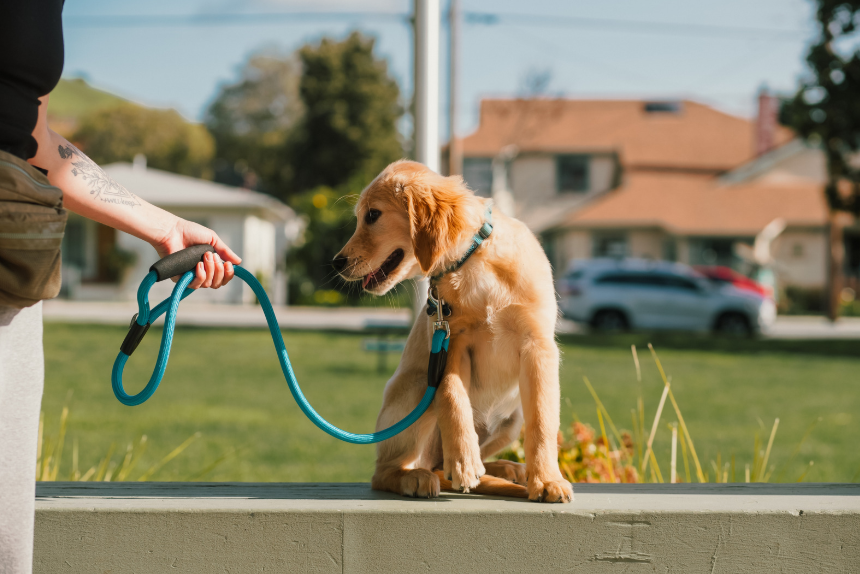
Start indoors. Let your puppy wear a flat collar and lightweight leash around the house for short periods so it gets used to the sensation without the pressure of actually going somewhere. Once the puppy is comfortable, pick up the leash and follow the puppy around. Don’t guide. Just follow. Let the puppy learn that the leash connects the two of you without restricting movement.
Next, begin introducing direction. When the puppy moves toward you, reward. When the leash goes tight because the puppy pulled ahead, stop walking. When the puppy turns back or creates slack, move forward and reward. The rule is simple: tight leash means nothing happens; loose leash means the walk continues.
Take your first outdoor walks in low-distraction environments. A quiet residential block in Beaverdale or a calm stretch of sidewalk in South of Grand gives your puppy a manageable level of stimulation. Save busier routes for after the skill is established. Our post on the basics of leash training covers the full technique and common errors owners make during this phase.
Puppy Training Schedule at a Glance
| Age | Milestone | Key Benchmark |
|---|---|---|
| Weeks 8–9 | Name recognition and attention | Puppy looks at you within 1–2 seconds of hearing its name in a quiet room |
| Weeks 8–10 | House-training routine | Puppy is eliminating outside on a consistent schedule with few indoor accidents |
| Weeks 8–11 | Crate comfort | Puppy naps and sleeps overnight in the crate without sustained distress |
| Weeks 9–13 | Bite inhibition | Puppy mouths gently during play and stops biting when attention is withdrawn |
| Weeks 8–14 | Socialization exposure | Puppy has had positive encounters with a wide variety of people, surfaces, sounds, and environments |
| Weeks 10–14 | Basic commands (sit, down, come) | Puppy responds to sit, down, and come in low-distraction settings with treat motivation |
| Weeks 12–16 | Leash introduction and loose leash walking | Puppy walks on a loose leash for short stretches in a quiet neighborhood |
What Happens If You Miss a Milestone
Life gets busy. Puppies get sick. Schedules fall apart. If you’re reading this and your puppy is already past 16 weeks without hitting every milestone on this list, don’t panic. These milestones represent the ideal timeline, but dogs are adaptable and skills can be built at any age.
The most time-sensitive milestone is socialization. The 8 to 14 week window is genuinely critical, and puppies that miss it face a steeper learning curve when encountering new people, environments, and stimuli later in life. That said, under-socialized puppies and adult dogs can still be socialized. It just takes more time, more structure, and more patience.
For every other milestone, starting late is always better than not starting at all. A six-month-old puppy that hasn’t been crate trained can still learn to love the crate. A one-year-old dog that pulls on the leash can still learn loose leash walking. The principles are the same. The timeline stretches, but the results are still achievable.
If you’re behind on multiple milestones, working with a professional trainer is the fastest way to catch up. In-home dog training lets a trainer assess where your puppy is, build a prioritized plan, and coach you through the skills in your own home. Explore all available dog training programs at All Dogs Unleashed in Des Moines to find the right fit for your puppy’s age and stage.
Frequently Asked Questions
When should I start training my puppy?
Training starts the day you bring your puppy home, which is typically around 8 weeks of age. Early training focuses on name recognition, house-training, crate conditioning, and socialization rather than formal obedience. Puppies are capable of learning from their first day in your home, and waiting until they’re “old enough” wastes the most receptive developmental window.
How long should puppy training sessions be?
Three to five minutes for puppies between 8 and 12 weeks old. Five to ten minutes for puppies between 12 and 16 weeks. Puppies have short attention spans, and pushing past their focus window creates frustration. Multiple short sessions throughout the day produce better results than one long session.
Can I take my puppy to public places before vaccinations are complete?
You can and should expose your puppy to public environments during the socialization window, but with reasonable precautions. Avoid high-risk areas like dog parks and pet store floors where unvaccinated dogs may have been. Carry your puppy in busy environments, use clean outdoor surfaces like sidewalks and patios, and prioritize locations where dog traffic is lower. The risk of behavioral problems from missed socialization is statistically greater than the risk of disease from managed public exposure.
What if my puppy isn’t food motivated during training?
Try higher-value treats like small pieces of boiled chicken, cheese, or freeze-dried liver. If food still doesn’t motivate your puppy, use play or a favorite toy as the reward instead. Some puppies respond better to a quick game of tug than a treat. The reward needs to be something the puppy actually values, not something you assume it should value.
Is it normal for my puppy to regress after making progress?
Yes. Puppies commonly regress during growth spurts, teething phases, and the adolescent fear period (around 6 to 14 months). A puppy that was reliably house-trained at 12 weeks may have a cluster of accidents at 16 weeks. A puppy that was confident around strangers may suddenly become cautious at 7 months. These regressions are temporary and normal. Maintain the training routine, avoid punishing the regression, and the puppy will typically return to its previous level within a few weeks.
Should I enroll my puppy in a group class or use a private trainer?
Both have value and serve different purposes. Group classes provide structured socialization with other puppies and teach basic obedience in a distracting environment. Private training, especially in-home sessions, addresses your specific household challenges and gives you personalized coaching. Many Des Moines puppy owners benefit from combining both formats.
Contact All Dogs Unleashed in Des Moines
The first 16 weeks go fast, and every week counts. The team at All Dogs Unleashed in Des Moines helps puppy owners build the right skills at the right time, from socialization and crate training to obedience foundations that set your puppy up for a lifetime of good behavior. Contact us today to get started while the window is open.
About All Dogs Unleashed
All Dogs Unleashed has spent decades helping puppy owners raise confident, well-behaved dogs from day one. With locations across the country, including Des Moines, ADU’s trainers bring hands-on experience with every breed and every developmental stage, from the first week home through adolescence and beyond.