
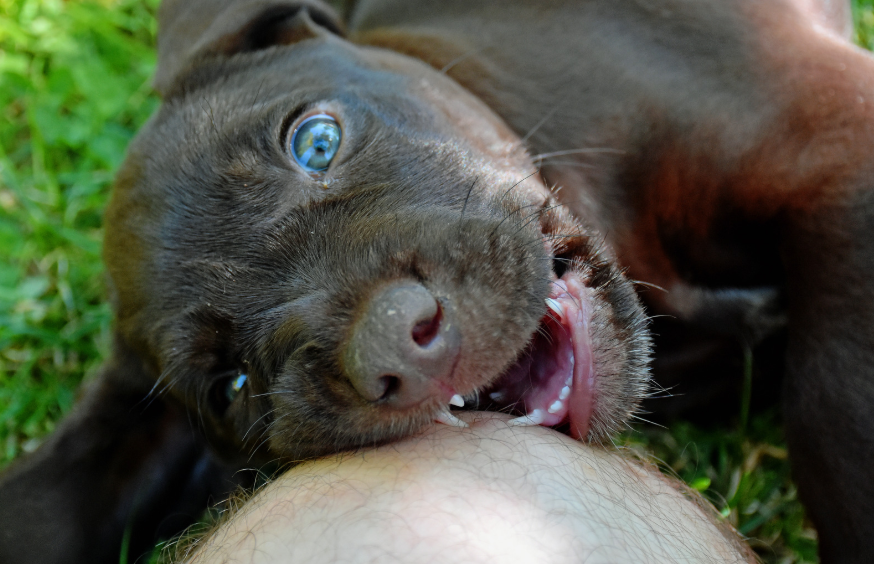
If you’ve recently brought a puppy home and your hands look like you’ve been tangling with a feral cat, welcome to one of the most universal puppy ownership experiences. Every Bossier City puppy owner deals with biting at some point, usually for several weeks running. The needle teeth, the shredded sleeves, the bleeding hands, the sharp little chomps on your ankles every time you try to walk across the room, none of it is a sign that something’s wrong with your puppy. It’s a sign that you have a puppy.
That said, how you respond to puppy biting in the first few months shapes your dog’s mouth behavior for the rest of their life. Handle it well now and your adult dog will have a soft mouth and clear understanding that teeth don’t belong on human skin. Handle it poorly and you can end up with an adult dog who plays too rough, mouths people inappropriately, or worse. This guide walks through exactly how to stop puppy biting the right way, what to do when teething is at its worst, and how to recognize the difference between normal puppy mouthing and something that needs professional attention.
The Reality Every Bossier City Puppy Owner Faces
A few truths worth getting out of the way upfront:
Puppy biting is universal. There’s no breed, no size, no temperament that skips this phase. Every puppy goes through it.
It hurts more than people expect. Puppy teeth are shaped like needles, and even gentle play bites can break skin. The shock value of how sharp those teeth are surprises every first-time puppy owner.
It’s not aggression. The vast majority of puppy biting is normal developmental behavior, not a sign of a future biter. Treating it as aggression usually makes things worse.
It does end. Most puppy biting peaks at around 13 weeks and is largely resolved by 6 to 7 months when adult teeth are fully in. The work you put in now is short-term pain for long-term results.
The biggest mistake new puppy owners make is responding to biting as a moral failure on the puppy’s part. It’s not. It’s a developmental phase that needs to be managed, redirected, and gradually shaped into appropriate behavior. The framework matters because owners who treat puppy biting as bad behavior often respond with corrections that backfire.
Why Puppies Bite (It’s Not What You Think)
Three primary reasons drive puppy biting:
Teething pain. Between roughly 12 and 16 weeks, your puppy’s adult teeth start erupting through their gums. This is uncomfortable, sometimes painful, and chewing relieves the pressure. A teething puppy will chew on anything they can find: your fingers, your couch legs, your shoes, your kid’s stuffed animals. They’re not being destructive. They’re trying to feel better.
Normal puppy play and exploration. Puppies use their mouths the way human babies use their hands. It’s how they investigate the world, interact with their environment, and play with their littermates. In the litter, puppies wrestle, mouth, and play-bite each other constantly. When they leave the litter and join your family, they don’t know that the rules have changed.
Overarousal. When puppies get excited, their impulse control collapses. Zoomies, rough play, visitors at the door, kids running, fast hand movements, squeaky toys, anything that spikes their excitement levels often triggers a biting episode. The bites during overarousal are usually harder and more frantic than the bites during calm play.
None of these is “aggression” or “bad behavior.” Treating them as such tends to make things worse. The fix is in addressing the actual cause: providing teething relief, teaching appropriate play, and managing overarousal.
The Teething Timeline: When This Will Actually End
Concrete milestones so you can see the path forward:
- 5 to 6 weeks: Your puppy’s first set of baby teeth (28 needle-sharp deciduous teeth) come in while they’re still with the litter. By the time you bring them home, these are usually fully present.
- 12 to 16 weeks: Adult teeth start pushing through the gums. This is when teething discomfort hits, and biting often peaks around 13 weeks. Many owners think their previously sweet puppy has suddenly become “bad” during this window. It’s not behavior, it’s biology.
- 16 to 20 weeks: The critical window for teaching bite inhibition (more on this in a moment). Puppies who don’t learn pressure control during this window often have weaker mouth control as adults.
- 4 to 6 months: Continued teething as more adult teeth come in. Biting frequency starts to decline as your puppy gains more impulse control.
- 6 to 7 months: All 42 adult teeth should be present. Teething is done. Biting should now be largely resolved if you’ve been working on it consistently.
- 8 to 12 months: Adolescence brings its own challenges (testing boundaries, occasional regression), but persistent puppy-style biting at this age usually indicates that bite inhibition wasn’t properly taught or that something else is going on.
If your puppy is still biting hard, drawing blood regularly, or seeming to get worse rather than better past 5 months, that’s a flag worth taking seriously.
Bite Inhibition: The Most Important Concept You’ll Read Today
Bite inhibition is your puppy’s ability to control the pressure of their mouth. It’s the difference between an adult dog who, when startled, gives a soft warning mouth versus one who breaks skin.
Here’s the part that surprises most owners: the goal during the puppy biting phase isn’t actually to get your puppy to never put their teeth on you. The goal is to teach them to control how hard they bite. A puppy who learns bite inhibition and then learns “no teeth on humans” becomes an adult dog with a genuinely soft mouth. A puppy who’s punished for any teeth contact often skips the bite inhibition lesson entirely, and as an adult, has no concept of how to control bite pressure if they ever do bite.
This matters because every dog will, at some point in their life, have a moment where their mouth might end up on a person, pain, fear, surprise, getting stepped on accidentally. A dog with good bite inhibition gives a warning bite that doesn’t break skin. A dog without it doesn’t know how to hold back.
The 16-week window matters because puppies learn bite pressure most easily through interaction with their littermates and other puppies during this developmental period. Once they’re past it, teaching pressure control becomes significantly harder.
This is why the standard advice for the first phase of puppy biting is to focus on teaching softer bites, not zero biting. As the bites get gentler, you progressively raise the standard until eventually your puppy understands that teeth shouldn’t touch human skin at all.
The Step-by-Step Method to Stop Puppy Biting
The actual protocol, in the order you should think about it:
Step 1: Set Up the Environment for Success
Before you can effectively respond to biting, you need to make biting less likely in the first place. Have appropriate chew toys in every main room of the house: living room, kitchen, bedroom, hallway, anywhere you and your puppy spend time. The best options are tug toys long enough to keep your hands away from teeth, soft rubber chew toys, and frozen Kongs for teething relief.
The principle is simple: when your puppy gets the urge to chew or mouth, the right thing should always be within arm’s reach. If you have to walk to the toy box every time your puppy gets bitey, the moment will pass and they’ll bite you instead.
Manage the environment too. If your puppy targets your ankles when you walk, keep a tug toy in your pocket. If your puppy bites during couch time, have a chew nearby before you sit down. If your puppy goes after kids, structure interactions so the kids aren’t moving fast or making excited sounds that trigger biting.
Step 2: Redirect to an Appropriate Toy (the “Toy Magnet” Method)
The instant your puppy starts mouthing you, present a toy at their mouth level. Keep it engaging, move it slightly to attract attention, and as soon as they grab it instead of you, praise them. This is the single most useful technique for the early stages.
The redirect needs to happen within 1 to 2 seconds of the bite. Slow redirects don’t work because your puppy doesn’t connect the toy to stopping the biting. Fast redirects create the association you want: when the urge to bite hits, a toy appears.
If they re-bite your hand instead of taking the toy, repeat the redirect once. If it happens a second time, escalate to Step 3.
Step 3: Use the “Yelp and Pause” Technique
When your puppy bites hard enough to actually hurt, give a high-pitched “ow!” or “ouch!” (mimicking the yelp another puppy would give if hurt during play). Then immediately stop all interaction. No talking, no eye contact, no movement. Stand still or stand up and turn away for 10 to 20 seconds.
The lesson you’re teaching: hard bites end the fun. Soft mouth keeps the play going.
This works for many puppies but not all. Some puppies actually get more excited by the yelp because the high-pitched sound mimics prey behavior. If your puppy starts biting harder when you yelp, skip this step and go directly to Step 4. Watch your specific puppy’s response.
Step 4: Time-Outs for Escalation
If yelping and pausing doesn’t slow the biting, escalate to a brief time-out. The moment teeth touch skin: stop play immediately, calmly stand up, and either walk out of the room for 30 to 60 seconds or calmly take your puppy to their crate or pen for the same window.
Time-outs only work if they’re brief and consistent. Long time-outs (several minutes) don’t teach the lesson because your puppy forgets what triggered them. Inconsistent time-outs don’t teach because your puppy can’t predict the consequence.
The crate during time-out should never feel like punishment. Calm, quiet, no scolding. Your puppy goes in, takes a brief break, comes out when they’ve settled. Many puppies actually fall asleep during time-outs, which is often a sign that the biting was driven by overtiredness in the first place. For more on using the crate well in puppy training, our blog on puppy crate training covers the foundational approach.
Step 5: Reward Calm, Gentle Behavior
The piece most owners forget. When your puppy is being gentle, when they take a toy instead of your hand, when they settle calmly next to you instead of mouthing your sleeve, mark and reward that behavior. A calm “good” and a treat reinforces what you want to see more of.
This is more important than the corrections. Punishment teaches what not to do. Reinforcement teaches what to do instead. Both matter.
Step 6: Manage the “Witching Hour”
Most puppies have a daily window, typically 6 to 9 PM, where biting spikes dramatically. This isn’t them being bad. It’s almost always overtiredness. Puppies need 18 to 20 hours of sleep per day, and most don’t get enough. By evening, they’re past their threshold and have lost what little impulse control they have.
The fix isn’t more training. It’s more sleep. When the witching hour hits, instead of trying to teach during a moment when your puppy can’t learn, structure them down for a nap. A quiet crate session with a frozen Kong often resolves the entire episode in 20 minutes.
For more on managing the broader sleep picture, our piece on dealing with a puppy sleep schedule covers what most puppies need versus what most get.
What NOT to Do
These responses to puppy biting either fail to work or actively make things worse:
- Yelling or screaming (often increases the puppy’s arousal and triggers more biting)
- Hitting, swatting, or any physical correction (creates fear, doesn’t teach anything useful)
- Holding the muzzle shut (escalates the situation, can damage trust)
- Pinning the puppy down or “alpha rolling” (outdated method based on debunked theory, often produces fear-based aggression later)
- Allowing clothing biting because “it’s not skin” (clothing biting becomes skin biting in older puppies)
- Wrestling or rough hand-play with your puppy (teaches them that hands are toys)
- Inconsistent responses (some family members allow biting, others correct it; the puppy can’t learn the rule)
- Using bitter sprays as the primary strategy (some puppies love the taste, and it doesn’t address the cause)
- Tolerating biting because it’s “cute” while small (the puppy is learning that biting is acceptable)
For the broader picture of what to avoid in puppy training, our blog on puppy training: what not to do covers more.
The Overtired Puppy Problem
This deserves its own section because it’s the single most underrecognized cause of severe puppy biting. Most owners trying to train their way out of evening biting sessions are fighting biology, not behavior.
A puppy with adequate sleep handles play, training, and family chaos with reasonable impulse control. A puppy who’s been awake too long becomes increasingly bitey, frantic, and unable to settle. The biting in this state isn’t trainable. The puppy literally can’t access the parts of their brain that hold back the bite.
Watch your puppy’s behavior over the course of a day. If biting starts getting worse around the same time every evening, the issue is almost always that they need to sleep, not that they need correction. Crate them with a chew, let them nap, and you’ll often get a different puppy back two hours later.
The same applies during the day. Puppies who’ve been heavily socialized in the morning, who’ve had visitors, who’ve gone to a new environment, or who’ve otherwise been overstimulated often show their fatigue through biting. Recognize the signal and structure rest.
Helping a Teething Puppy Find Relief
During the 12 to 24 week window when teething is at its worst, physical relief reduces the biting itself. Options that work:
- A frozen Kong stuffed with peanut butter (xylitol-free), wet food, or plain yogurt is the gold standard. The cold soothes sore gums while the chewing and licking provides genuine relief. Most teething puppies will work on a frozen Kong for 20 to 45 minutes.
- Frozen washcloths twisted into a knot give your puppy something cold and chewable. Wet a clean washcloth, twist it, freeze it for an hour, and let your puppy gnaw on it. Cheap, effective, washable.
- Frozen carrots, apple slices, or blueberries provide cold relief plus a small healthy treat. Check with your vet before adding new foods to make sure they’re appropriate.
- Teething-specific toys made of soft rubber give appropriate textures for sore mouths. Brands like Nylabone and Kong make graduated lines specifically for puppies.
- Avoid hard chews like real bones, antlers, or hard plastic for teething puppies. These can crack baby teeth and damage developing adult teeth coming in underneath.
For more on managing chewing behavior broadly, our blog on understanding and eliminating destructive chewing covers the related topic of redirecting chewing onto appropriate items.
Special Considerations for Households With Kids
Many Bossier City families bring puppies home with children already in the household. The combination is wonderful long-term but requires extra structure during the biting phase.
Kid-puppy interactions need adult supervision. Period. Both parties are still developing impulse control, and both can accidentally escalate situations. Letting a 6-year-old and a 12-week-old puppy play unsupervised tends to produce one or both getting hurt.
Teach your kids how to handle puppy biting before it happens. The instructions are simple and short:
- If the puppy bites, “be a tree” (stop moving, fold arms, look up)
- Don’t run away (running triggers chase behavior, which triggers more biting)
- Don’t scream or wave hands (overarousal worsens biting)
- Call for an adult if the puppy keeps biting
Practice this with your kids before the puppy comes home if possible. Adrenaline-soaked moments are not the time to learn the response.
Manage rough play by directing energy into appropriate channels. A long tug rope that lets a child play with the puppy without hands near teeth works much better than wrestling. Fetch is another safe option. Hand-based play should be off-limits with kids until the puppy is well past the biting phase.
For families with toddlers or very young children, baby gates and pens are essential. Toddlers move unpredictably, vocalize loudly, and have face-level contact with puppies. The combination is dangerous in both directions. Structure their interactions so close contact only happens when both parties are calm and supervised.
When Puppy Biting Crosses Into Concerning Territory
Most puppy biting is normal. A small subset of cases warrants closer attention. Worth distinguishing if you see any of the following:
- Stiff, tense body before or during biting (versus relaxed play body)
- Growling that sounds like a real warning (versus playful growling)
- Bites that are deliberate and hard rather than mouthy and exploratory
- Biting that’s specifically triggered by handling (being picked up, restrained, or having body parts touched)
- Bites that consistently break skin past 4 months of age
- Biting that’s getting worse rather than better past 5 months
- Aggressive responses to having food, toys, or sleeping spots approached
- Bites that target specific people in the household
- Lunging or snapping with intent rather than play
These signs don’t necessarily mean a permanent problem, but they’re flags that the puppy needs more than the standard puppy biting protocol. For temper tantrum behavior specifically (where the puppy bites hard during handling or restraint), the underlying issue is often handling sensitivity that needs careful counter-conditioning rather than correction.
For broader context on adult dog mouthiness and jumping behavior, our piece on understanding canine behavior: dog nipping and jumping covers what these patterns look like as dogs mature past puppyhood.
When to Bring in a Professional
Most puppy biting can be managed with the protocol above. Bring in professional help if:
- Your puppy is past 5 months and biting is still severe. The teething explanation no longer applies, and there’s likely something else going on.
- You’re seeing the concerning signs listed in the previous section.
- You have small children in the home and the biting is creating a safety issue that home methods aren’t solving.
- The biting is affecting your relationship with your puppy or your willingness to interact with them.
- You’ve tried the standard methods consistently for several weeks and aren’t seeing improvement.
Our dog training programs include puppy work specifically designed to address bite inhibition, mouth manners, and the broader foundation that prevents biting from becoming a longer-term issue. In-home dog training is often the right format for puppy biting because the work happens in your actual home, where the biting actually occurs, and we can coach the entire family on consistent responses. For families who want more intensive structured time, our board and train program is available, though for young puppies the in-home approach typically produces better results because it preserves the bonding window.
Frequently Asked Questions
My puppy is 4 months old and still biting hard. Is this normal?
Yes, this is the peak of teething for many puppies. As long as you’re seeing some general improvement and the biting isn’t escalating in intensity, you’re on track. Stay consistent with the redirection and time-out protocol. Most puppies show significant improvement between 5 and 6 months once teething starts to wind down.
Should I let my puppy bite me at all to teach bite inhibition?
You don’t need to allow biting to teach bite inhibition. Most puppies will mouth your hands during play whether you invite it or not. When that happens, the yelp-and-pause method teaches pressure control. You don’t need to actively encourage mouthing for the lesson to happen.
What if my puppy bites my child and the child gets really scared?
Take it seriously. A scared child plus a biting puppy creates a situation where neither one can develop the right relationship. Step back from direct interactions for a few weeks. Use baby gates and pens to keep them in the same space without contact. Teach the child the “be a tree” response calmly when no puppy is around. Resume supervised interactions only when both can be calm. If your child has been bitten hard enough to need real comforting, talk to a professional trainer about restructuring the integration plan.
Is it true that you should never play tug with a puppy?
This is an outdated piece of advice that’s largely been debunked. Tug played with rules (you start it, you can stop it, the puppy releases on cue, no teeth on hands) is actually a great training tool. It builds impulse control, releases energy appropriately, and teaches your puppy to engage with toys instead of hands. The “never play tug” rule comes from the misconception that tug teaches dogs to be aggressive. It doesn’t. Played correctly, it does the opposite.
My puppy bites me when I try to put on their leash. What’s going on?
This is usually one of two things: handling sensitivity (the puppy isn’t comfortable with being held still and reached toward) or overarousal at the prospect of going outside. For handling sensitivity, slow down and counter-condition the leashing process with treats and patience. For overarousal, work on calm leashing before outings. Practice clipping and unclipping the leash multiple times a day in calm moments so it’s not always associated with high-excitement outings.
Should I worry that my puppy might grow up to be a biter?
Probably not. Puppy biting is not a reliable predictor of adult biting. Most puppies who bite hard during the teething phase grow up to be normal, well-mannered adult dogs as long as they receive appropriate training during the bite inhibition window. Adult biting is more often the result of fear, lack of socialization, or poor handling during adolescence than of normal puppy biting that wasn’t addressed.
About All Dogs Unleashed
All Dogs Unleashed is a professional dog training facility serving Bossier City, Shreveport, and the surrounding communities. Located at 4500 Benton Rd, Suite 200, Bossier City, LA 71111, our team specializes in foundational puppy work, including the bite inhibition training that sets puppies up for a lifetime of soft-mouthed, well-mannered adulthood. All Dogs Unleashed believes that the work you put in during the first six months of a puppy’s life pays off for the next decade and a half, and we help Bossier City families do that work right.
Tired of the Bite Marks? Let Us Help.
Puppy biting is exhausting, and most owners reach a point where they’re not sure if they’re handling it right or just making it worse. If you’ve been working on it consistently and aren’t seeing the progress you’d hoped for, or if you’d rather have professional support to make sure you’re doing it right from the start, we can help.
Call us at (318) 562-6536 or visit our contact page to schedule a consultation. Let’s get your puppy on the path to a soft mouth, calm manners, and a happy household.