
Does your dog panic the second you grab your keys? Dog separation anxiety is one of the most common behavior issues we see at our Frisco training office, and the good news is it can be fixed with the right plan. Our team builds well-balanced customizable programs that calm your dog, rebuild confidence, and give you back a peaceful home.
Ready to help your dog feel safe when you leave? Call us today at (972) 573-1715.
Key Takeaways
- Dog separation anxiety shows up as barking, chewing, pacing, or accidents the moment you leave the house.
- The root cause is panic, not bad behavior, so punishment makes the problem worse instead of better.
- Structured training, clear leadership, and gradual departure work build lasting confidence in your dog.
- Our Frisco trainers offer board and train programs with unlimited follow-up support for anxiety cases.
Your Dog Falls Apart When You Leave. Here’s What’s Really Going On.
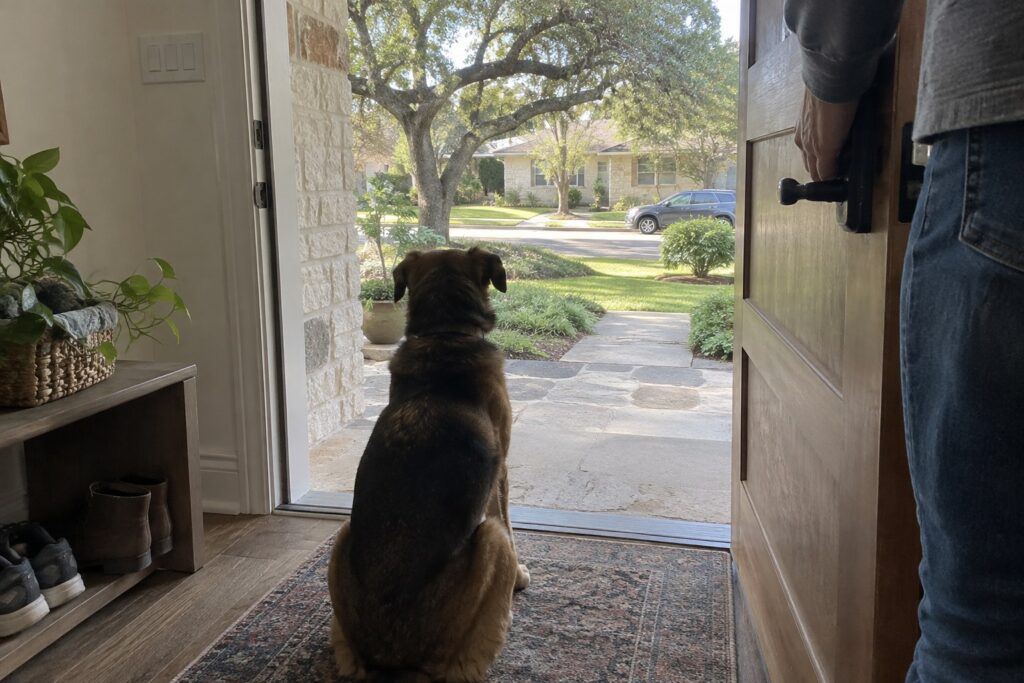
You shut the front door. By the time you hit the driveway, the barking starts. You come home to chewed baseboards, a scratched-up door frame, and a polite text from your neighbor two townhomes down. Sound familiar?
Separation anxiety in dogs is one of the most common behavior problems we see, and one of the most fixable. With the right plan, most dogs improve a lot in a few weeks. No magic pills required.
This guide covers four things every owner needs:
- How to spot real dog separation anxiety vs. boredom or bad manners
- The science behind what’s happening in your dog’s brain
- A step-by-step plan you can start today
- When to call in a dog trainer in Frisco, TX for hands-on help
What Is Dog Separation Anxiety and Is That Really What Your Dog Has?
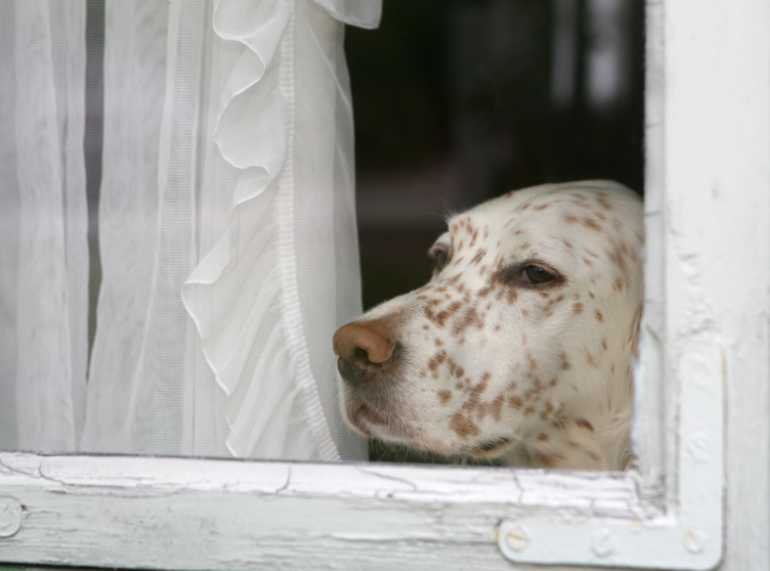
Real separation anxiety is a clinical condition triggered only by your absence. The dog panics when left alone. That panic produces the chewing, barking, and accidents you come home to. But here’s the catch: most dogs we see in the Frisco area don’t actually have it. They have something that looks identical on the surface but has a very different root cause.
True Separation Anxiety vs. Simulated Separation Anxiety
True separation anxiety is panic. Simulated separation anxiety looks the same but comes from boredom, pent-up energy, or learned behavior. A bored dog chews the couch because nothing else is happening. An anxious dog chews the door frame because they’re terrified you’re never coming back. Different problem, different fix.
Run this quick self-test before assuming the worst. Does your dog only act out when you leave the house? Or do they also pester, whine, or destroy things when you’re home but in another room? If it happens whether you’re home or not, you’re likely dealing with simulated signs, not true anxiety.
Four triggers we see constantly with commuter households driving to Legacy Business Park or working long days near Stonebriar:
- Not enough daily physical exercise
- Zero mental stimulation during the day
- No predictable routine around departures and returns
- Reinforced demand behaviors (barking gets attention, so it keeps happening)
Reading the Signs
Veterinary behaviorists look for a specific cluster of signs when diagnosing dog separation anxiety:
- Vocalization (barking, howling, whining) within 30 minutes of you leaving
- Destruction focused on exit points like doors, window frames, and crates
- House soiling in a dog who is otherwise fully potty trained
- Pacing, drooling, or refusing food when they see pre-departure cues (keys, shoes, work bag)
- Self-injury in severe cases, like broken teeth or torn nails from escape attempts
The single best diagnostic tool you have? Your phone. Set it on a tripod facing the main living area, hit record, and leave for an hour. Watch the footage. You’ll know within minutes whether your dog settles, sleeps, and only reacts at the door, or whether they’re in genuine distress the entire time.
If house soiling is part of the picture, rule out a training gap first with our house training guide for Frisco dog owners before assuming separation anxiety in dogs is the cause.
Why Dogs Develop Separation Anxiety: The Behavioral Science in Plain English
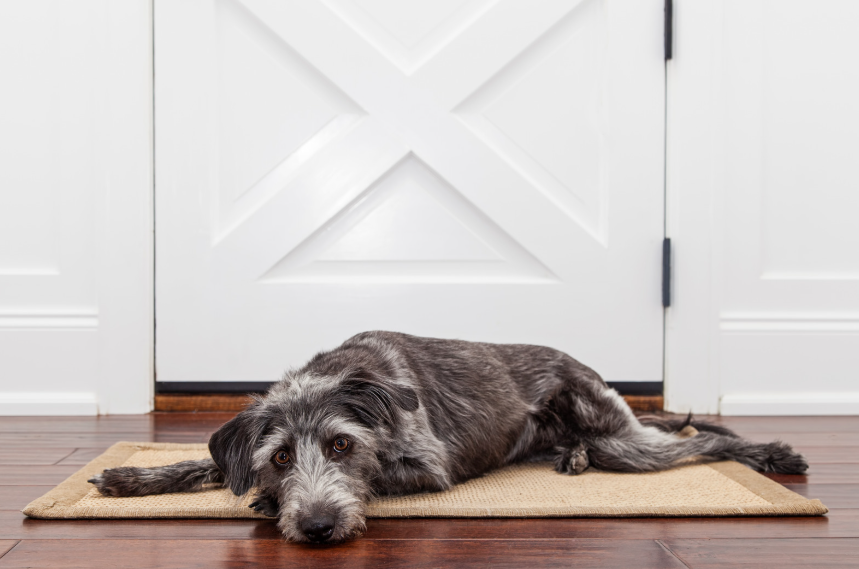
Dogs develop separation anxiety because of overdependence on one person, and their nervous system genuinely panics when that person disappears. This is not stubbornness or spite. It is a real stress response, hardwired into a pack-social animal that suddenly finds itself alone.
We saw a huge wave of this after the 2020-2022 adoption surge. Families across Collin County brought home puppies during lockdown. Those dogs are now 3-4 years old, and many are showing delayed anxiety as work schedules return to normal.
The Attachment Bond
When one human becomes a dog’s entire social world, departure registers as a threat to survival. The brain floods with cortisol. The dog paces, drools, barks, or destroys things to cope.
Some breeds are wired to bond harder than others. Veterinary literature flags these as more prone to separation anxiety in dogs:
- Labrador Retrievers
- Vizslas
- Border Collies
- German Shepherds
- Bichon Frises
Rescue and shelter dogs also show elevated rates. Prior abandonment sensitizes the stress-response system, so even a short absence can trigger a full panic episode.
How Owners Accidentally Make It Worse
Good intentions often feed the problem. Effective canine separation anxiety treatment starts with fixing four common owner habits:
- Dramatic emotional goodbyes. Long hugs and baby talk before leaving spike the dog’s arousal. The contrast when you walk out feels even sharper.
- Rushing back when the dog cries. This teaches the dog that vocalizing brings you home. The behavior gets stronger every time.
- Post-event punishment. Scolding a dog for chewing the couch hours later adds fear without teaching anything. The dog links your return to stress.
- Sudden crate confinement without conditioning. Throwing an anxious dog in a crate cold turkey often triggers injury attempts and deepens the panic.
If any of these sound familiar, you are not a bad owner. You just have not been shown the counter-conditioning steps yet. That is fixable.
Talk to a trainer who has worked with hundreds of anxious dogs across the DFW area. Call (972) 573-1715 today.
A Step-by-Step Desensitization Plan You Can Start This Week
You can start at home with a structured protocol, and most dogs show measurable improvement in two to four weeks of daily practice. The plan has three parts: break the meaning of your departure cues, build up time alone in small doses, and teach calm behavior. Work the steps in order, not all at once.
Step 1 – Departure Cue Desensitization
Your dog has memorized your routine. Keys, shoes, jacket, garage door. Each cue spikes anxiety before you ever leave. The fix is repetition without consequence.
Put on your shoes, pick up your keys, then sit back down on the couch. Repeat 10 to 15 times in one session. Do this twice a day. Mix it up: grab keys and make coffee, put on shoes and fold laundry. No single cue should predict a long absence anymore.
Step 2 – Graduated Absences
Once cues are boring, start leaving for real, but tiny. Here is a sample four-week progression for how to treat dog separation anxiety at home:
- Days 1-3: Step outside the door for 10 to 30 seconds.
- Days 4-7: Build to 1 to 3 minutes.
- Week 2: 5 to 10 minutes.
- Week 3: 20 to 30 minutes.
- Week 4: 60 minutes and beyond.
The single biggest mistake to avoid: never return while your dog is barking or whining. Wait for at least 2 seconds of quiet before opening the door. Coming back during the noise teaches your dog that loud panic brings you home.
Support each session with these tools:
- A frozen Kong or food puzzle handed out 5 minutes before you leave.
- An audiobook or talk podcast playing at low volume.
- Real physical exercise before departures. North Texas heat is brutal by mid-morning, so walk early or after sundown.
- A vet-approved calming supplement if your vet recommends one.
- Do not rely on adding a second dog as your only fix. It rarely solves true canine separation anxiety treatment goals.
Step 3 – Teaching the Place Command
A dog who can settle on cue has the foundation for calm independence. Mark and reward four paws on a mat. Build duration first (30 seconds, then 2 minutes, then 10), then add distance as you walk away. Place pairs beautifully with recall work, so practicing alongside teaching your dog to come when called gives you two reliable obedience tools that make dog anxiety training stick.
When Home Training Isn’t Enough: Professional Behavior Modification in Frisco
Some dogs have anxiety too severe or too deeply conditioned for home practice alone. Recognizing that threshold early saves months of stress for both of you. If your dog has been on a consistent protocol for three weeks with no progress, it is time to bring in help.
Signs You Need a Professional
Call us when you see any of these patterns. These are not problems that resolve with more YouTube videos or another week of crate practice.
- Self-injurious behavior: bloody paws, broken teeth, torn nails from escape attempts
- Refusal to eat for over a full day when left alone
- Escalation despite three or more weeks of consistent home protocol
- Destructive behavior that creates a real safety risk, chewed outlets, swallowed drywall, jumping through windows
- Bite history or resource guarding that complicates training decisions
- Your dog cannot tolerate even a ten-second departure without panic
If any of these sound familiar, you are past the DIY stage. Severe cases often pair with other behavior issues too, like reactivity or stopping jumping behavior when guests arrive, and those layers need a trained eye to untangle.
How Our Team Approaches It
Our dog behavior modification Frisco programs are built around your dog’s specific triggers and history, not a generic template. We start with an in-home assessment to see what your dog actually does during departure, not what you think they do. Then we build a plan with measurable thresholds.
For severe cases, our board and train option works well. Your dog learns independence in a structured setting without you present to reinforce dependent patterns. They build confidence around new handlers, new spaces, and predictable absences before coming home to you. Trainer Jake explains the why behind every step and sends mid-visit report cards by text. Trainer Randall is no-nonsense and gets results fast. Across 289 five-star reviews averaging 5.0, the common thread is dogs that came home calmer and owners who finally understood what was happening.
Every dog anxiety training Frisco program at All Dogs Unleashed Dog Training Frisco includes unlimited follow-up support after the program ends. You are never stuck guessing once the formal training is over.
If you have run the home protocol for three weeks and your dog still cannot handle short absences, call our team at (972) 573-1715 for a behavior consultation. We will assess where your dog is stuck and build a plan around their specific triggers.
Frequently Asked Questions
Can Medication Help My Dog’s Separation Anxiety?
Yes, in moderate to severe cases a veterinarian may prescribe anti-anxiety medication such as fluoxetine or clomipramine to lower your dog’s baseline stress enough for behavior modification to take hold. Medication is not a standalone fix but can make training significantly more effective when the anxiety is too intense for a dog to learn in a distressed state.
All Dogs Unleashed Dog Training Frisco recommends coordinating with your vet if your dog shows extreme physical symptoms like self-injury or complete refusal to eat while alone, and pairing medication with a structured training program gives the medication something to support.
How Long Does It Typically Take to See Real Improvement?
Mild cases often show noticeable progress within two to four weeks of consistent daily training. More deeply rooted separation anxiety can take three to six months of structured behavior modification before a dog can reliably tolerate extended alone time. The timeline depends heavily on how consistently the plan is followed and whether the dog has had the anxiety reinforced for months or years before training begins. A board and train stay can compress that timeline significantly because the structure is enforced around the clock.
Is It Safe to Use a Crate With a Dog That Has Separation Anxiety?
It depends on the individual dog. Some dogs find a properly introduced crate calming because it creates a predictable, den-like space. However, dogs with true separation anxiety may panic in a crate, causing self-injury from attempts to escape, which makes the anxiety worse over time. If your dog destroys bedding, breaks teeth on crate bars, or injures paws trying to dig out, discontinue crate use and consult a trainer at All Dogs Unleashed Dog Training Frisco before continuing. Working with a trainer through in-home dog training is often the safest way to rebuild a positive crate association.
Will Getting a Second Dog Solve My Dog’s Separation Anxiety?
This is one of the most common myths surrounding separation anxiety, and the answer is almost always no. True separation anxiety is rooted in a dog’s attachment to a specific person, not a general fear of being alone, so another dog in the home rarely eliminates the distress. Adding a second dog without resolving the underlying issue can also put financial and logistical pressure on the household while the anxious dog continues to struggle.
Can Puppies Develop Separation Anxiety, or Is It Only an Adult Dog Problem?
Puppies absolutely can develop separation anxiety, and the early weeks after adoption are actually a critical window where habits form quickly. Puppies who are never taught to spend short periods alone, or who receive constant contact during the day, can develop strong over-attachment patterns that become full separation anxiety by adolescence. Starting short, calm alone-time practice from the first week home is one of the most effective prevention strategies, and the foundation skills covered in our standard Frisco training programs help prevent the problem from taking root.
What Should I Do If My Neighbor Complains About My Dog Barking All Day?
First, set up a camera or audio recorder to confirm that barking is actually happening and to gauge how long it lasts and when it peaks. This footage also serves as a useful baseline to share with a professional trainer so the severity of the anxiety can be properly assessed. All Dogs Unleashed Dog Training Frisco can help you build a documented behavior modification plan, which some landlords and HOA boards accept as evidence that the problem is actively being addressed.
In the meantime, dog boarding on your longest workdays can give your neighbors immediate relief while training is underway, and adding dog grooming to a boarding stay keeps your dog comfortable through the transition.
Are Certain Dog Breeds More Prone to Separation Anxiety Than Others?
Breeds that were selectively developed for close human cooperation, such as Labrador Retrievers, Vizslas, Border Collies, and Velcro breeds like the Hungarian Puli, do show higher rates of separation anxiety in research studies. That said, any dog of any breed or mix can develop the condition depending on their history, socialization, and the routines established at home. Breed tendency is a risk factor, not a guarantee, and individual temperament and owner behavior ultimately play a larger role.
Ready to Get Started with All Dogs Unleashed Dog Training Frisco?
Call (972) 573-1715 to speak with our team directly, or reach out using the form below.
Reach out today and let’s talk about how we can help.