
Teaching your dog the right commands early makes everything easier, from daily walks to real-world situations like busy Dallas sidewalks and crowded patios. At All Dogs Unleashed DFW, our certified dog trainers work with your pup on the eight dog obedience commands that matter most, with guaranteed results and lifetime support backing every program. Start here, and you will have a well-behaved dog you can actually trust. Ready to get started? Our team is here to help your pup learn the commands that stick.
Key Takeaways
- The eight core dog obedience commands cover the situations Dallas dogs face every single day.
- Starting with foundational commands like Sit, Stay, and Come builds the base for everything else your dog learns.
- Dallas environments like Deep Ellum patios and White Rock Lake trails are real-world tests for a well-trained dog.
- Certified trainers can teach these commands faster and with longer-lasting results than most owners achieve on their own.
- Consistent practice in short daily sessions is the fastest way to get reliable obedience from your pup.
Your dog pulls you down the White Rock Lake trail. He blows off your recall at the dog park. He jumps on every guest who walks through your door. Sound familiar? You’ve probably tried training before. The problem usually isn’t your dog. It’s the order you taught the commands and whether they actually stuck.
These eight basic dog commands are ranked by priority, not alphabetically. Each one builds on the last. Skip ahead and the whole thing falls apart.
All Dogs Unleashed DFW has earned over 2,000 five-star reviews and a 4.9-star Google rating helping owners across Dallas, Plano, Frisco, and surrounding DFW communities fix exactly these problems. Our trainers, including Randall and Jake, work with real dogs in real situations every day. These are the dog obedience commands our trainers address most often. Let’s get into them.
Why the Order of Commands Matters More Than the Commands Themselves
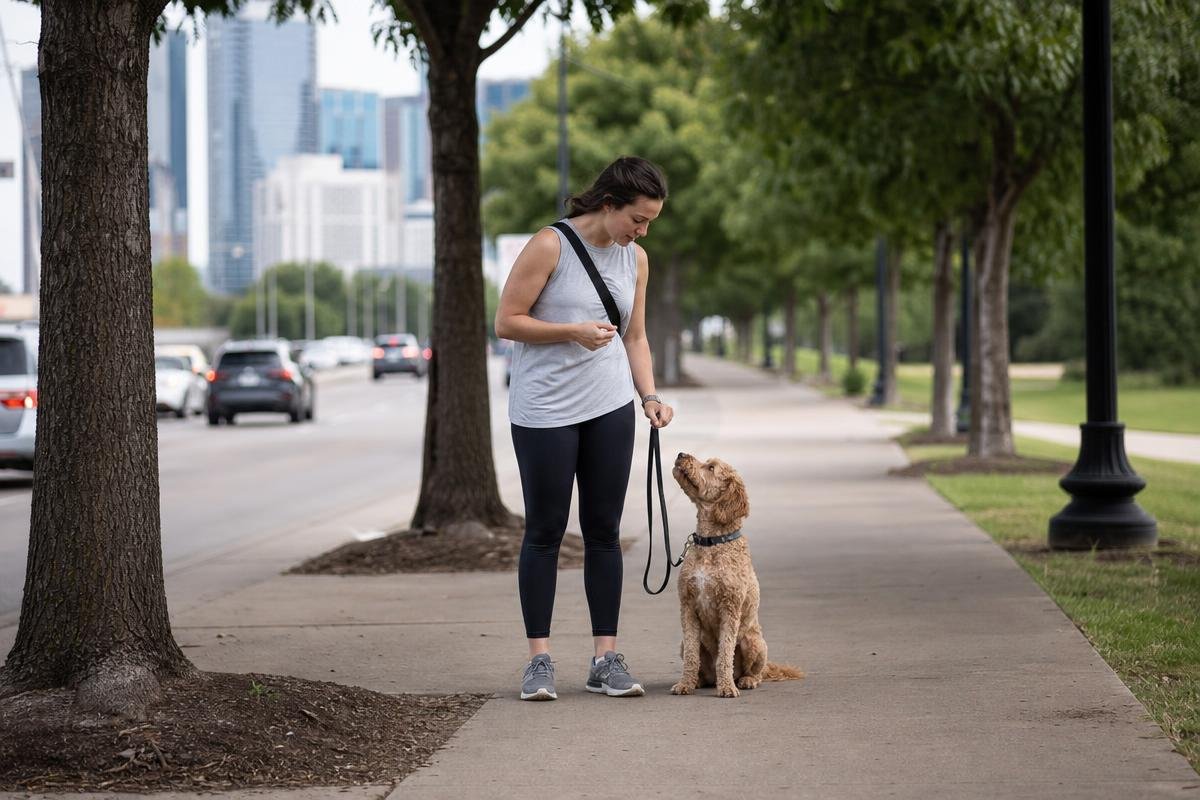
Yes, the order absolutely matters. Most owners jump straight to “Come” or “Heel” and wonder why their dog ignores them. The reason is simple: your dog hasn’t learned the building blocks yet. Commands stack on top of each other, and skipping steps creates gaps that show up at the worst moments. This is one of the most common issues we see: dogs that know individual commands but fall apart in real situations because the foundation was never solid.
Build on Each Command Like Stacking Blocks
Think of obedience training in three chains:
- Sit → Stay → Come: This is your core safety chain. A dog can’t hold a Stay if it hasn’t mastered Sit. A reliable recall depends on Stay first.
- Down → Place → Off: This chain builds impulse control. It’s what keeps your pup calm at a Deep Ellum patio or settled in an Uptown apartment hallway while another dog passes.
- Leave It + Heel: These tie everything together for real-world environments. Leave It is the foundation for safe off-leash work. Heel is what makes a walk along the Katy Trail actually enjoyable.
Skip the foundation and the whole structure wobbles. Build it right and the advanced stuff comes fast.
How Long Does It Take to Teach Basic Commands?
Here are realistic timelines for dog training commands for beginners:
- Reliable Sit: 3 to 5 short sessions of about 5 minutes each
- Solid Stay with distance and distraction: 2 to 4 weeks of consistent practice
- Reliable off-leash Come in a high-distraction environment: 4 to 8 weeks
Those timelines assume daily, consistent reps with good timing. Our board and train program compresses that progress significantly. Repetition density and precise trainer timing do in two weeks what most owners take months to build on their own.
Basic dog commands take time. But the right order makes every step faster. Want the fastest path to a reliable dog? Our two-week immersion program builds every command on this list with pro-level structure.
The 8 Essential Dog Obedience Commands, Ranked by Priority
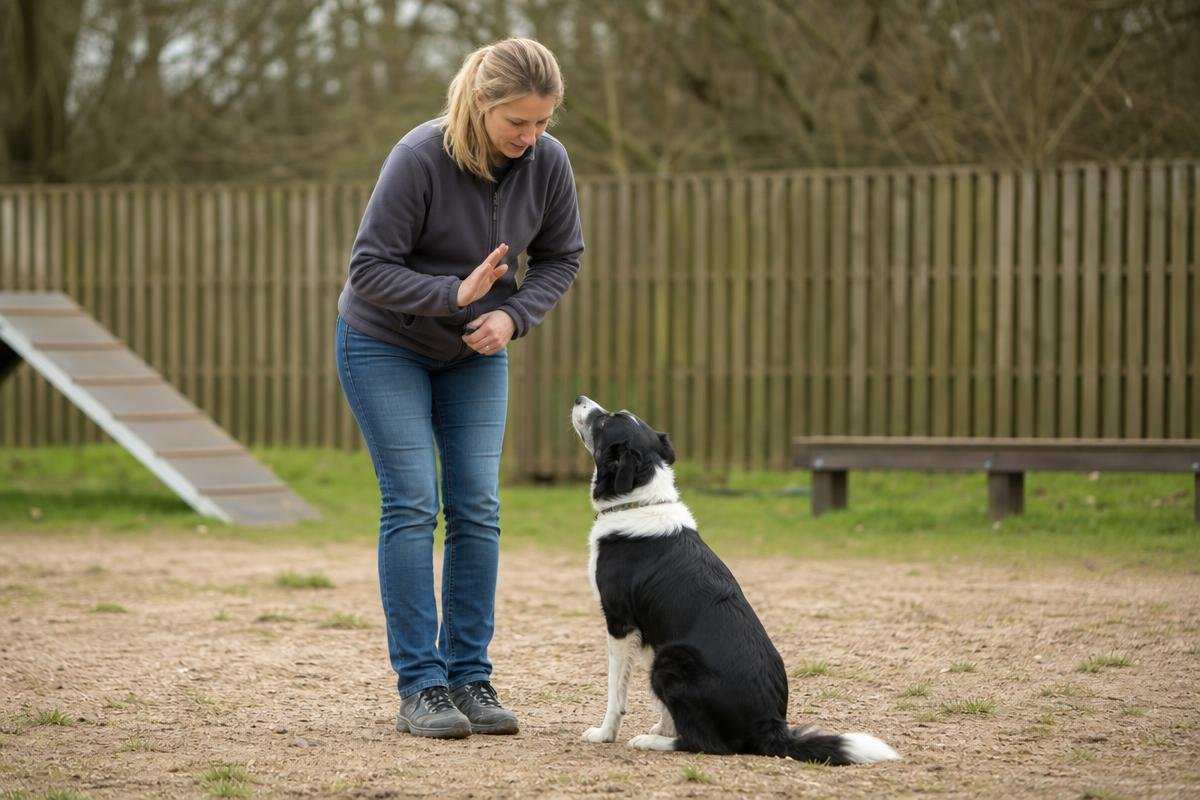
These are the core dog obedience commands we teach every dog that comes through our program. We ranked them this way on purpose. Each command builds on the one before it. Skip around and you’ll slow yourself down.
1. Sit
Sit asks your dog to put their rear on the ground and hold it until you release them. It’s the foundation for almost every other command on this list.
- Real-life use: Waiting at a busy Uptown street crossing before the light changes.
- How to teach it: Hold a treat at your dog’s nose. Slowly move it back over their head. The rear drops naturally as the nose follows the treat. Mark the moment the rear hits the ground and reward. Never push the rear down. That creates tension and slows the learning.
- Trainer tip: In Texas heat, concrete and stone patios can burn a dog’s rear and make Sit feel like punishment. Practice on grass or a shaded surface first, then generalize to harder ground once the behavior is solid.
Common mistakes owners make with Sit:
- Repeating the cue over and over before the dog responds
- Rewarding too late, after the dog has already stood back up
- Skipping the release word so your dog never knows when Sit is done
2. Down
Down means lie all the way down, belly to the floor, until released. It’s a calming position that’s essential for longer stays in public.
- Real-life use: Settling under your table at a Deep Ellum patio restaurant while you eat.
- How to teach it: Start from a Sit. Hold a treat between the front paws, then drag it slowly forward along the floor. The dog follows it down. Mark and reward the moment the elbows hit the ground. Never use “Down” to mean “get off the couch.” That’s a different command entirely. Pick one meaning and stick with it.
- Trainer tip: Slick tile and polished concrete, common in DFW patios and apartments, make dogs reluctant to slide into a Down. Start on a rug or mat so your pup feels stable, then move to harder surfaces.
Common mistakes owners make with Down:
- Using “Down” for jumping off furniture, which confuses the dog
- Luring too fast so the dog pops back up before fully lying down
- Not rewarding the position, only the movement into it
3. Stay
Stay means hold your position until I release you. Teach duration first, then distance, then distraction. Never add two of those at once.
- Real-life use: Holding position at the door while you answer it without your dog bolting outside.
- How to teach it: Ask for a Sit or Down. Count silently to three. Reward before your dog breaks. Add one second at a time. Once you have ten seconds solid, take one step back. Always use a clear release word like “okay” or “free” so your dog knows when Stay is actually over.
Common mistakes owners make with Stay:
- Moving away before the dog understands duration
- Releasing the dog after they already broke the Stay
- Never using a release word, leaving the dog guessing
4. Come (Recall)
Come is the most critical safety command on this list. When your dog is headed toward danger, this is the one that stops it.
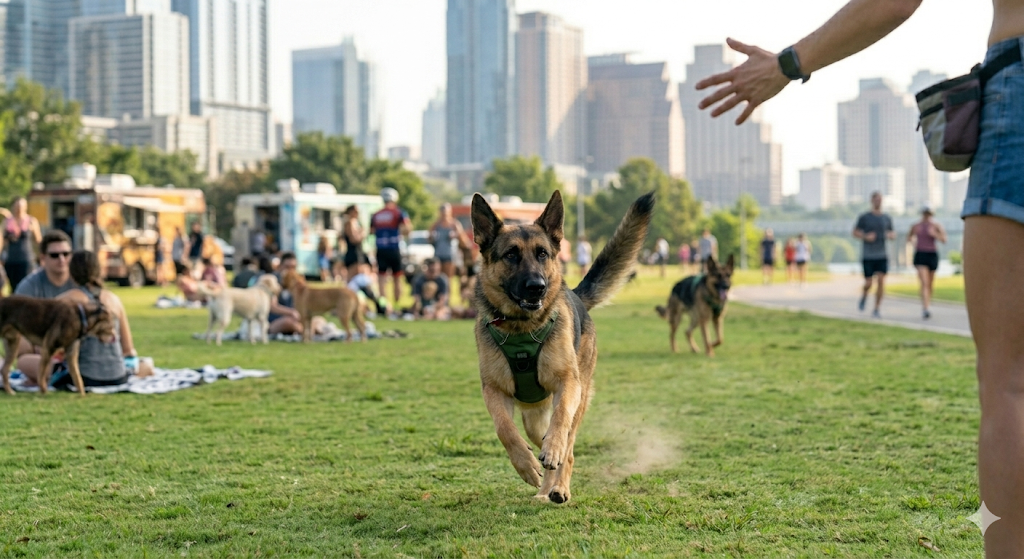
- Real-life use: Preventing a dash toward traffic or stopping a conflict at the White Rock Lake trail, where off-leash dogs and cyclists appear around every bend.
- How to teach it: Call your dog’s name, say “come,” and make arriving at you the best moment of their day. Big reward. Huge praise. Every single time. Never punish a dog who comes to you, even after a long delay. If you do, you’re teaching them that coming to you is a bad idea.
Common mistakes owners make with Come:
- Calling “come” and then doing something the dog dislikes, like a bath or nail trim
- Repeating “come, come, come” until the word loses meaning
- Only practicing recall when it’s time to leave the dog park
5. Place
Place means go to a specific mat or cot and stay there until released. It gives your dog a job and gives you control without conflict.
- Real-life use: Sending your dog to their cot when guests arrive or settling them in a shared hallway in a Knox-Henderson apartment building.
- How to teach it: Lure your dog onto the mat, mark when all four paws are on it, and reward. Build duration the same way you build Stay. One important note: do not use your dog’s sleep bed as the place cot. Use a separate, defined surface so the command stays clear.
Common mistakes owners make with Place:
- Using the dog’s regular bed, which blurs the boundary
- Releasing the dog too early before they settle
- Skipping Place because the dog “seems calm already”
6. Leave It
Leave It means ignore that thing completely. It’s a two-phase skill. First, your dog learns to leave a treat in your closed fist. Then you generalize it to objects on the ground.
- Real-life use: Bishop Arts District sidewalks are full of food smells and dropped scraps. A solid Leave It keeps your dog from eating something dangerous. Always pair it with a “take it” release cue so your dog knows the difference between “not now” and “never.”
Common mistakes owners make with Leave It:
- Only practicing Leave It at home, never in real-world environments
- Saying “leave it” after the dog already grabbed the item
- Never teaching the “take it” release, leaving the dog confused
7. Off
Off means four paws on the floor. It is not the same as Down. Do not use those words interchangeably.
- Real-life use: Stopping your dog from jumping on guests at the door or on strangers during a walk. These are some of the most common behavior problems our private trainers fix most often.
- How to teach it: The moment your dog jumps, turn away and remove all attention. The second all four paws hit the floor, mark and reward. Consistency across every person in the house is everything. If one family member lets it slide, the behavior stays.
Common mistakes owners make with Off:
- Pushing the dog down, which still counts as attention and reinforces jumping
- Using “Down” instead of “Off,” which confuses two separate commands
- Inconsistency among family members
8. Heel
Heel means your dog walks with their shoulder at your hip, on a loose leash, matching your pace. It is the hardest command on this list to proof in real life.
- Real-life use: Walking the Katy Trail without getting pulled into every distraction. Start in your backyard. Build to low-traffic streets. Then test it somewhere like the trail, where cyclists, runners, and other leashed dogs appear fast.
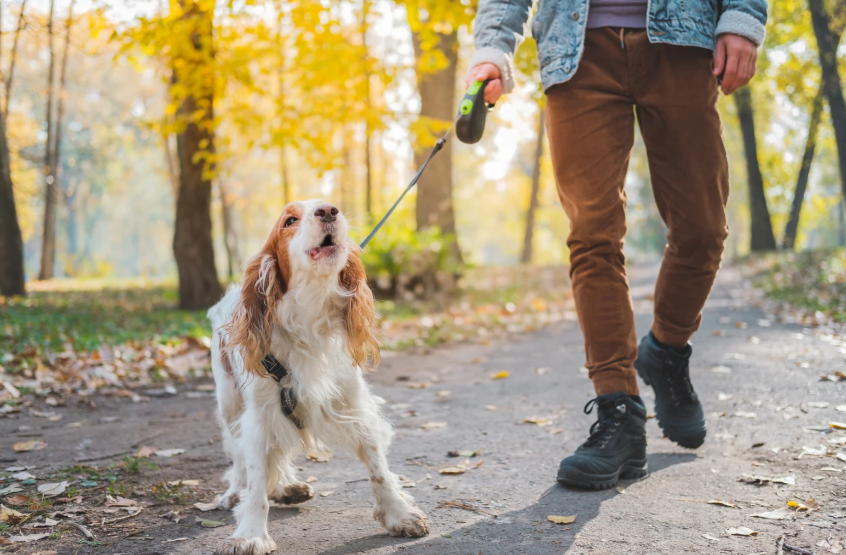
- How to teach it: Reward your dog for being in the correct position at your hip. Stop moving the moment the leash goes tight. Wait. Reward when they return to position. One critical rule: put away the retractable leash. It teaches your dog that pulling equals more freedom, which destroys heel training completely.
Common mistakes owners make with Heel:
- Using a retractable leash during heel training
- Proofing in high-distraction areas before the dog is solid at home
- Inconsistent position standards, sometimes allowing the dog to forge ahead
Positive Reinforcement: The Training Method That Actually Sticks
Your dog is not being stubborn. Your dog is confused. Most at-home training struggles come down to one thing: the dog cannot tell which exact moment earned the reward. Positive reinforcement fixes that, but only when you run the loop correctly.
Mark, Reward, Repeat: The Core Loop
Every rep follows three steps. First, give the cue word. Second, mark the exact correct moment with a clear “yes!” or a clicker. Third, deliver the treat within one to two seconds. The marker is the message. The treat is the paycheck.
Without a marker, your dog is guessing. You said “sit,” the dog sat, you fumbled for a treat, the dog stood back up, and the treat arrived while all four paws were on the ground. You just rewarded standing.
Match the reward to the task. Use high-value treats like small pieces of chicken or cheese for dog training commands for beginners and brand-new skills. Once a command is solid, kibble works fine. For toy-motivated dogs, a quick game of tug counts as a reward too.
Timing Is Everything: The 1.3-Second Window
Research puts the reward window at roughly 1.3 seconds. Miss it and you are reinforcing whatever the dog is doing at that moment, not what you asked for. Fix this before your next session: load treats into a hip pouch so your hand is never searching.
Our trainers work in a climate-controlled facility year-round. That matters more than it sounds. Outdoor summer sessions around Klyde Warren Park or over in Frisco regularly push the heat index above 105°F. When you are overheated, your timing slips. Trainer timing stays precise every single rep.
Owners consistently describe a night-and-day difference after two weeks of professional training. That gap almost always traces back to timing. And yes, senior dogs can learn new skills in Dallas using this same method. Age is rarely the barrier people think it is. Want to see the mark-reward loop in action with your own dog? Book a no-cost evaluation and watch our certified trainers get results fast.
Common Mistakes That Slow Down Your Dog’s Training Progress
These mistakes don’t mean you’re a bad owner. They’re the same things nearly every owner does. Knowing them puts you ahead of most people who start dog obedience training in Dallas.
Inconsistency Across Family Members
This is the number one problem we see. If one person enforces “Off” and another lets jumping slide, your dog isn’t confused. Your dog is learning that the rule depends on the person, not the behavior.
The fix is simple. Write down all eight commands and their exact cue words. Put the list on the fridge. Everyone in the house uses the same word, every time. “Down” means lie down. It doesn’t also mean get off the couch. Pick one meaning and stick to it.
Training Sessions That Are Too Long
Five focused minutes beats thirty frustrated minutes. Every time. When your dog starts sniffing the ground, looking away, or offering random behaviors, the session is over. That’s not stubbornness. That’s a full brain.
Always end on a win. Ask for something your dog already knows, reward it, and stop there. This also explains why your dog nails “sit” in the kitchen but ignores you at the park, where behavior problems pile up fast. The environment is new. The mental load is higher.
Moving Too Fast Before the Foundation Is Solid
Most dogs entering our immersion training have been pushed too fast on Stay and Come. Well-meaning owners added distance or distraction before the dog could hold a Stay for ten seconds in a quiet room.
Use the 3D rule: Duration, Distance, Distraction. Add only ONE at a time. Never two at once. Get ten seconds of Stay in your living room before you try it on a busy sidewalk near Bishop Arts. That progression is what makes the command real.
Teaching These Commands in Dallas: What Makes It Different Here

Dog obedience training in Dallas comes with challenges you just don’t face in cooler climates. The heat alone changes everything about how and when you can train outside.
Heat, Humidity, and Short Training Windows
From June through September, the heat index here regularly hits 105 to 115°F. A hot dog is a distracted, unmotivated dog. Pushing through a session in that heat does more harm than good.
Practical rules for outdoor training in summer:
- Train before 8 AM or after sunset only
- Cap sessions at 5 minutes maximum in high heat
- Use high-value treats like chicken or cheese because your pup needs extra motivation when it’s hot
- Watch for panting, lagging, or disinterest as early warning signs. Learn more about signs of dehydration in Dallas dogs before your next outdoor session.
This is exactly why our indoor, climate-controlled training works so well here. Progress doesn’t stop when it’s 105 degrees outside.
High-Distraction Environments Dallas Dogs Face Every Day
Your pup needs to perform commands in real life, not just your living room. North Texas has no shortage of challenging spots to practice.
- Trinity Groves and the Trinity Skyline Trail: Foot traffic, food vendors, and open water make this ideal for proofing recall and loose-leash walking
- Bishop Arts District sidewalks: Crowds, patio diners, and food smells are a real-world test for impulse control commands
- Knox-Henderson and Uptown area apartments: Elevators, shared hallways, and constant dog-to-dog greetings make calm greeting behaviors essential daily skills
Start in low-distraction spots at home. Build up to these locations gradually as your dog gets more reliable.
Frequently Asked Questions
What are the most important dog obedience commands to teach first?
The eight basic dog commands every dog needs are Sit, Come, Place, Leave It, Off, a walking command, a settling command, and a boundary command. Sit and recall are highest priority because they have direct safety implications. Get those two solid before anything else.
How long does it take to teach a dog basic obedience commands?
A reliable Sit typically takes 3 to 5 short sessions. A solid recall in a high-distraction environment, like the Knox-Henderson area or a busy park, takes 4 to 8 weeks of consistent work. Our immersion program compresses months of progress into roughly two weeks because of repetition density and precise trainer timing.
Can older dogs learn obedience commands, or is it too late?
It is never too late. Dogs of any age can learn new commands. Older dogs may take slightly longer to build new habits, but they are often more focused than puppies. We regularly see five-year-old dogs come through training and leave as completely different animals. Read more about senior dog training in Dallas if you have an older pup.
What is the best method for teaching dog obedience commands at home?
Positive reinforcement works best. Mark the correct behavior the instant it happens and reward within one to two seconds. Use high-value treats for new commands. Keep sessions to five minutes. End on a win. Every person in the house needs to use the same words and the same rules.
How many commands should I teach my dog at one time?
Stick to one or two commands per session. Teaching three or four new behaviors at once overwhelms most dogs and slows overall progress. Once a command is solid in a quiet room, start proofing it in busier environments before adding something new.
When should I consider professional dog obedience training in Dallas?
If your dog is not reliably responding after four to six weeks of consistent practice, it is time to call in a pro. The same goes for aggression, severe anxiety, or reactivity. All Dogs Unleashed DFW, led by trainers Randall and Jake, has earned over 2,000 five-star reviews helping DFW dogs at every stage. We offer board and train, in-home training, and boarding across the area.
Ready to stop repeating yourself and start seeing real results? Our board and train program gives your dog the repetition, timing, and structure that at-home practice rarely delivers. Contact us today and tell us what your dog is struggling with. Randall and Jake will build a plan that fits your dog, your schedule, and your goals. Visit our Dallas training facility or reach out through the website to get started.
Ready to Get Started with All Dogs Unleashed DFW?
Get in touch to speak with our team directly. We’re ready to answer your questions, walk you through your options, and help you find the right solution for your needs. Whether you’re just starting to plan or ready to move forward, we’ll make the process simple and stress-free. Reach out today and let’s talk about how we can help.