
Leash reactivity in dogs is one of the most common behavioral
challenges we see from Denver owners, and one of the most misunderstood.
Your dog may be perfectly social off leash, but the moment a collar
clips on and you hit a busy sidewalk near RiNo or the Platte River
Greenway, the lunging, barking, and pulling take over.
At All Dogs
Unleashed Dog Training Denver, our team has trained thousands of
dogs across the metro Denver area, and our trainers work with reactive
dogs every day using structured, supervised desensitization and
counterconditioning protocols. Our board and train graduates come with
lifetime support, meaning you can call us with a training question long
after the program ends.
Ready to stop dreading every walk? Our experienced trainers can
help.
Key Takeaways
- Leash reactivity in dogs is a trainable behavioral condition, not
a permanent personality trait. - Denver’s high-traffic trails and narrow urban sidewalks create
frequent trigger exposure that makes reactivity worse without structured
intervention. - Desensitization and counterconditioning protocols are the most
effective tools for lasting behavioral modification in reactive
dogs. - Board and train programs offer controlled, distraction-proofing
environments that accelerate progress compared to weekly group classes,
and our graduates keep lifetime support after they go home. - Early intervention produces faster results, but dogs of any age
can make lasting improvement with the right training structure.
What Is
Leash Reactivity in Dogs, and Why Does It Happen?
Leash reactivity in dogs is a behavioral pattern in which a dog
overreacts to stimuli, such as other dogs, cyclists, or joggers, when on
leash, typically presenting as barking, lunging, or pulling. It is
disruptive, embarrassing, and exhausting. But it is also a specific,
addressable behavior pattern with identifiable causes and proven
modification approaches.
The Mechanics
of Reactivity: Frustration vs. Fear
Not all leash reactivity looks the same beneath the surface. There
are two distinct drivers, and they require different approaches to
correct.
Frustration-based reactivity occurs in socially
motivated dogs. Your dog wants to approach another dog or person. The
leash blocks that. The result is an outburst, not aggression, but
frustration at being physically prevented from doing what it wants.
These dogs are often described as “friendly but reactive.”
Fear-based reactivity is the opposite. Your dog
perceives a threat and wants to flee. The leash removes that option.
With no escape route available, the dog defaults to the only outlet
left: barking, lunging, and forward posturing. Both presentations look
nearly identical externally, which is why precise behavioral assessment
matters before any modification protocol begins. Our dog
training programs in Denver start with exactly that kind of
structured assessment.
The visible signs of an over-threshold response include barking,
lunging, pulling, piloerection (raised hackles), a hard stare, and a
stiff forward body posture. Understanding which driver is behind those
signs determines the correct path forward.
Three terms define how reactivity escalates.
Threshold is the point at which your dog shifts from
noticing a trigger to reacting to it. Trigger stacking
happens when multiple sub-threshold exposures compound over a single
walk, pushing your dog over the edge. Over-threshold
response is the full reactive outburst that results. On
high-traffic corridors like the Cherry Creek Trail during the 7 to 9
a.m. rush, trigger stacking can happen within the first five minutes of
a walk.
Why the Leash Makes It Worse
This is the question we hear constantly: “He’s fine at the dog park,
so why is he reactive on leash?” The answer is barrier frustration. Off
leash, your dog has two behavioral options: approach or flee. The leash
eliminates both. That loss of behavioral choice is what produces the
outburst.
In areas like the City Park perimeter or the Bear Creek Trail, where
off-leash dogs, cyclists, and joggers appear from multiple directions
simultaneously, that barrier frustration compounds fast. Dog-to-dog
reactivity in these environments is not a sign of aggression. It is a
sign that your dog has run out of options and is communicating that in
the only way left available to it. Recognizing the distinction between
reactivity and true aggression is the first step toward lasting
behavioral modification.
10
Leash Reactivity Fixes Denver Dog Owners Can Start Today
Dog lunging on leash is one of the most common complaints we hear
from owners across the Denver area. These ten fixes are ordered by
immediacy. Start with Fix 1 before your next walk. Each one addresses a
specific mechanical failure point, not just a vague suggestion to “be
calm.”
Fix 1: Map
Every Trigger and Its Threshold Distance
Your dog has a distance at which it can notice a trigger and stay
under threshold. Walk your regular routes and note exactly how far away
a dog, cyclist, or jogger must be before your dog stiffens, stares, or
vocalizes. Write it down. That number is your working distance for every
exercise that follows.
Fix 2:
Use ‘Find It’ Scatter Feed to Break the Visual Lock
The moment your dog locks eyes on a trigger, scatter five to eight
small pieces of cooked chicken or soft cheese on the ground and say
“find it.” Scatter feeding can help redirect a dog’s attention away from
a trigger and create space to move away before the reaction escalates.
Use small, high-value treats your dog responds to, then adjust the
distance from the trigger as needed.
Fix 3:
Teach the Emergency U-Turn Before You Need It
Condition a “let’s go” cue in your living room first. Mark and reward
the moment your dog pivots with you. Practice until the response time is
under two seconds with no hesitation. On the street, use it to exit
situations before your dog crosses threshold. This is a management tool
that prevents rehearsal of the reactive behavior. It is not a cure.
Bottleneck situations like the LoHi pedestrian bridges make a fast,
reliable U-turn non-negotiable. If you want structured coaching on cue
timing, our in-home
dog training in Denver can drill these mechanics with you
directly.
Fix
4: Build ‘Watch Me’ Eye Contact From Zero Distractions Up
Start indoors with zero distractions. Say “watch me,” and mark and
reward the instant your dog makes eye contact. Add one distraction at a
time over multiple sessions. Eye contact on cue gives you an interrupt
behavior you can deploy before your dog reaches threshold on the Cherry
Creek Trail or any other high-traffic corridor.
Fix 5:
Manage the Environment While Training Is Underway
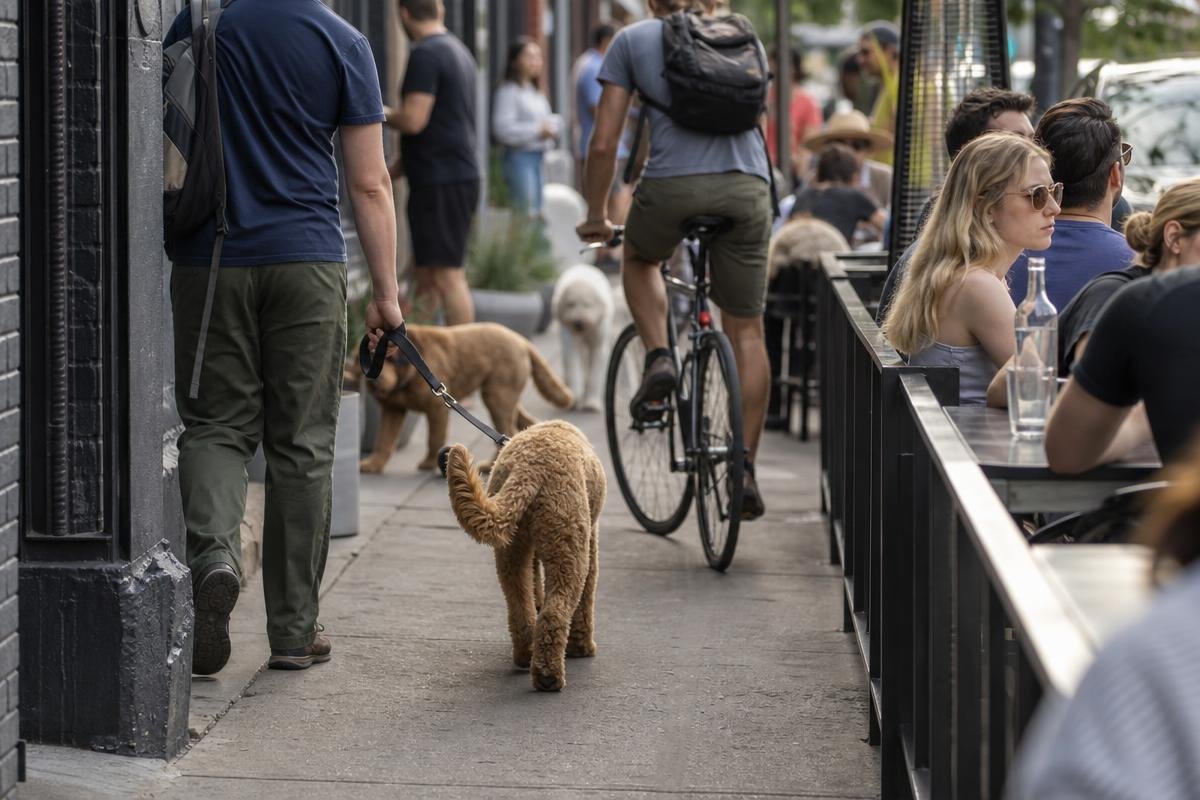
Avoid the Washington Park loop and the Stapleton path network between
7 and 9 a.m. and 5 and 7 p.m. on weekdays. Those peak windows compress
threshold distances and stack triggers faster than most dogs in training
can handle. Walk the Central Park greenways or a quiet residential grid
during off-peak hours instead, and cross the street proactively rather
than waiting for a reaction to start.
Fix
6: Run Systematic Desensitization at Sub-Threshold Distance
This is the core behavioral modification protocol for leash
reactivity in dogs. Position your dog at a distance where it can see the
trigger but remains calm. Pair the trigger’s appearance with high-value
food. Reduce distance by no more than one to two feet per session. Most
owners fail this protocol by moving too fast.
If your dog reacts, you have moved too close too soon. Reset to the
previous distance and hold it for three to five sessions before
progressing. When at-home repetition is not enough, our board and
train program runs this exact protocol multiple times a day in a
controlled setting. Not sure how close is too close for your dog? Get a
structured assessment and a threshold-based plan built for your dog’s
specific triggers.
Fix
7: Practice Controlled Parallel Walking With a Neutral Dog
You need a second handler and a calm, neutral dog. Start at a
distance where both dogs are under threshold and walk parallel, never
converging. Gradually reduce the gap over multiple sessions. This
exercise builds tolerance through repeated, controlled exposure in a
park setting rather than a chaotic sidewalk encounter. If you need
structured support setting this up, our in-home
dog training in Denver program can run this protocol in your
actual neighborhood with your specific triggers.
Fix
8: Implement a Structured Walk Protocol to Lower Arousal Baseline
Require your dog to sit and make eye contact before the leash goes
on. Walk at a controlled pace. No pulling, no sniffing on demand. A
structured walk lowers your dog’s overall arousal baseline before you
encounter any trigger. Dogs that are already at a seven out of ten
arousal before the walk starts have almost no threshold buffer left when
a trigger appears.
Fix 9: Build Impulse
Control at Home First
Impulse control exercises like “leave it,” “wait at the door,” and
hand-target holds build the same neural pathways your dog needs to
override a reactive response on leash. Practice these daily in a
low-distraction environment. A dog that cannot hold a three-second
“wait” at home will not hold it when a dog barking on leash triggers a
reaction at close range.
Fix 10: Keep a
Trigger Log and Review It Weekly
Record six fields after every walk: date, location, trigger type,
distance, response intensity on a scale of one to ten, and your handler
action. Review the log weekly. Patterns that are invisible in the moment
become clear across twenty entries. A trained professional can read your
log and identify trigger stacking sequences you are missing, which is
exactly how we build a targeted behavior modification plan for each dog
we work with.
How
Denver’s Urban Environment Amplifies Leash Reactivity
Your dog may behave reasonably well in a quiet neighborhood but fall
apart the moment you hit RiNo or a crowded lakeside path. That is not a
coincidence. The Front Range lifestyle puts reactive dogs in some of the
most demanding urban environments imaginable, and the layout of these
neighborhoods makes standard management strategies much harder to
execute.
High-Density
Trigger Zones: Where Denver Dogs Struggle Most
RiNo, just blocks from our facility at 2301 Blake St, is one of the
hardest environments for a leash reactive dog. Narrow sidewalks, outdoor
dining patios with dogs tied nearby, and constant cyclist traffic
eliminate your ability to create distance. There is simply no room to
execute a U-turn or move your dog below threshold before the trigger is
already at close range.
Sloan’s Lake compounds the problem differently. Dogs approach from
multiple directions at once. You cannot choose a single, controlled
sub-threshold exposure because three more are already closing in from
your left. The 16th Street Mall corridor and its pedestrian bottlenecks
create physical choke points where emergency exits are not realistic
options. These are not forgiving environments for dog-to-dog reactivity
in the metro Denver area.
Trigger stacking is the real danger here. A single walk through a
busy district can deliver five or six separate exposures in sequence.
Each one adds stress, even if your dog holds it together in the moment.
By the sixth trigger, your dog is over threshold from cumulative load,
not from any single cause. Understanding this is essential for structured
reactive dog training in Denver that actually transfers to
real-world environments.
Why Denver’s
Dog Culture Creates Unique Pressure
This city has a strong dog-friendly identity, and that creates a
specific problem for reactive dog owners. Off-leash dogs appear
regularly in on-leash areas. Strangers approach your dog without asking.
There is an ambient cultural expectation that every dog should tolerate
close, unannounced contact. For a leash reactive dog, that expectation
is a setup for failure.
Managing leash reactive dog behavior in these conditions requires
more than basic avoidance. It requires systematic distraction-proofing
in controlled settings before you ever attempt high-traffic routes. Our
board
and train program builds exactly that foundation, preparing your
dog for the real environments you actually live in.
Your neighborhood is not going to get quieter. Call (720) 310-7337 today to talk through a
training plan built for where you actually walk your dog.
When
DIY Fixes Are Not Enough: Signs Your Dog Needs Professional Reactive Dog
Training
The management techniques above work for many dogs. But some dogs
need more than owner-led practice on a quiet street. Knowing when to
stop troubleshooting on your own and call in experienced trainers is one
of the most important decisions you can make for your dog’s long-term
behavior.
Behavioral Red
Flags That Indicate Escalation
Reactivity that is improving looks different from reactivity that is
escalating. Watch for these five specific markers:
- Threshold distance is growing, not shrinking. If
your dog now reacts at 60 feet to a trigger that used to set him off at
30 feet, the behavior is worsening. In a dense neighborhood like RiNo,
where sidewalks are narrow and outdoor patios seat dogs within arm’s
reach, a growing threshold leaves you with no workable space. - Redirected aggression onto you. Snapping at your
hand, biting the leash, or spinning toward you during a reactive episode
signals a dog who has lost the ability to regulate under threshold. This
is a safety issue, not a training inconvenience. - Recovery time exceeds 10 to 15 minutes. A dog
who cannot settle after a reactive episode within that window is staying
flooded far too long. Repeated flooding accelerates sensitization rather
than reducing it. - Reactivity appearing in new contexts. If your
dog was only reactive on leash toward other dogs and now reacts to
cyclists, joggers, or sounds, the behavior is generalizing. A busy
lakeside loop, where dogs approach from multiple directions
simultaneously, often exposes this pattern quickly. - You are avoiding walks entirely. When the
management strategies stop feeling manageable, owners stop walking. That
avoidance is its own signal that the current approach is not
working.
What
Professional Leash Reactivity Training Looks Like
Professional reactive dog training in Denver is not a group class
where your dog practices being overwhelmed. Our team builds controlled
trigger exposure protocols calibrated to your individual dog’s
threshold, in a supervised environment where the variables are managed.
One owner who was, in her own words, “getting to their wits’ end” with
leash pulling and reactivity saw lasting improvement after working with
our trainer Marcus, who structured the sessions around the dog’s
specific triggers rather than a generic curriculum.
For dogs whose triggers are tied to a specific route or neighborhood,
our in-home
dog training in Denver puts the work directly in the environment
where the behavior occurs. For dogs who need faster progress, our board and
train program in Denver runs multiple short desensitization and
counterconditioning sessions daily, compressing a timeline that
owner-led once-daily walks cannot match. If you are unsure which format
fits your dog, call (720) 310-7337
today to talk through the options with our team.
Frequently Asked Questions
What exactly is leash
reactivity in dogs?
Leash reactivity in dogs is a pattern of exaggerated behavioral
responses, including barking, lunging, growling, or spinning, triggered
by specific stimuli such as other dogs, cyclists, joggers, or strangers
encountered while on leash. The leash restricts your dog’s ability to
flee or approach, which intensifies the response. Leash reactivity is
not a sign that your dog is inherently dangerous or aggressive.
Can
leash reactivity in dogs be fully resolved, or just managed?
The prognosis depends on the root cause. Frustration-based
reactivity, where your dog wants to greet but cannot, often reaches full
resolution with structured training. Fear-based reactivity typically
requires ongoing management of high-intensity triggers even after
significant improvement. Professional training improves outcomes in both
cases by addressing the underlying emotional state, not just the outward
behavior.
How
long does it take to see improvement in a reactive dog?
Most owners doing consistent owner-led work see measurable
improvement within four to eight weeks. Progress is rarely linear. Your
dog may handle a calm sidewalk walk well before struggling on a crowded
RiNo patio block. A board and
train program in Denver accelerates the timeline significantly
through multiple structured sessions daily in a controlled
environment.
Is leash
reactivity the same as dog aggression?
No, but the distinction matters less than most owners think.
Reactivity and aggression are different behavioral patterns. However,
unaddressed reactivity can escalate into genuine aggression when the
outburst is repeatedly reinforced by the trigger disappearing. Every
unmanaged reaction rehearses the pattern and raises the threshold for
the next one.
What
is the best training program for a leash-reactive dog in Denver?
The right format depends on your dog’s severity level and your
schedule. Mild cases often respond well to in-home or group structured
work. Severe dog-to-dog reactivity typically requires a board and train
format for the intensity and repetition needed. Review the All
Dogs Unleashed Dog Training Denver dog training programs in
Denver and call (720)
310-7337 to discuss which format fits your dog’s specific
reactivity profile.
How much
does reactive dog training cost in Denver?
Costs vary based on program format, session count, and severity of
the behavioral challenges involved. A consultation is the right starting
point before any financial commitment. Visit our team at 2301 Blake St,
Denver, CO 80205 or call (720)
310-7337 to get a clear program recommendation and pricing
before you commit to anything.
Should
I use a prong collar or head halter for a leash-reactive dog?
Equipment selection requires professional assessment. Head halters
such as the Gentle Leader or Halti reduce pulling and improve
directional control, which helps you manage your dog in tight spots like
the LoHi pedestrian bridges. They do not address the underlying
reactivity. Prong collars require correct fit and experienced handler
technique. Using either tool incorrectly can worsen fear-based
responses.
Leash reactivity does not improve on its own. Every unmanaged walk
rehearses the pattern and makes the next one harder. If the fixes in
this article are not producing measurable progress, or if you are
already seeing the escalation markers described in earlier sections,
contact our team at (720) 310-7337
or visit us at 2301 Blake St, Denver, CO 80205.
We will assess your dog’s specific reactivity profile and recommend
the program format that fits your dog’s needs and your schedule. The
walk does not have to be a source of dread.
Ready
to Get Started with All Dogs Unleashed Dog Training Denver?
Call (720) 310-7337 to speak with
our team directly. We’re ready to answer your questions, walk you
through your options, and help you find the right solution for your
needs. Whether you’re just starting to plan or ready to move forward,
we’ll make the process simple and stress-free. Ready to start your dog’s
board and train program? Reach out today and let’s talk about how we can
help.