
How to House Train a Dog Fast: A Frisco Owner’s Guide
House training a dog comes down to three things: a tight schedule, constant supervision, and rewarding the right behavior outside. Most puppies and adult dogs in Frisco can be reliably potty trained in two to four weeks when you stay consistent. At All Dogs Unleashed Dog Training Frisco, we help local owners skip the guesswork and build habits that actually stick through our full lineup of training programs, whether you have an 8-week-old puppy or an adult rescue still figuring out the rules of the house.
Need hands-on help house training your dog? Call our Frisco team today at (972) 573-1715.
Key Takeaways
- Learning how to house train a dog fast depends on a strict feeding, water, and potty schedule.
- Puppies need a bathroom break every 1-2 hours; adult rescues usually need every 3-4 hours at first.
- Crate training speeds up housebreaking by tapping into your dog’s natural instinct to keep their space clean.
- Accidents are part of the process; punishment slows progress, while consistent rewards build it.
You are tired of scrubbing the rug at 6am. We get it.
Here is the short answer. To house train a dog, take them outside every 2 to 3 hours to the same designated potty spot, praise or treat the second they finish, and supervise closely indoors or confine them to a crate when you cannot watch. Stay consistent through setbacks. Most dogs are reliably trained in 2 to 4 weeks.
That is the foundation. The details are where most owners get stuck, so this guide breaks down what actually works:
- Building a daily feeding and potty schedule
- Using a crate the right way
- Reading the signals your dog is about to go
- Adjusting the plan for an adult rescue versus a young puppy
Whether you just brought home a puppy from a local breeder or adopted an adult from a Collin County shelter, the same core principles apply. Let’s get your house clean again.
Why a Consistent Daily Schedule Is the Foundation of House Training
Dogs learn through patterns. When you take your dog outside at the same times every day, their body starts to expect those breaks and holds it in between. A random schedule produces random accidents. A predictable one builds a house-trained dog.
This is the single biggest reason a puppy potty training schedule works faster than hoping your dog “figures it out.” You are training the bladder, not just the brain.
When to Take Your Dog Outside Each Day
Here are the non-negotiable potty trip times. Hit every one of these and accidents drop fast:
- First thing in the morning, before anything else
- 15 to 20 minutes after every meal
- Right after every nap
- Right after any play session or excitement
- The moment your dog exits the crate
- Last trip of the night, right before bed
For puppies, use the age-plus-one rule to set your maximum hold time. A 2-month-old can hold it about 3 hours. A 4-month-old, about 5 hours. Push past that limit and you are setting the puppy up to fail.
One local note our trainers in Plano and McKinney remind owners about every summer: those triple-digit July and August afternoons in North Texas are brutal on paws and patience. Shift your trips to before 8am and after sunset when possible. Midday breaks should be short and shaded. Hot concrete burns pads in under a minute.
How Long It Takes to See Real Progress
Here is what a realistic timeline looks like when you stick to the schedule:
- Puppies 8 to 16 weeks: 4 to 8 weeks of consistent work
- Puppies 4 to 6 months: 2 to 4 weeks
- Untrained adult dogs: 1 to 3 weeks (they have bladder control already, they just need the routine)
- Rescue adults with unknown history: 2 to 4 weeks, sometimes longer if there is crate or kennel trauma
- Housetraining a puppy through a growth phase: expect regression around teething and any major schedule change
Setbacks happen. New baby in the house, a move, daylight saving time, a week of houseguests. Your dog reads the change and the old habits slip. Reset the schedule, tighten supervision for a few days, and you are usually back on track.
If you want to compress the timeline, our board and train program in Frisco runs the schedule around the clock for you. The dog gets dozens of correctly-timed potty trips per day in our care, which is the fastest way to house train an adult dog or stubborn puppy. You pick up a dog who already knows the routine, and we hand you the schedule to keep it going at home.
How to Use a Crate to Speed Up House Training
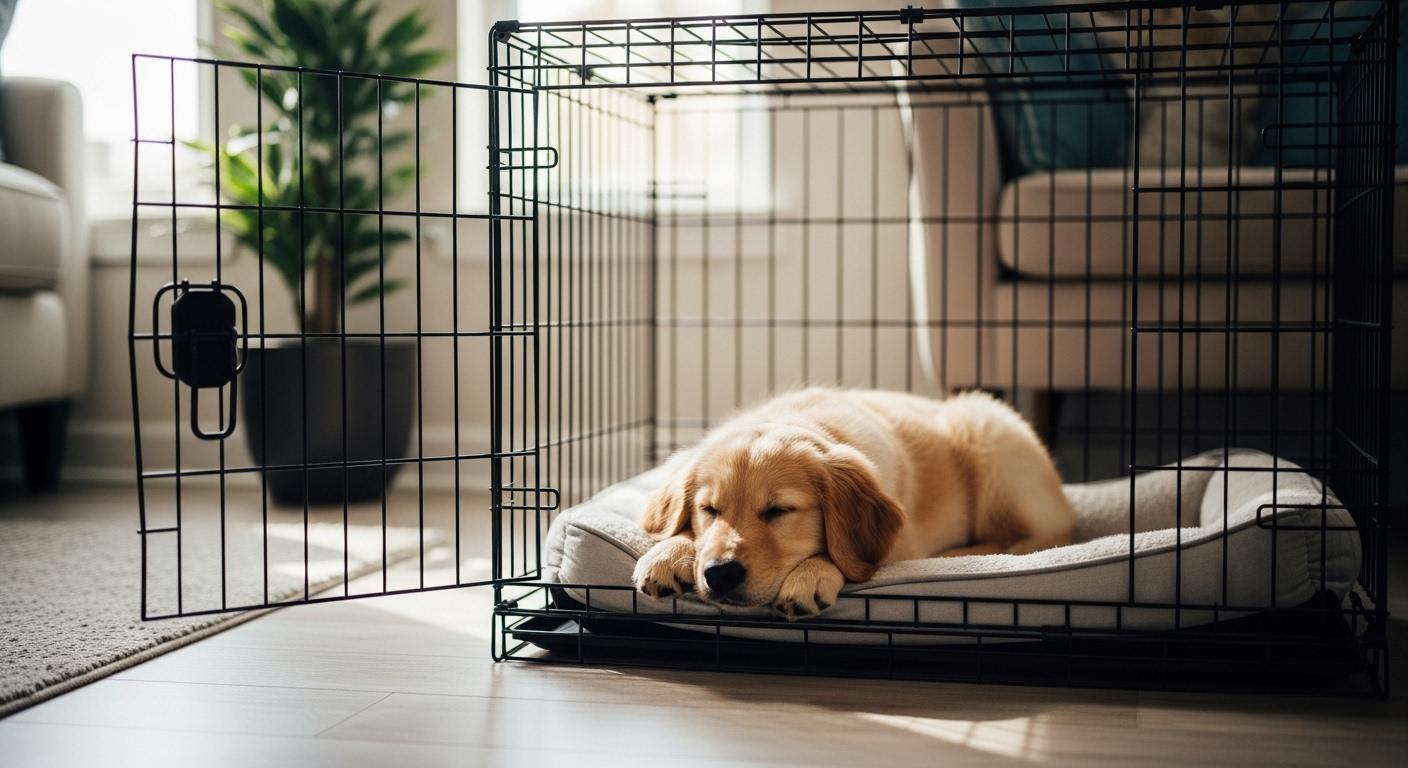
Dogs are den animals. A properly sized crate taps into their natural instinct to keep their sleeping space clean, which is the fastest shortcut in housetraining a puppy. The crate is a tool, not a punishment, and used right it cuts accidents dramatically.
If your dog hates the crate or panics when the door closes, that’s a separate problem worth solving with a trainer working directly in your home. Our in-home dog training covers crate desensitization alongside potty work so the two reinforce each other.
Choosing the Right Crate Size
The sizing rule is simple. The crate should be big enough for your dog to stand up, turn around, and lie down comfortably. Any bigger and your dog will eliminate in one corner and sleep in the other, which defeats the whole point.
For puppies who will grow into a large adult crate, buy the adult size and use a divider panel. Move the panel back as your puppy grows.
Quick sizing guide by weight:
- Under 25 lbs: 24-inch crate
- 25 to 50 lbs: 30 to 36-inch crate
- 50 to 90 lbs: 42 to 48-inch crate
- 90+ lbs: 48 to 54-inch crate
Crate type matters too. Wire crates give better airflow, which is a real concern in North Texas summers. Plastic travel crates feel more enclosed and suit security-seeking dogs who want a darker den. In Plano, McKinney, or any home with a sunroom or south-facing window, go wire and keep the crate out of direct afternoon sun. A crate parked in a hot garage in July is dangerous, not helpful.
Building a Positive Crate Routine
You want your dog walking into the crate on their own. Forcing them in only builds resistance. Use this 5-step introduction:
- Place the crate in a common area where the family hangs out, not isolated in a back room.
- Leave the door open and toss treats inside. Let your dog explore on their own time.
- Feed all meals inside the crate with the door still open.
- Start closing the door for 5 to 10 minutes at a time, then extend gradually.
- Never let your dog out while they are whining or barking. Wait for a quiet moment, even 10 seconds, before opening the door.
That last step is the one most owners miss. Releasing a whining dog teaches them whining works. They will whine louder and longer next time.
How long can your dog stay crated? Here are the limits we use with clients across Allen, Prosper, and the surrounding area:
- Puppies under 6 months: 3 to 4 hours max during the day
- Adult dogs: 4 to 6 hours max without a potty break
- Overnight: 7 to 8 hours is fine because dogs sleep and their systems slow down
Stick to these windows and pair them with the schedule from the last section. That combination is where dog potty training tips stop being theory and start producing a clean house.
If you need a place for your dog during a workday or weekend trip while house training is in progress, our dog boarding keeps the same potty schedule and crate routine intact so you do not lose ground. Many owners also add dog grooming to the stay since accidents during the early weeks can leave a puppy needing a fresh start.
How to Read Your Dog’s Signals Before an Accident Happens
A consistent schedule prevents most accidents. Reading your dog catches the rest. Between scheduled trips, your dog will still feel the urge, and they almost always tell you before anything hits the floor. The trick is knowing what to look for.
Common Pre-Potty Warning Signs
Most dogs run through the same short list of behaviors right before they squat. Watch for these:
- Circle-sniffing the floor in tight patterns
- Sudden loss of focus during play or chewing
- A brief half-squat that looks like stretching
- Whining or walking toward the door
- Agitated pacing from room to room
- Scratching at the door, the rug, or your leg
Puppies go from signal to puddle in about 10 to 15 seconds. Adult dogs usually give you 30 seconds or more. Either way, move fast and stay calm. Scoop the puppy up, leash the adult, and head straight outside. Never scold the signal itself, or your dog will learn to hide it from you.
One more note for owners dealing with leg-lifting or repeat indoor marking spots: that is a different problem than basic potty training. If you are seeing marking patterns, our behavior modification training in Frisco handles those cases directly.
What to Do When You Catch an Accident in Progress
Catching them mid-squat is actually a training opportunity. Here is the correct response:
- Make a sharp, neutral interrupt sound. A quick “ah-ah” or a single clap. No yelling, no name-calling.
- Guide them outside immediately, on leash if needed.
- Wait at the potty spot. If they finish outside, reward with calm praise and a treat.
- Clean the indoor spot with an enzymatic cleaner.
Enzymatic cleaners matter more than most owners realize. The protease enzymes break down the biological compounds your dog can still smell long after the stain looks gone. Skip ammonia-based cleaners. Ammonia smells like urine to a dog and basically marks the spot as a bathroom. The hard surface floors common in newer Plano and McKinney builds, luxury vinyl plank and tile, are more forgiving than carpet, but your dog still scents the subfloor. Clean it properly the first time.
One last piece of advice that contradicts what a lot of people will tell you: never punish an accident you find later. If you did not catch it happening, your dog cannot connect the mess to your reaction. Dragging them over to it only damages trust and makes house training take longer. Just clean it and move on.
If your dog is stuck at the same point in house training, or you want trained results faster than DIY allows, our team can help. Call All Dogs Unleashed at (972) 573-1715 to talk through your dog’s situation and find the right training path.
Frequently Asked Questions
Does Age Affect How Quickly a Dog Can Be House Trained?
Yes, age plays a real role in house training timelines. Puppies under 12 weeks have limited bladder control and simply cannot hold it as long as older dogs, so accidents are expected more frequently early on. Adult and senior dogs can often learn faster once training begins because they have greater physical control, though they may also bring established habits that take extra time to redirect. All Dogs Unleashed Dog Training Frisco works with dogs of all ages and tailors each training program to fit the individual dog.
Should I Punish My Dog After Finding an Accident I Did Not Witness?
Punishing a dog for an accident you did not see directly is ineffective and can create anxiety or fear around you. Dogs do not connect a correction to something that happened even minutes earlier, so scolding after the fact only confuses them. The better response is to clean the spot thoroughly with an enzymatic cleaner to remove the scent marker, then focus on tightening your supervision and schedule going forward.
What Cleaning Products Actually Eliminate Odor So My Dog Does Not Return to the Same Spot?
Standard household cleaners like ammonia-based products can actually mimic the scent of urine and attract your dog back to the same area. Enzymatic cleaners are specifically formulated to break down the proteins in urine and feces at a molecular level, which fully removes the odor cue your dog is following. Look for pet-specific enzymatic sprays at most pet retailers, and allow adequate soak time before blotting the area dry.
Can a Dog Be Successfully House Trained Without Using a Crate?
Crate-free house training is possible but requires much more intensive supervision and a very consistent schedule. Without a crate, you need to either keep the dog within direct sight at all times or confine them to a small, easy-to-clean area using baby gates or an exercise pen. The risk of unsupervised accidents is significantly higher, which can slow overall progress. Our in-home dog training is the best fit here because the trainer maps out a crate-free management plan inside your actual home layout, with or without a crate.
Is House Training Harder for Certain Breeds Than Others?
Some breeds are commonly described as more difficult to house train, including many small and toy breeds whose owners may have tolerated accidents longer before seeking help. Scent hound breeds can also be easily distracted outdoors, making it harder to keep them focused on going to the bathroom rather than following a smell. That said, individual temperament, early socialization history, and consistency in training matter far more than breed alone in determining how quickly a dog learns.
How Do I Handle House Training When My Dog Refuses to Go Outside in Bad Weather?
Weather reluctance is a common challenge, particularly for small dogs or breeds with thin coats. A dog raincoat or booties can reduce discomfort enough to get them moving, and going outside with your dog rather than just sending them out reinforces that outdoor potty trips happen regardless of conditions.
Keeping a specific covered or sheltered potty spot consistent can also help your dog feel more comfortable during rain or cold. Practicing short, positive outdoor trips during mild weather builds a strong enough habit that most dogs will follow through even when conditions are less ideal.
What Should I Expect During a Follow-Up Session With a Trainer if Progress Has Stalled?
A follow-up session typically starts with a review of your current daily routine, supervision habits, and any patterns around when and where accidents are happening. A trainer will look for gaps in the schedule, inconsistencies in confinement, or signals the owner may be missing before an accident occurs. All Dogs Unleashed Dog Training Frisco uses that information to adjust the specific plan rather than starting over.
For stubborn cases that have stalled too long, our board and train program runs the schedule around the clock and resets the habit fast, and many owners pair the stay with dog boarding coverage for follow-up trips along with dog grooming since accidents during the early weeks often leave a puppy needing a fresh start.
Ready to Get Started with All Dogs Unleashed Dog Training Frisco?
Call (972) 573-1715 to speak with our team directly, or reach out using the form below.
Reach out today and let’s talk about how we can help.