
A tired dog is a good dog. You’ve heard it a hundred times. But what most owners don’t realize is that physical exercise alone isn’t enough. A dog that runs three miles and comes home still restless, still chewing the couch, still barking at every sound, isn’t under-exercised. It’s under-stimulated.
Dog enrichment ideas aren’t extras or luxuries. They’re how you meet your dog’s mental needs, the ones that a walk around the block and a game of fetch don’t fully address. Mental stimulation for dogs burns energy, reduces anxiety, prevents destructive behavior, and builds the kind of calm confidence that makes every other part of your relationship with your dog easier. The best part is that most of these activities cost nothing, take less than ten minutes to set up, and use things you already have at home. Here are ten you can start today.
Key Takeaways
- Mental fatigue tires a dog out faster and more effectively than physical exercise alone
- Most common behavior problems like destructive chewing, excessive barking, and hyperactivity trace back to boredom and insufficient mental stimulation
- Enrichment doesn’t require expensive toys; many of the most effective activities use household items or your dog’s regular meals
- Nose work and scent games tap into your dog’s strongest sense and provide deep mental engagement with minimal physical effort
- Short training sessions are one of the highest-value enrichment activities available, and they build obedience skills at the same time
- Enrichment should be matched to your dog’s breed, drive, and temperament for the best results
Why Enrichment Matters More Than Most Owners Realize
Dogs evolved to spend their days working. Tracking scent, hunting, patrolling, herding, problem-solving. The modern pet dog spends most of its day sleeping on the couch waiting for something to happen. That gap between what the dog’s brain is built to do and what it actually gets to do is where behavior problems grow.
A dog that chews your shoes isn’t being spiteful. It’s bored. A dog that barks nonstop when you leave isn’t being dramatic. It has nothing else to do. A dog that can’t settle in the evening after a full day of napping isn’t broken. It’s mentally unfulfilled. Our guide on destructive chewing and digging covers how these behaviors develop, and enrichment is the preventive measure that keeps them from starting in the first place.
Fifteen minutes of mental stimulation can tire a dog out as effectively as a 45-minute walk. That’s not an argument against walks. It’s an argument for combining both. A dog that gets physical exercise and mental enrichment is a calmer, more settled, more trainable dog.
1. Scatter Feeding and Snuffle Mats
The simplest enrichment swap you can make is to stop feeding your dog from a bowl. Your dog’s kibble is a training and enrichment resource that gets wasted every time you dump it into a dish.
Scatter feeding means tossing a handful of kibble across the grass in your backyard or across a clean floor and letting your dog use its nose to find each piece. It takes a dog that would inhale a bowl of food in 90 seconds and turns mealtime into a 10- to 15-minute nose work session.
A snuffle mat works on the same principle. It’s a fabric mat with deep fleece strips that hide food throughout the folds. The dog pushes its nose through the fabric to find each piece, which engages the seeking system in the brain and produces a natural calming effect. You can buy one or make your own with a rubber sink mat and fleece strips.
Des Moines backyards work perfectly for scatter feeding in spring, summer, and fall. During Iowa winters, move the activity indoors onto a textured rug or towel.
2. Frozen Kongs and Stuffed Chews
A frozen Kong is the workhorse of dog enrichment. Stuff it with a mix of your dog’s kibble, a smear of peanut butter (xylitol-free), mashed banana, or plain yogurt, and freeze it overnight. The frozen filling takes 20 to 40 minutes for most dogs to work through, which gives you a reliable block of calm, focused activity.
Build difficulty gradually:
- Beginner: Loose kibble with a peanut butter plug at the opening. The food falls out easily and the dog learns the concept.
- Intermediate: Mixed filling (kibble, wet food, banana) packed tightly and frozen for four to six hours. Requires licking and chewing to extract.
- Advanced: Layered filling frozen solid overnight with a hard plug of frozen broth at the opening. Takes 30 to 40 minutes of sustained effort.
Rotate the fillings to keep the experience novel. A dog that gets the same peanut butter Kong every day will eventually lose interest. Variety keeps the enrichment value high.
3. Nose Work and Scent Games
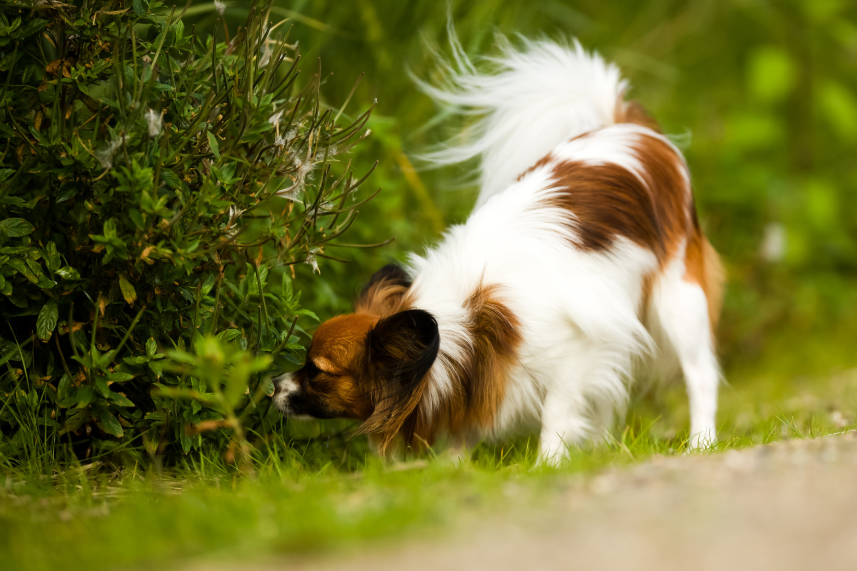
Your dog’s nose is its most powerful tool. Dogs have up to 300 million olfactory receptors compared to a human’s 6 million. Nose work taps into that capability and provides deep mental engagement with almost no physical effort, which makes it especially valuable for puppies, senior dogs, injured dogs, or dogs recovering from surgery.
Start with a simple hide-and-seek game. Place your dog in a sit-stay (or have someone hold the dog), hide three to five high-value treats in easy locations around one room, and release the dog with a “find it” cue. As the dog gets better, increase the number of hiding spots, spread the search across multiple rooms, and choose harder locations like behind furniture or inside open drawers.
For Des Moines owners, outdoor nose work is ideal in cooler months. Hide treats along a fence line, under rocks in the backyard, or at the base of trees during a walk. The dog isn’t just walking anymore. It’s working. For owners with scent-driven breeds like Beagles, Bloodhounds, or Coonhounds, our guide on training hounds with strong instincts covers how to channel that drive productively.
4. Training Sessions as Enrichment
Five minutes of focused training is one of the most mentally taxing things you can ask your dog to do. Learning new skills, holding commands under duration, and problem-solving through shaping exercises all require intense concentration, which is exactly what makes training such effective enrichment.
You don’t need to teach new tricks every session. Practicing known commands in new contexts (sit in the backyard instead of the kitchen, down on a park bench instead of the living room floor) is a form of mental stimulation because the dog has to generalize the skill to a new environment. Adding duration (holding a sit for 30 seconds instead of 5) or distance (staying while you walk 20 feet away instead of 5) also increases the mental demand.
The key is keeping sessions short and ending on a success. A five-minute session that ends with a perfectly executed recall is more productive than a twenty-minute session that ends with a frustrated owner and a confused dog. For strategies on extending your dog’s ability to focus during these sessions, our tips on building your dog’s attention span cover the progression.
5. Structured Tug With Rules
Tug is one of the most misunderstood dog games. Played without rules, it can ramp a dog’s arousal to a level that’s hard to bring back down. Played with structure, it becomes one of the best enrichment activities available because it combines physical effort with impulse control.
The rules are simple:
- The game starts with a cue (“get it” or “tug”)
- The game stops immediately when you say “drop” or “out”
- The dog must release the toy and sit before the game resumes
- If teeth touch skin, the game ends for 30 seconds
This start-stop structure teaches the dog to regulate its own arousal, which is a skill that transfers directly to every other area of behavior. A dog that can get intensely excited during tug and then immediately calm down on cue is a dog that’s learning emotional control. Our deep dive on is tug of war safe for dogs covers the full mechanics and addresses the common myths about tug causing aggression.
6. Decompression Walks
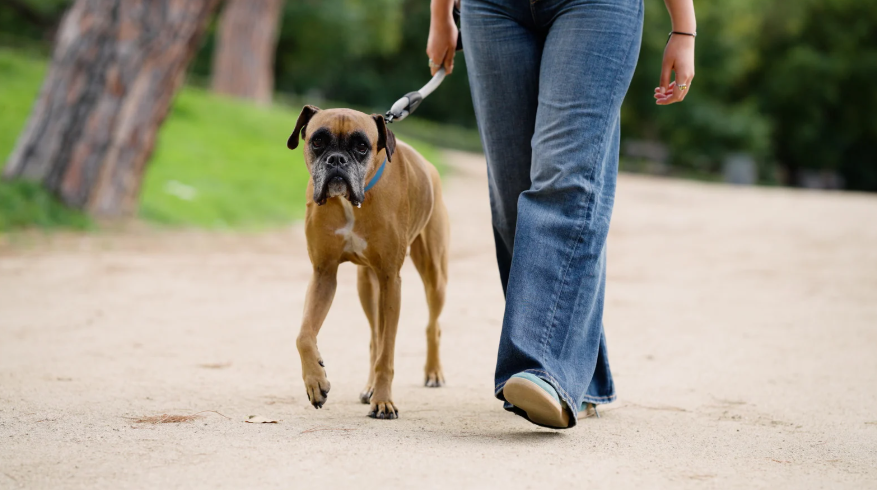
A decompression walk is the opposite of a structured heel. It’s a long-line walk where you let the dog lead with its nose, choosing where to go and how long to sniff at each spot. The purpose isn’t exercise. It’s sensory processing.
Attach a 15- to 20-foot long line, head to a quiet stretch of the Walnut Creek Trail, Brown’s Woods, or a low-traffic neighborhood sidewalk, and let your dog sniff everything. Don’t rush it. Don’t redirect. Don’t ask for commands. Just follow. A 30-minute decompression walk where the dog sniffs freely can be more mentally satisfying than a 60-minute structured walk at heel.
Decompression walks are especially valuable for dogs that are anxious, reactive, or overstimulated. Sniffing activates the parasympathetic nervous system, which naturally lowers stress and arousal. For dogs that struggle with overexcitement in general, our post on how to curb overexcitement covers additional strategies.
7. Puzzle Feeders and Interactive Toys
Puzzle feeders require the dog to manipulate an object to access food. They range from simple wobble toys that dispense kibble when knocked around to multi-step puzzles with sliding panels and lift-off compartments.
Start with an easy puzzle and work up. A dog that’s never used a puzzle feeder and gets handed a level-three puzzle will give up after 30 seconds. A dog that’s been working through progressively harder challenges will spend 15 minutes problem-solving with focus and patience.
Rotate puzzles every few days. A dog that solved the same puzzle yesterday already knows the answer, and the enrichment value drops to near zero. Keep three or four puzzles in rotation and swap them weekly to maintain novelty.
8. Novel Environment Exposure
Novelty itself is enrichment. A dog that walks the same route every day eventually tunes out the environment because there’s nothing new to process. Changing the route, the neighborhood, or the trail forces the dog’s brain to engage with unfamiliar sights, sounds, surfaces, and smells.
Des Moines makes this easy. Drive to a different trailhead on the weekend. Walk through the East Village instead of your usual Beaverdale loop. Take your dog to an outdoor patio on Ingersoll Avenue. Visit a pet-friendly store. Every new environment is a mental workout because the dog has to process unfamiliar information, which is exactly what enrichment is designed to provide.
Even small changes count. Walking your usual route in the opposite direction, going out at a different time of day, or parking at a different trailhead entrance on the same trail all give the dog something new to process.
9. Place Command and Calm Enrichment
Enrichment isn’t only about stimulation. Teaching your dog to settle, to be calm and relaxed on a designated mat or bed, is a skill that requires mental effort and produces genuine behavioral benefits.
The “place” command asks your dog to go to a specific spot and remain there in a relaxed state until released. It sounds passive, but for many dogs, especially high-energy or anxious dogs, learning to do nothing is the hardest thing you can ask of them. Holding a calm down-stay while activity happens around the house builds impulse control, reduces arousal-based behavior problems, and gives the dog a clear framework for when it’s time to be still.
Practice during low-key moments first. Have the dog hold place while you cook dinner, watch television, or fold laundry. Reward the calm. Gradually introduce more stimulating contexts. This skill is especially valuable for dogs whose attention-seeking behavior disrupts the household routine.
10. DIY Enrichment With Household Items
You don’t need to buy anything to enrich your dog’s day. Some of the most effective enrichment activities use items you already have.
- Muffin tin game: Place treats in a few cups of a muffin tin and cover each cup with a tennis ball. The dog has to remove the balls to find the food.
- Towel roll: Lay treats along a hand towel, roll it up, and let the dog unroll it with its nose and paws.
- Cardboard box search: Fill a box with crumpled newspaper or paper towels and hide kibble throughout. The dog digs and sniffs to find each piece.
- Plastic bottle spinner: Put kibble inside an empty plastic water bottle (cap removed) and let the dog figure out how to tip and roll it to get the food out.
- Ice block treasure hunt: Freeze toys and treats in a bowl of water overnight and give the dog the frozen block to lick and paw apart in the backyard.
Supervise all DIY activities to make sure the dog doesn’t ingest paper, plastic, or other materials. Once the dog finishes, remove the items.
Matching Enrichment to Your Dog’s Breed and Drive
Not every enrichment activity works equally well for every dog. Tailoring the activity to your dog’s natural drives produces better engagement and deeper mental satisfaction.
| Drive Type | Breeds (examples) | Best Enrichment Match |
|---|---|---|
| Scent-driven | Beagles, Bloodhounds, Basset Hounds, Coonhounds | Nose work, scatter feeding, scent trails, decompression walks |
| High prey drive | Terriers, Sighthounds, Huskies, Belgian Malinois | Tug with rules, flirt pole (controlled), puzzle feeders with movement |
| Retrieve drive | Labradors, Golden Retrievers, Spaniels | Fetch with obedience layered in (sit before throw, recall between throws) |
| Velcro/handler-focused | German Shepherds, Border Collies, Poodles | Training sessions, shaping games, cooperative tasks |
| Independent | Shiba Inus, Akitas, Chow Chows, Basenjis | Puzzle feeders, solo nose work, frozen Kongs, environment exploration |
These are starting points, not rules. Every dog is an individual, and the best enrichment plan is one built around what your specific dog finds engaging. Explore all available dog training programs at All Dogs Unleashed in Des Moines if you want help building a structured enrichment and training plan tailored to your dog’s breed and temperament.
Frequently Asked Questions
How much mental stimulation does a dog need per day?
Most adult dogs benefit from 15 to 30 minutes of dedicated mental enrichment per day, which can be broken into two or three short sessions. This is in addition to physical exercise, not a replacement for it. High-energy and working breeds may need more. Senior dogs and low-drive breeds may be satisfied with less. Watch your dog’s behavior for signals: a dog that’s calm, settled, and not destroying things is getting enough.
Can enrichment replace physical exercise?
No, but it complements it powerfully. Physical exercise addresses the body. Enrichment addresses the brain. A dog that gets both is significantly calmer and better behaved than a dog that only gets one. On days when physical exercise isn’t possible, such as during Iowa’s January cold snaps or July heat waves, enrichment activities can bridge the gap and prevent the restlessness that leads to behavior problems.
Will my dog get bored of enrichment activities?
Dogs can lose interest in any activity that becomes too predictable. The solution is rotation and progression. Change the activity, increase the difficulty, vary the location, and swap out the toys or puzzles regularly. A dog that mastered a puzzle feeder last month needs a harder one this month or a completely different type of enrichment.
Is enrichment helpful for anxious dogs?
Very. Many enrichment activities, especially nose work, decompression walks, and frozen Kongs, activate the parasympathetic nervous system and produce a natural calming effect. Enrichment also gives anxious dogs a structured activity to focus on, which redirects the mental energy that would otherwise fuel pacing, whining, or destructive behavior.
Can I use my dog’s regular kibble for enrichment?
Absolutely, and you should. Instead of feeding meals from a bowl, use the entire daily kibble portion across scatter feeding, puzzle feeders, frozen Kongs, and training sessions. The dog eats the same amount but works for every piece, which turns three passive meals into three enrichment sessions.
What enrichment is best for puppies?
Frozen Kongs, simple scatter feeding, short nose work games, and brief training sessions (three to five minutes) are ideal for puppies. Avoid complex puzzles that cause frustration, and supervise all activities closely. Puppies benefit enormously from novel environment exposure during the socialization window. For a full developmental timeline, in-home dog training can help you build an enrichment plan matched to your puppy’s age and stage.
Contact All Dogs Unleashed in Des Moines
A well-enriched dog is a calmer, happier, and more trainable dog. The team at All Dogs Unleashed in Des Moines can help you build an enrichment and training plan that fits your dog’s breed, drive, and daily routine. Contact us today to get started.
About All Dogs Unleashed
All Dogs Unleashed has spent decades helping dog owners go beyond basic obedience to build a complete relationship with their dogs. With locations across the country, including Des Moines, ADU’s trainers work with every breed and energy level, combining structured training with enrichment strategies that produce calmer, more confident dogs at home and in the real world.