
Your dog lunges at another dog on the trail, barks at a passing cyclist, or freezes up at the dog park. Is that aggression, or something else entirely? A lot of Oklahoma City dog owners aren't sure, and that confusion can lead to the wrong training approach. Understanding reactive dog training vs. aggressive dog training is the first step toward real results.
The team at All Dogs Unleashed Dog Training OKC works with dogs across the metro every week, and we know firsthand that getting this distinction right changes everything about the plan we build. Not sure which training your dog needs? Book a behavioral assessment in OKC and get a clear answer.
Key Takeaways
- Reactivity and aggression look similar but have different causes, and each requires a different training approach.
- Most dogs that lunge, bark, or growl on leash are reactive, not truly aggressive.
- Understanding the difference between the two helps you choose the right training program for your dog.
- Early intervention matters. Untreated reactivity can escalate into more serious behavior over time.
- We assess your dog's specific behavior in person before recommending any program.
Is Your Dog Reactive or Aggressive? Here's Why It Matters
You're embarrassed, frustrated, and honestly not sure if your dog is dangerous or just out of control. Sound familiar? It's one of the most common questions we hear from Oklahoma City dog owners: is my dog reactive or aggressive, and does it actually matter which one? It matters a lot. The root causes are different, the training approach is different, and mixing them up can genuinely make things worse.
This guide covers exactly what separates reactivity from aggression, what causes each one, how one can escalate into the other, and which training path fits your dog. We put this together for owners who want real answers, not guesswork. Our dog training team in Oklahoma City assesses these behaviors in person every week, and by the end of this article you will know what your dog needs and what to do next.
What Is Dog Reactivity?
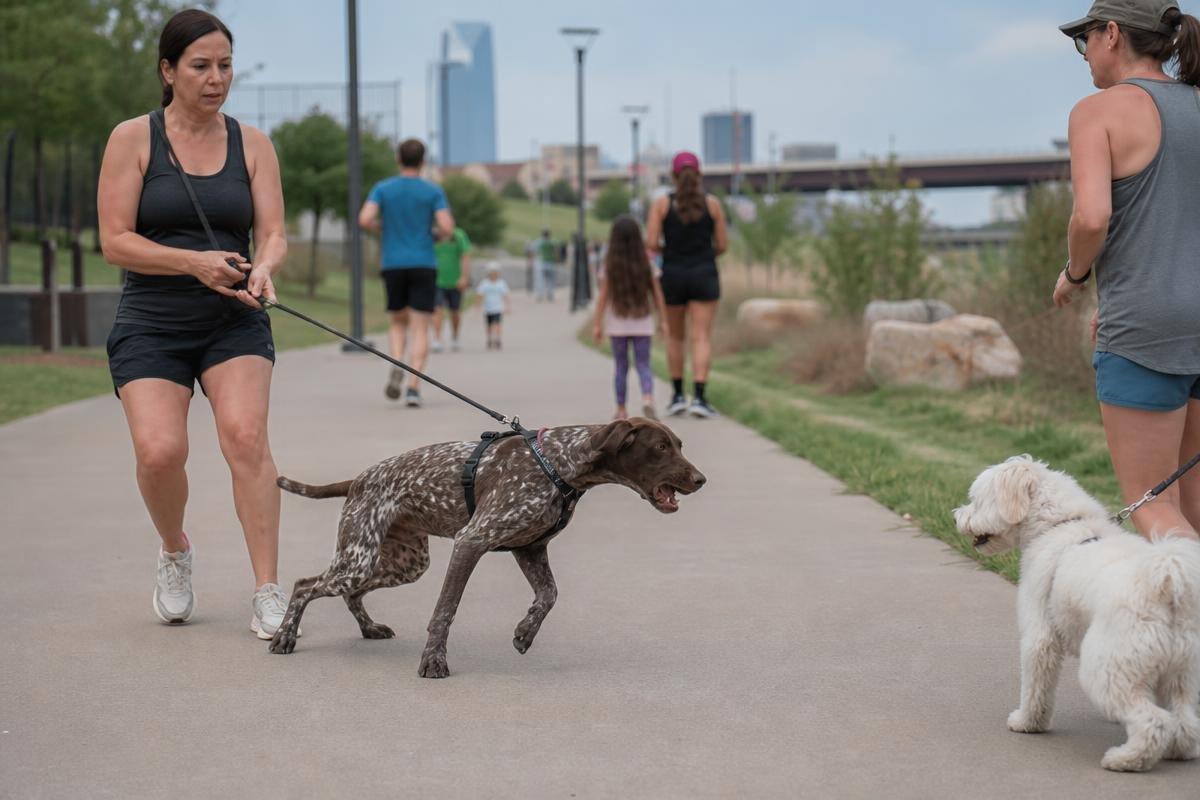
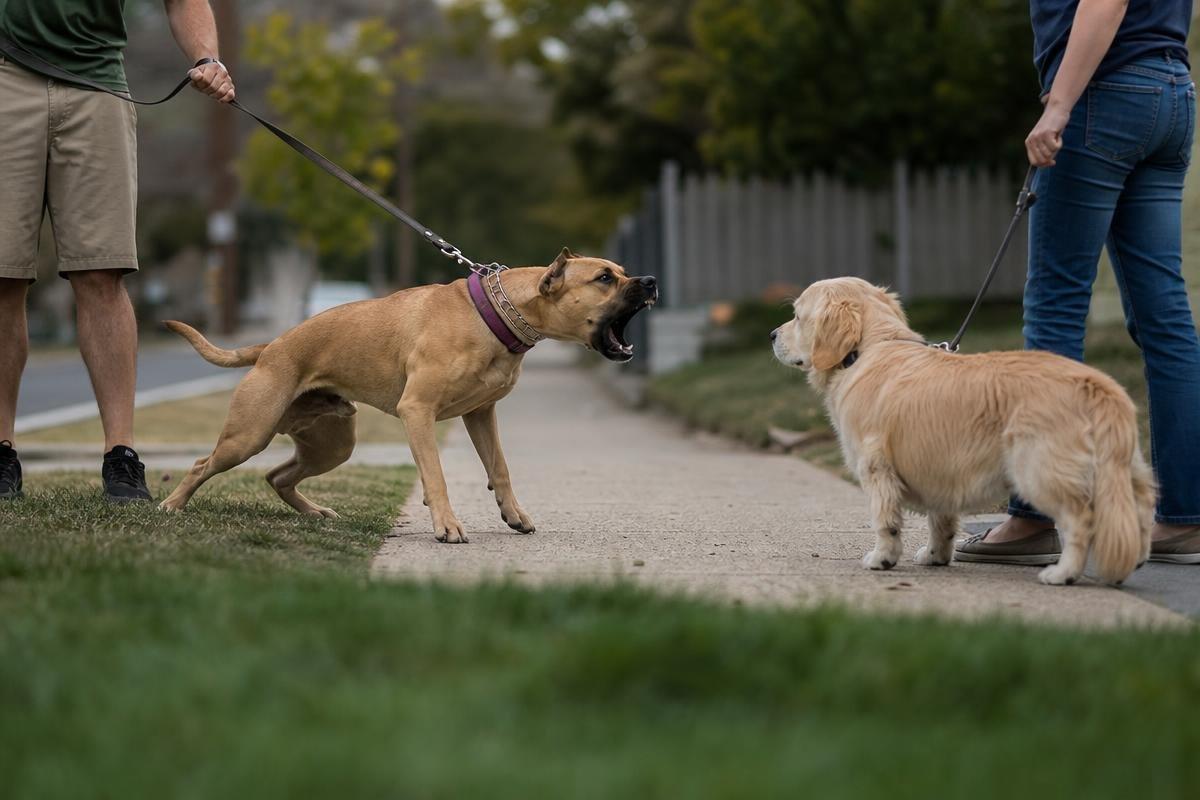
Dog reactivity is an overreaction to a specific trigger in the environment. It is not an intent to harm. A reactive dog's nervous system is running hot, and behaviors like barking, lunging, or hard pulling are coping responses, not calculated attacks. The American Kennel Club describes reactivity as a response that is simply disproportionate to the actual threat level the dog is facing.
This explains why your dog can be perfectly calm on the couch and then completely lose it the moment another dog appears around the corner. At home, there are no triggers. On the leash, the triggers come fast and the dog has nowhere to go. That trapped feeling is often what turns a mildly anxious dog into one that looks, from the outside, like a serious behavior problem.
The Signs of a Reactive Dog
Reactive behavior shows up in a recognizable pattern once you know what to look for. These are the signs we see most often with dogs brought in for evaluation:
- Lunging toward or away from a trigger on leash
- Barking or growling at something across the street
- Hard pulling that feels frantic, not just excited
- Hackles raised along the back
- Inability to refocus on you once the trigger appears
- Pacing or whining before the trigger is even visible
That last one is important. Reactive dogs often pick up on cues you cannot see yet. Their threshold is already rising before you realize what is coming.
What Triggers Reactivity?
The most common triggers are other dogs, unfamiliar people, fast-moving objects like bikes or joggers, and loud or sudden sounds. Leash reactivity specifically, where the dog reacts because the leash removes its ability to flee or approach freely, is one of the most frequent issues we address through structured behavior work.
This is especially common in high-traffic areas. Neighborhoods like Midtown and the Plaza District have cyclists, foot traffic, and the occasional off-leash dog that can push a reactive dog past its limit quickly. It's worth remembering that Oklahoma City's leash ordinance requires dogs to be restrained in public spaces, so an off-leash dog running up to your reactive dog is not only stressful, it's a genuine variable you can't control.
There's a real difference in stress levels, too, when Oklahoma summer heat pushes into the upper 90s and above. A dog that's already hot and panting hits threshold faster, which is why we often shift training sessions to early morning during July and August. The good news is that reactivity is common and very treatable. It is not a character flaw in your dog. It is a dog that needs the right support.
Ready to start behavior modification for your reactive dog? Book an assessment in OKC and we'll pinpoint the triggers.
What Is Aggression in Dogs?
Aggression is intentional threatening or harmful behavior directed at a person, another animal, or an object. That word "intentional" matters. An aggressive dog is not just reacting to a feeling. The dog is working toward a specific outcome, whether that is making a threat go away, protecting a resource, or controlling space.
The behavioral markers are distinct. You will see a stiff, rigid body. A hard, unblinking stare. A low, steady growl. Snapping without contact, or a bite that makes contact. These are not the frantic, over-the-top signals of a reactive dog. They are deliberate and controlled, which is exactly what makes aggression a more serious behavioral issue.
Knowing the difference between the two matters because the training approach is completely different. Misreading aggression as simple reactivity can put people and other dogs at risk.
Types of Dog Aggression
Aggression is not one single thing. Across the OKC metro, we see several distinct types:
- Fear-based aggression: the most common type we see; the dog feels cornered and goes on offense
- Territorial aggression: protecting the home, yard, or vehicle
- Resource guarding: food, toys, furniture, or even a person
- Redirected aggression: frustrated by one trigger, the dog redirects onto whoever is closest
- Pain-induced aggression: a dog in physical discomfort may snap when touched
Fear-based aggression and resource guarding are the two types we see most often in dogs coming to us from Edmond, Yukon, and surrounding areas. In our experience, redirected aggression is the one owners misidentify most, because it looks like the dog "turned on them" out of nowhere. In reality the dog was already over threshold at another trigger, and the closest person or pet caught the fallout. Correctly identifying that root trigger, rather than treating the redirect, is what actually resolves it.
What Causes Aggressive Behavior?
Root causes vary, but common ones include limited socialization early in life, a traumatic experience, punishment-heavy training that increases fear, and pain or illness. Always rule out a medical issue first. A vet check before starting any behavior program is a step we strongly recommend.
One thing worth knowing: aggression rarely appears without warning. Most dogs gave signals that were missed or ignored over time. That is why working with an experienced behavior professional matters so much. A trained eye identifies the root cause first, then builds a plan around it.
Reactive vs. Aggressive: The Key Differences Side by Side
Now that we have defined both behaviors, let's put them next to each other. The difference is not just about how loud or scary the behavior looks. It comes down to what is driving it.
Emotional State vs. Intent
A reactive dog is emotionally overwhelmed. The behavior is a stress response, not a strategy. Think of it like a person who screams and jumps when someone sneaks up behind them. They are not trying to hurt anyone. They are just startled and scared.
An aggressive dog is goal-directed. The behavior is meant to make something happen, usually to make a threat go away or to protect a resource. Think of someone who steps toward you and says "back off." That is a deliberate choice, not a panic response.
That single distinction, emotional overwhelm versus intentional behavior, is the clearest way to understand dog reactivity vs aggression.
How Each Behavior Looks in Real Life
Here is a side-by-side look at how each behavior actually shows up:
- Trigger response: Reactive dogs explode suddenly at the trigger. Aggressive dogs may escalate more deliberately, often with warning signals first.
- After the trigger is gone: A reactive dog typically settles and returns to normal fairly quickly. An aggressive dog may stay tense and vigilant.
- Body language: Reactive dogs often show high arousal, lunging, barking, spinning. Aggressive dogs show hard stares, stiff posture, low growls, and controlled stillness.
- Predictability: Reactive dogs are often consistent around specific triggers. Aggressive dogs can be harder to predict across different contexts.
- Training focus: Reactive dogs need threshold management and positive associations. Aggressive dogs need structured behavior modification with safety protocols in place.
Picture a dog on a walk through Nichols Hills. Another dog appears across the street. Your dog erupts, barking and pulling hard. The other dog passes. Your dog shakes it off and trots along happily. That is reactivity.
Now picture a dog at his food bowl. You walk toward him. He freezes. His eyes go hard. He stiffens without making a sound, then snaps when you get too close. That is resource-guarding aggression, a very different problem that needs a different plan. We assess both patterns before recommending any program. Getting the diagnosis right is what makes the training work.
Can a Reactive Dog Become Aggressive Over Time?
Yes. Without support, a reactive dog can develop truly aggressive behavior. This is not inevitable, but it is a real risk that owners in the Edmond and Yukon areas ask us about regularly. The good news is that early intervention makes a significant difference in how this plays out.
The Escalation Risk
Here is how the slide from reactivity to aggression typically happens. A reactive dog barks and lunges as a warning. Those signals are the dog's way of saying, "I am uncomfortable, please create distance." When those warnings are repeatedly punished or suppressed, the dog learns that warning signals do not work. So the dog skips them and goes straight to snapping or biting.
This is called learned helplessness in warning behavior, and it is one of the more serious outcomes we see. A related problem is trigger stacking, where a dog encounters multiple stressors in a short window and tips over the threshold faster than the owner expects. Busy walking environments make this worse. Trails near Lake Hefner, for example, can hit a reactive dog with joggers, cyclists, and other leashed dogs all within a few minutes. That kind of repeated rehearsal accelerates the problem.
Cornell Veterinary School has noted that reactivity without support can progress to aggression over time. That framing matches what we see in real cases here every week.
What Stops the Slide from Reactivity to Aggression
Three interventions make the biggest difference when working with an over-threshold dog:
- Desensitization: Working below your dog's threshold and gradually closing distance to the trigger at a pace the dog can handle.
- Counter-conditioning: Pairing the trigger with high-value rewards so the dog builds a new emotional association with the thing that scared them.
- Management tools: Front-clip harnesses, head halters, and distance protocols prevent your dog from rehearsing reactive behavior while training is underway.
Consistency and timing are everything here. That is why professional involvement produces faster, more reliable results than a DIY approach. For dogs who need more intensive work, ask us about what happens during a board and train program in OKC and whether it fits your dog's situation. The sooner you act, the more options you have. Worried your reactive dog is heading in the wrong direction? Let's get ahead of it. Call us at (405) 299-3386 to talk through what your dog needs.
Which Training Approach Does Your Dog Actually Need?
Getting this right matters more than most people realize. A reactive dog and an aggressive dog need different training plans. Using the wrong approach can stall progress or, in aggression cases, make things worse.
Training for Reactive Dogs
Reactive dog training is built around threshold work. We start by identifying the exact distance at which your dog notices a trigger but stays under control. Then we use counter-conditioning and desensitization to shift your dog's emotional response, pairing the trigger with high-value rewards so your dog learns that other dogs or cyclists predict good things, not a threat.
Session by session, we also build impulse control. Commands like "watch me," "leave it," and "sit" give your dog something to do instead of reacting. Leash skills matter too. A tight, anxious leash makes reactivity worse. Most dogs with true reactivity show real improvement within a few weeks of consistent work.
- Threshold-based desensitization to specific triggers
- Counter-conditioning with high-value food rewards
- Impulse control exercises: sit, watch me, leave it
- Loose-leash walking and handler positioning skills
One important note: group classes are not the right starting point for a reactive dog. The environment is too stimulating before the dog has the skills to cope. Private sessions are where reactive dog training in Oklahoma City should begin. Read what to expect from your first in-home training session in Oklahoma City to understand how we structure those early sessions.
Training for Aggressive Dogs
Aggressive dog behavior training in OKC starts with a thorough behavioral assessment. We need to know the trigger, the context, and the bite history before we build any plan. Management protocols come first so the behavior stops being rehearsed while training is underway.
From there, we use systematic desensitization specific to the aggression trigger, combined with owner education on reading body language correctly. Aggression cases are never a DIY project. We handle these cases directly. Attempting to correct aggression without guidance can escalate the behavior fast.
Dealing with growling, snapping, or guarding? Ask us about a behavior modification program built for your dog's specific triggers.
When to Choose Board and Train vs. In-Home Sessions
The right format depends on your dog's severity and your triggers. Here is the short version:
- Board and train: Better fit for moderate to severe reactivity or aggression. Daily, consistent training in a controlled environment accelerates progress.
- In-home sessions: Best for mild reactivity, dogs whose triggers are primarily inside the home, or owners who want to be hands-on in every session from day one.
Not sure which fits your dog? Reach out to our team and we will help you figure it out before you commit to anything.
Reactive and Aggressive Dogs in Oklahoma City: What Local Trainers See
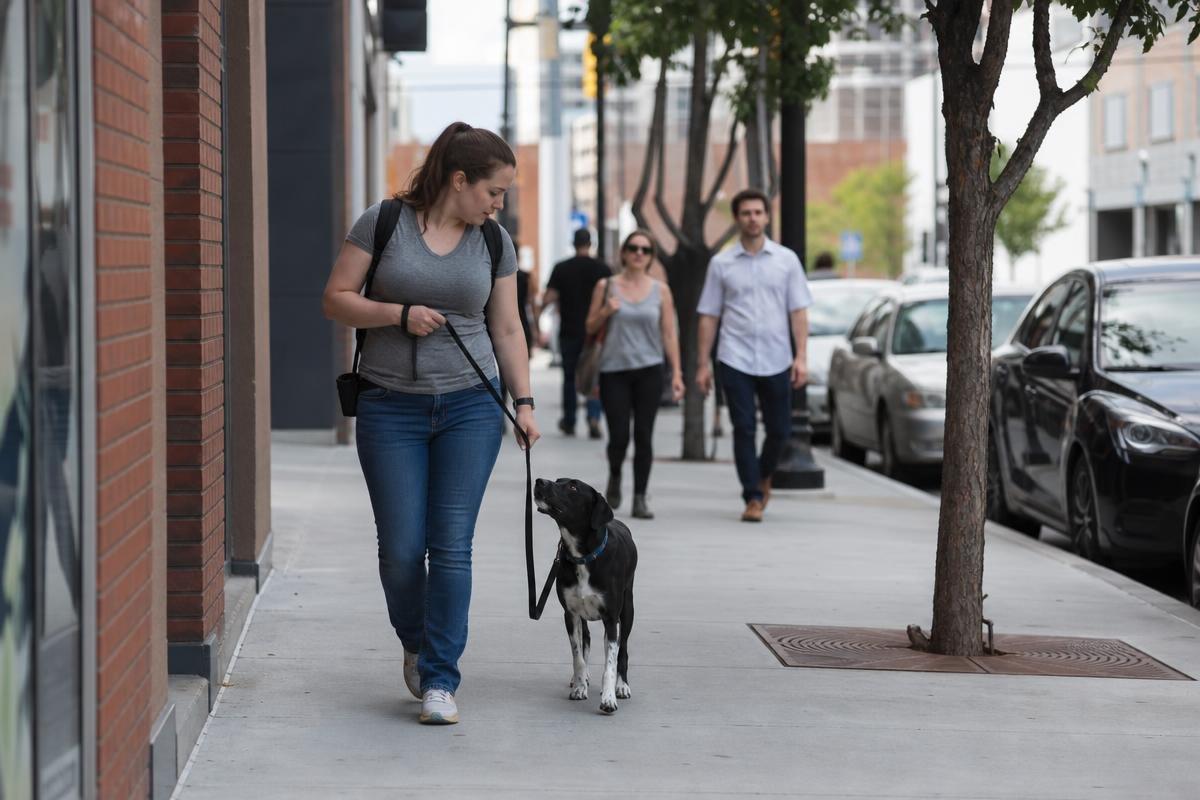
Our team works with dogs across the metro every week, and a few things stand out. Midtown and the Plaza District are packed with foot traffic, cyclists, and off-leash dogs cutting across sidewalks. The trails near Lake Hefner bring joggers, bikes, and other dogs around every bend. These are beautiful spots for a walk, but they can be genuinely overwhelming for a dog who hasn't built the skills to handle that kind of stimulation.
OKC's dog-friendly culture is something we love about this city. But dog parks and pet-friendly patios can put reactive or over-threshold dogs in situations they aren't ready for. Under Oklahoma City ordinance, dogs must be leashed in public unless they're inside a designated off-leash area, and those fenced dog parks are exactly where unstructured exposure tends to backfire. Too much uncontrolled contact often makes reactivity worse, not better. We see this pattern regularly with dogs coming in from Mustang, Moore, and the Choctaw area.
The most consistent thing we hear from owners? They waited longer than they needed to before asking for help. By the time they called us, the behavior had been building for months. Many of them describe picking up their dog after training and feeling like they brought home a completely different animal.
If you're unsure whether your dog is reactive, aggressive, or somewhere in between, you don't have to figure that out alone.
Frequently Asked Questions
Is my dog reactive or aggressive, and how can I tell?
The clearest test is what happens after the trigger disappears. A reactive dog barks, lunges, and then settles once the other dog or person is gone. An aggressive dog stays tense, continues to threaten, or snaps even after the trigger has passed. If you are seeing sustained threatening behavior, treat it as aggression and get a professional assessment right away.
Can reactive dogs be cured, or just managed?
Many reactive dogs make dramatic improvements with the right training. Some will always need management in high-stimulation environments like busy dog parks or crowded patios. The real goal is a dog that functions calmly in everyday life. Owner follow-through after training is the biggest variable in how far your dog goes.
What type of trainer should I look for to help a reactive or aggressive dog?
Look for someone with specific behavior modification experience, not just basic obedience. Avoid trainers who rely on punishment-based techniques for fear-based reactivity or aggression. Those methods can make things worse fast. The team at All Dogs Unleashed in Oklahoma City always does a behavioral assessment before recommending any program.
Is it safe to take a reactive dog to group training classes?
Generally, no. Not until the reactivity is under control. Putting a reactive dog near triggers before they have the focus to handle it reinforces the behavior rather than reducing it. Start with private sessions or board and train, then add group classes once your dog can hold attention around distractions.
How long does it take to see results from reactive or aggressive dog training?
Mild reactivity can improve in two to four weeks. Established reactivity or aggression typically takes two to four months of consistent work. Board and train accelerates that timeline because your dog is getting structured training every single day, not just once a week.
Does your team work with reactive and aggressive dogs?
Yes. Behavior modification for these cases is a core part of what we do. We offer in-home training, board and train, and obedience programs built around your dog's specific needs. If you are not sure where to start, reach out to our team or call us directly at (405) 299-3386.
Still not sure whether your dog is reactive or aggressive? Do not guess. Call (405) 299-3386 or contact us online to schedule a behavioral consultation. We'll assess your dog, give you a clear answer, and build a plan that gets real results. The sooner you start, the faster your dog gets there.
Ready to Get Started with All Dogs Unleashed Dog Training OKC?
Call (405) 299-3386 to speak with our team directly. We're ready to answer your questions, walk you through your options, and help you find the right solution for your needs. Whether you're just starting to plan or ready to move forward, we'll make the process simple and stress-free.
Reach out today and let's talk about how we can help.