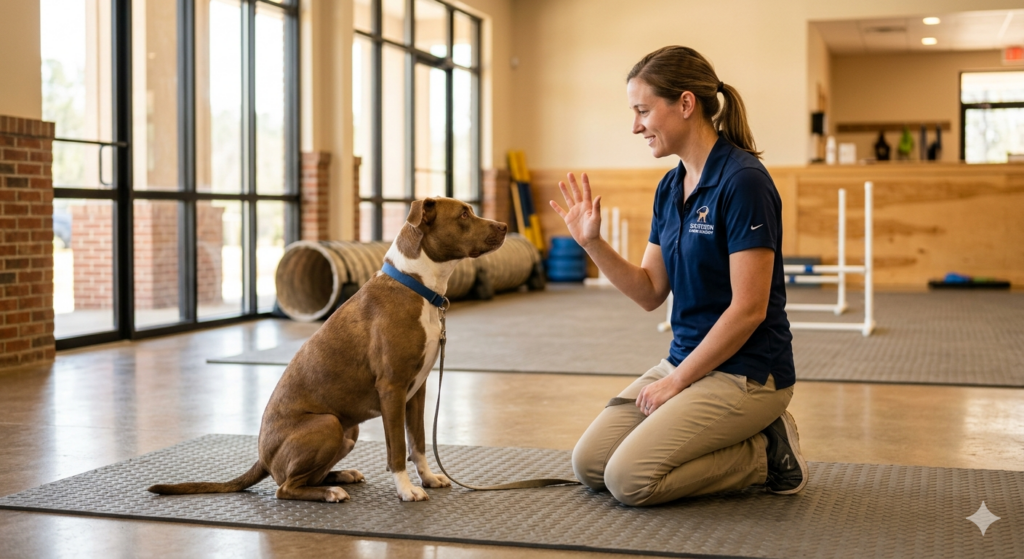
A service dog is not a pet with a vest. It is a working animal that has been individually trained to perform specific tasks that directly mitigate a person’s disability. That distinction matters legally, practically, and in how the training process is structured. If you are considering service dog training in Shreveport, understanding what is actually required before, during, and after training saves you significant time and helps you make decisions that hold up in the real world.
Key Takeaways
- A service dog must be individually trained to perform a specific task that directly mitigates a disability. Comfort through presence alone does not meet the legal standard under the ADA or Louisiana law.
- Service dogs, emotional support animals, and therapy dogs are legally distinct categories with different access rights. Only service dogs have full public access protections.
- Temperament is the most important factor in determining whether a dog is a realistic service dog candidate. Reactivity, fearfulness, or any aggression are disqualifying regardless of breed.
- Service training happens in phases: foundational obedience, public access conditioning, task-specific training, and handler training. Most dogs require six months to two years to complete the full process.
- Louisiana law does not require certification or registration. No vest, ID card, or registry carries legal weight. What matters is that the dog is trained to perform a qualifying task.
- Professional training is not legally required but significantly improves reliability. Gaps in owner-trained dogs often only appear in demanding real-world environments where failure carries real consequences.
What Qualifies as a Service Dog Under the ADA and Louisiana Law
Under the Americans with Disabilities Act, a service dog is defined as a dog that has been individually trained to do work or perform tasks for a person with a disability. The task the dog performs must be directly related to the person’s disability. Louisiana law mirrors this definition under Louisiana Revised Statute 46:1952, extending the same protections to people with both physical and mental disabilities.
Three distinctions are worth understanding clearly before pursuing service dog training.
- Service dogs vs. emotional support animals. Emotional support animals provide comfort through their presence alone. They are not trained to perform a specific task, and they do not have the same public access rights as service dogs. Under the ADA and Louisiana law, businesses are only required to admit service dogs, not emotional support animals.
- Service dogs vs. therapy dogs. Therapy dogs are trained to provide comfort to groups of people in settings such as hospitals, schools, or care facilities. They work with multiple people and are not assigned to a single handler. They do not carry public access rights under the ADA.
- The task requirement. The dog must be trained to perform a specific, observable task. A dog that calms its owner simply by being present does not meet the standard. A dog that has been trained to detect the physiological signs of an oncoming anxiety attack and take a specific action in response does. The distinction is between presence and trained behavior.
Louisiana law also provides a useful protection during the training phase: trainers and puppy raisers working with a dog in active service training have the same public access rights as a handler with a fully trained service dog, which allows for proper real-world socialization during the training process.
Types of Service Dogs and the Tasks They Perform
Service dogs are trained across a wide range of disability categories. The type of work a dog performs shapes every aspect of its training, from which tasks it learns to the environments it must be conditioned to handle reliably.
Mobility assistance dogs. These dogs assist people with physical disabilities by retrieving dropped objects, opening and closing doors, pressing elevator buttons, providing balance support, and pulling wheelchairs. They must be large enough and physically strong enough to brace against a handler’s weight.
Medical alert dogs. Trained to detect biological changes in their handler, these dogs alert to the onset of seizures, drops in blood sugar for diabetic handlers, or other medical events. The alert gives the handler time to get to a safe position or take medication before an episode begins.
Psychiatric service dogs. These dogs are trained to perform specific tasks for handlers with PTSD, severe anxiety, depression, or other psychiatric conditions. Tasks include interrupting nightmares or self-harming behaviors, clearing rooms before a handler enters, creating physical space between the handler and strangers, and reminding handlers to take medication.
Autism support dogs. Paired primarily with children, these dogs are trained to track a child who bolts, interrupt repetitive or self-injurious behaviors, and provide grounding through tactile interaction during meltdowns. They often tether to the child to prevent elopement in public settings.
Hearing alert dogs. Trained to alert deaf or hard-of-hearing handlers to specific sounds, including doorbells, smoke alarms, crying babies, and the handler’s name being called. The dog physically alerts the handler and leads them toward or away from the sound source.
Does Your Dog Have What It Takes? Temperament and Breed Considerations
Not every dog is suited for service work, and recognizing that early saves months of training effort on a dog that will not be reliable in a working role. Temperament is the primary filter, and it is more predictive than breed.
A strong service dog candidate is calm in novel environments, recovers quickly from startling sounds or sudden movements, is food or praise motivated without being frantic, shows no aggression toward people or other animals, and can sustain focus in distracting public settings. These traits must be present naturally. They can be refined through training but they cannot be created from scratch.
Disqualifying traits include reactivity toward strangers or other dogs, fearfulness in public environments, a high prey drive that cannot be reliably interrupted, and any history of aggression. A dog that growls at strangers in a grocery store or lunges at passing cyclists cannot function safely in the public access role that service work requires.
Breed matters less than individual temperament, but some breeds have traits that make service work more or less practical. Golden retrievers, Labrador retrievers, and standard poodles are commonly used because of their trainability, even temperament, and size. Smaller breeds can be effective for psychiatric and medical alert work. Large guardian breeds often struggle with the neutrality required in public settings.
A professional evaluation before committing to service training is time well spent. It gives you an honest assessment of whether your dog is a realistic candidate and, if not, what alternative path might better serve your needs.
What the Service Dog Training Process Actually Involves
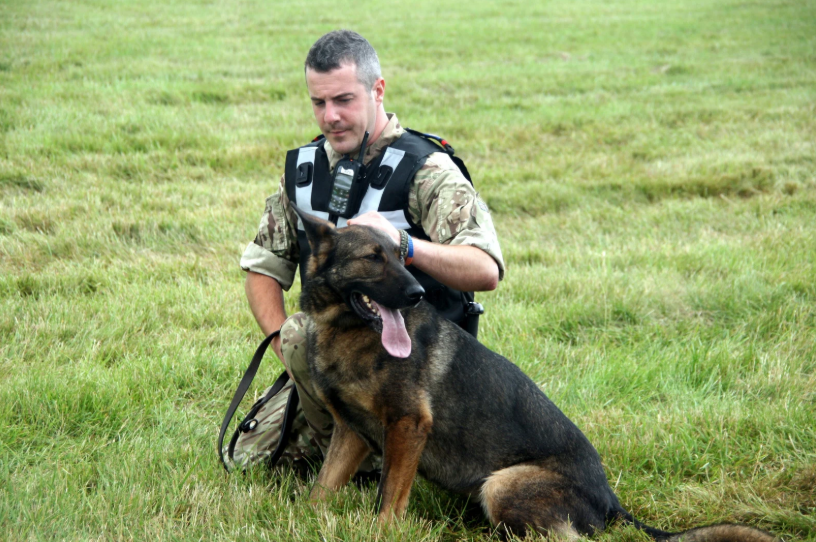
Service dog training is not a single program. It is a multi-phase process that builds progressively over months. Most dogs require six months to two years of consistent, structured training before they are ready for full public access duty. The timeline depends on the dog’s starting point, the complexity of the tasks required, and how consistently the handler practices between sessions.
Phase 1: Foundational Obedience
Before any service-specific task work begins, the dog must have a rock-solid obedience foundation. Heel, recall, sit/stay, down/stay, place, boundary training, and door manners must be reliable across all environments and with all levels of distraction. A service dog that loses its sit-stay in a crowded hospital corridor or breaks its heel position in a grocery store aisle is not ready for task training. See our post on foundational obedience commands for more on what this foundation looks like.
Phase 2: Public Access Training
A service dog must be able to work calmly in every environment a handler might need to enter: hospitals, restaurants, retail stores, public transit, crowded sidewalks, and more. Public access training exposes the dog to all of these settings in a gradual, controlled progression. The dog learns to ignore food on the floor, other animals, loud noises, and strangers attempting to make contact.
This phase also teaches the dog to remain focused on its handler rather than the environment. A service dog that is more interested in what is happening around it than in its handler is a liability, not an asset. The approach used throughout this process determines whether the training method matters for long-term reliability or breaks down under real-world pressure.
Phase 3: Task-Specific Training
Once foundational obedience and public access behavior are solid, task training begins. The specific tasks trained depend entirely on the handler’s disability and daily needs. Task training is precise and requires the dog to perform reliably on cue, in any environment, regardless of distraction. This is the phase that makes a dog a service dog rather than a well-trained pet.
Phase 4: Handler Training
The handler must be trained alongside the dog. A service dog paired with a handler who does not know how to give clear cues, manage the dog in public, or reinforce the behaviors between sessions will regress quickly. Handler training is not optional. It is the phase that determines whether the team functions effectively in the real world.
Owner-Trained vs. Professionally Trained Service Dogs
The ADA does not require service dogs to be trained by a professional or certified by any organization. An individual with a disability may train their own service dog. This is an important legal protection, but it does not mean professional training is unnecessary.
Owner-trained dogs have a meaningful failure rate. Without structured guidance, handlers often miss behavioral issues that disqualify a dog from public access work, train tasks incorrectly, or create patterns that break down under the real-world pressure of a busy public environment. A dog that passes a casual test at home may fall apart in the Willis-Knighton or Ochsner LSU Health Shreveport corridors, the crowded Saturday vendor lanes at the Bossier City Farmers Market, or the busy plaza at the Louisiana Boardwalk.
Professional training does not remove the handler from the process. It structures the process so the dog is built correctly from the ground up, and it gives the handler the education needed to maintain what the dog has learned. Our dog training programs are built around real-life situations, which is exactly what service training demands.
For handlers weighing their options, our post on which training format fits your situation outlines the key differences between our Board and Train program and in-home dog training in practical terms.
What to Expect When Your Service Dog Is in Public
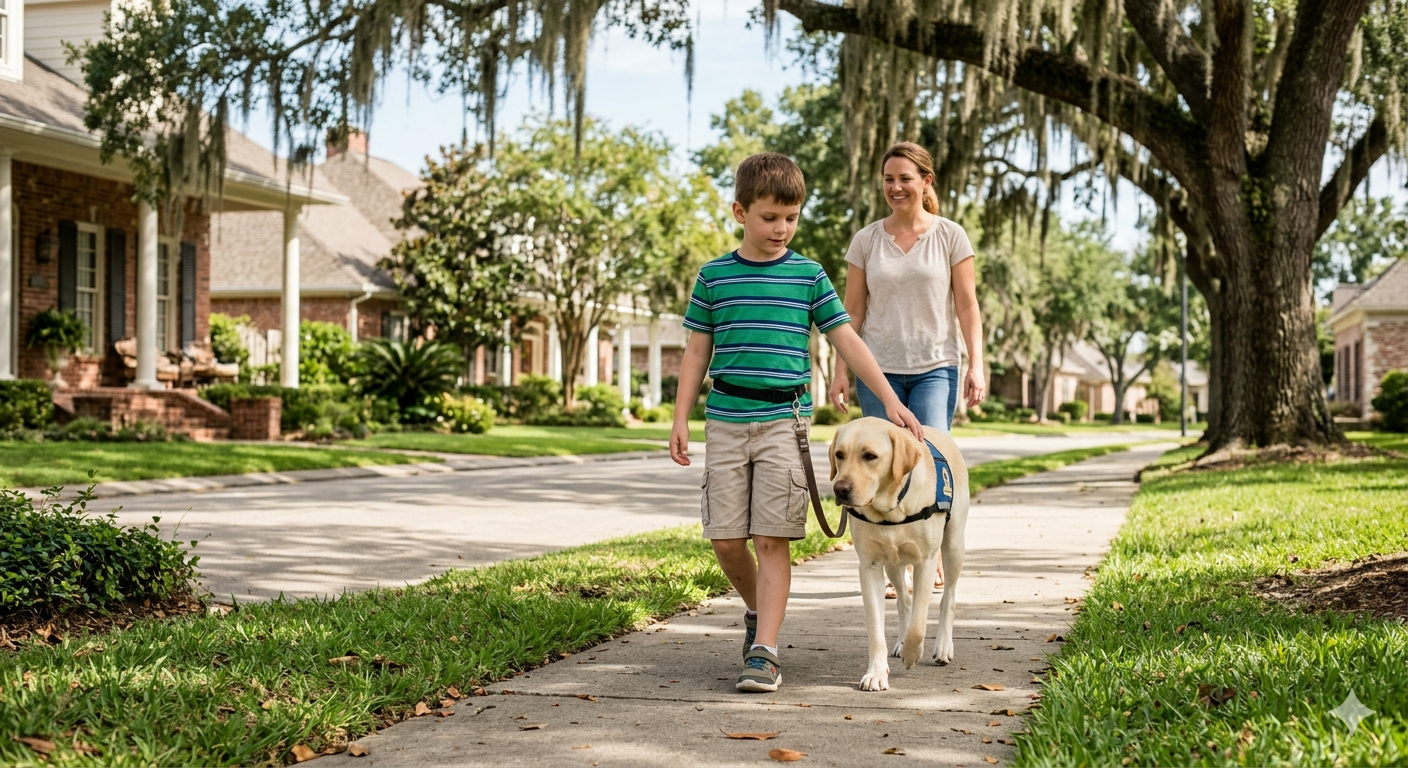
Once your dog is fully trained and working, federal and Louisiana law give you clear rights in public spaces. Understanding those rights, and knowing how to handle the situations where they are challenged, is part of being an effective service dog handler.
- Where your dog is allowed. Under the ADA, a service dog may accompany its handler in any place open to the public, including restaurants, hotels, retail stores, hospitals, schools, and government buildings. From the Mall St. Vincent food court to the Caddo Parish Courthouse to the lobby of the Hilton Shreveport, your access rights are the same. Louisiana law provides the same access rights. A business cannot require your dog to wait outside, confine it to a specific area, or charge you an additional fee.
- The two questions a business may ask. A business is legally permitted to ask only two questions: whether the dog is a service animal required because of a disability, and what work or task the dog has been trained to perform. They cannot ask you to identify your disability, demand documentation or certification, or require the dog to demonstrate its task.
- When a business may exclude your dog. A service dog can be excluded if it is out of control and the handler is not able to manage it effectively, or if the dog is not housebroken. These are the only valid grounds for exclusion. If your dog is barking continuously, jumping on customers, or eliminating indoors, the business has legal standing to ask you to remove the dog.
- No certification or registration is required. There is no official service dog registry in the United States and no vest, ID card, or certification is legally required. Products marketed as official service dog registration or certification carry no legal weight. What matters is that the dog is trained to perform a task related to your disability.
Read what Shreveport owners have experienced working with our team on our client testimonials page.
Ready to Talk About Service Dog Training?
Service dog training is one of the most involved and high-stakes training processes a dog and handler can go through. Getting the foundation right from the start makes every phase that follows more effective and the final result more reliable. Our team in Shreveport is ready to discuss your situation, evaluate your dog, and help you build a realistic path forward.
Contact us today to schedule your consultation. Call us at (318) 562-6536 or reach out online to get started.
Frequently Asked Questions
Does Louisiana require service dogs to be registered or certified?
No. Neither the ADA nor Louisiana law requires a service dog to be registered, certified, or carry any documentation. There is no official government registry for service dogs in the United States. Any organization offering official registration or certification is providing a product with no legal standing. What matters under the law is that the dog has been individually trained to perform a task that mitigates the handler’s disability.
Can I train my own dog to be a service dog in Louisiana?
Yes. The ADA specifically permits individuals with disabilities to train their own service dogs without the involvement of a professional trainer or certified program. However, the dog must still meet the legal standard of being trained to perform a specific task related to the disability and must be under control in public settings. Many owner-trained dogs benefit significantly from professional guidance to avoid behavioral gaps that only become apparent in demanding real-world environments.
How long does service dog training take?
The timeline varies depending on the dog’s starting point and the complexity of the tasks being trained. Most dogs require six months to two years of consistent, structured work before they are ready for reliable public access duty. Foundational obedience must be solid before task training begins, and public access conditioning runs in parallel throughout the process. Handler training is ongoing and does not end when formal sessions conclude.
What breeds work best as service dogs?
Breed is less important than individual temperament. Golden retrievers, Labrador retrievers, and standard poodles are commonly selected because of their even temperament, trainability, and size, but dogs of many breeds have performed successfully in service roles. What disqualifies a dog is not its breed but specific traits: reactivity, fearfulness in public, high prey drive, or any aggression. A professional temperament evaluation before committing to service training is the most reliable way to assess a specific dog’s suitability.
What is the difference between a service dog and a psychiatric service dog?
A psychiatric service dog is a specific type of service dog trained to perform tasks that mitigate a psychiatric disability, such as PTSD, severe anxiety, or depression. Like all service dogs, it must be individually trained to perform a specific task rather than simply providing comfort through presence. Psychiatric service dogs have full public access rights under the ADA. This distinguishes them from emotional support animals, which provide comfort but are not task-trained and do not carry the same access rights.
Can any dog become a service dog with enough training?
No. Training can refine and develop a dog’s existing traits, but it cannot create the foundational temperament that service work requires. A dog that is reactive toward strangers, fearful in novel environments, or shows any aggression cannot be trained into a reliable service dog regardless of the effort invested. Evaluating a dog’s temperament before beginning service training is essential, both to protect the handler and to avoid investing significant time in a dog that will not be safe or reliable in a public working role.
About All Dogs Unleashed Shreveport
All Dogs Unleashed is Shreveport’s trusted dog training and care center, offering fully customized training programs for dogs of every background, behavior level, and purpose. Our balanced, real-world training approach builds the kind of reliability that service work demands.