Bringing home a new puppy is one of the most rewarding things a dog owner can do, and one of the most consequential. The habits your puppy builds in its first few months are the ones it carries into adulthood. Getting them right early saves years of frustration. Getting them wrong means undoing patterns that, by the time most owners notice the problem, have already been practiced hundreds of times.
In-home puppy training in Shreveport gives new owners a structured, expert-guided start in the actual environment where those habits form.
Key Takeaways
- The critical socialization and learning window runs from roughly eight to sixteen weeks. Habits formed during this period are the most durable and the most effortless to establish. Starting early is the single most impactful decision a new puppy owner can make.
- In-home puppy training addresses potty training, crate introduction, bite inhibition, basic commands, leash manners, and door behavior, all within your actual household environment.
- Training in the home produces better results for puppies because it addresses real triggers in real spaces with real family members involved, rather than a controlled setting that does not transfer.
- The most common early mistakes, waiting to start, skipping crate training, accidental reinforcement of bad behavior, and inconsistency across the household, are all preventable with professional guidance from the first weeks.
- Socialization is controlled, positive exposure to a wide range of stimuli during the critical window. Quality of exposure matters more than quantity. A single negative experience can create lasting associations that take months to undo.
- Owner involvement between sessions is where most progress happens. Daily reinforcement woven into normal household routines builds reliable behavior faster than formal practice alone.
Why the First Few Months Shape Everything
Puppies go through a critical developmental window between roughly eight and sixteen weeks of age. During this period, a puppy’s brain is extraordinarily receptive to new experiences. The patterns it forms, the environments it becomes comfortable in, the behaviors that get rewarded, and the responses it learns to give its owner all become deeply embedded during these weeks.
This does not mean training is impossible after sixteen weeks. It means that habits established during this window take root with far less effort and far more permanence than habits built later. A puppy that learns to settle calmly on a place command at ten weeks old is not fighting years of practiced alternative behavior. An eighteen-month-old dog with the same problem has months of self-reinforcing history to overcome.
The single most common mistake new puppy owners make is waiting. Waiting until the puppy is older, until it settles down on its own, until the problem gets bad enough to feel urgent. By that point, the window has closed and the work becomes significantly harder. Starting structured training from the first weeks your puppy is home is the most efficient investment you can make in a well-behaved adult dog.
What In-Home Puppy Training Covers
A professional in-home puppy training program addresses the full range of skills a puppy needs to become a reliably well-behaved dog. These are not tricks. They are foundational behaviors that determine how your puppy functions in your household and in the world.
- Potty training. Establishing a consistent elimination schedule, recognizing the signals a puppy gives before an accident, and teaching the puppy that going outdoors is the expected behavior. This is one of the areas where professional guidance makes the most immediate difference, because potty training errors are almost always caused by inconsistent human behavior rather than a slow-learning puppy.
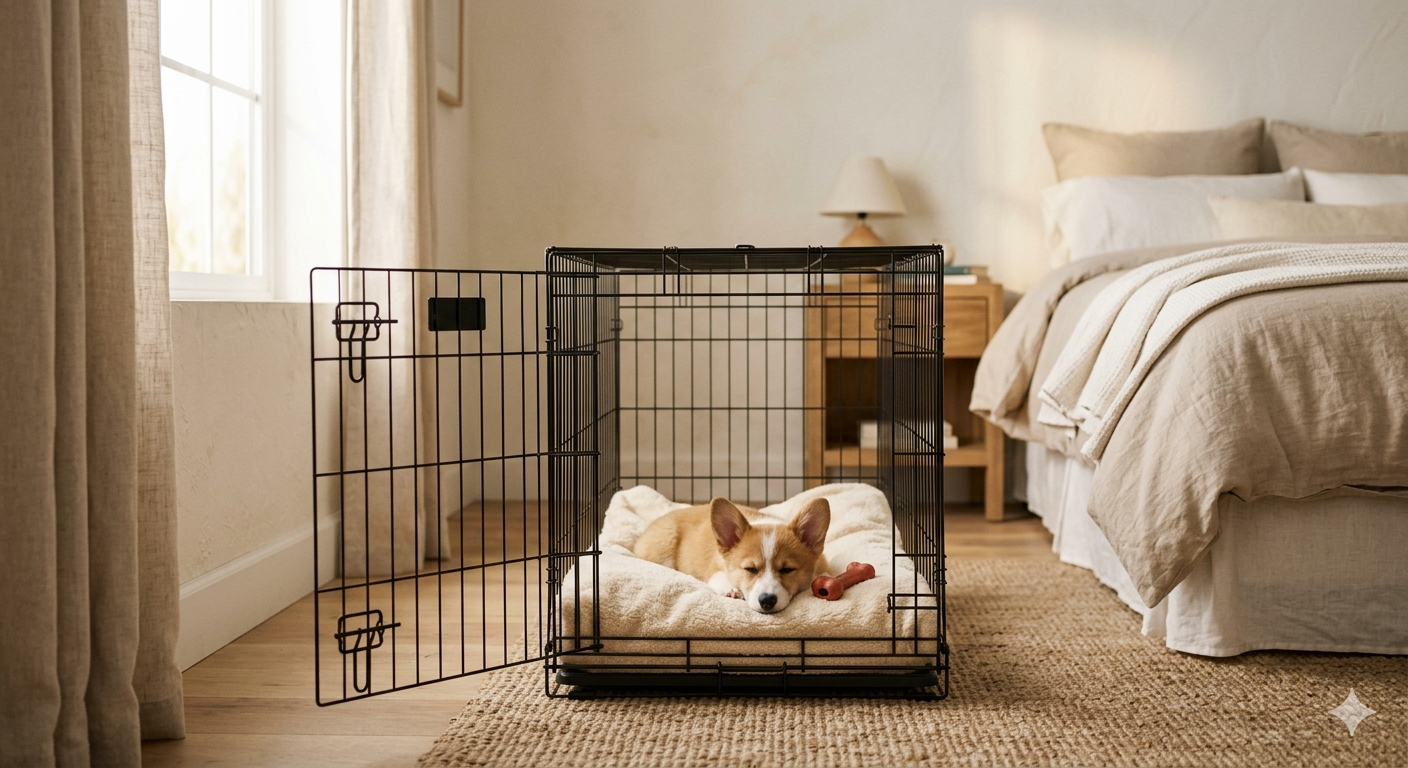
- Crate training. Teaching the puppy to view its crate as a calm, safe space rather than a punishment. A puppy that is comfortable in a crate can be managed safely when unsupervised, which prevents destructive behavior and accelerates potty training by working with a puppy’s natural instinct to keep its sleeping area clean.
- Bite inhibition. Puppies explore the world with their mouths, and nipping is a natural behavior that must be redirected rather than simply punished. Training teaches a puppy what is appropriate to mouth and what is not, and establishes clear responses that the whole household uses consistently.
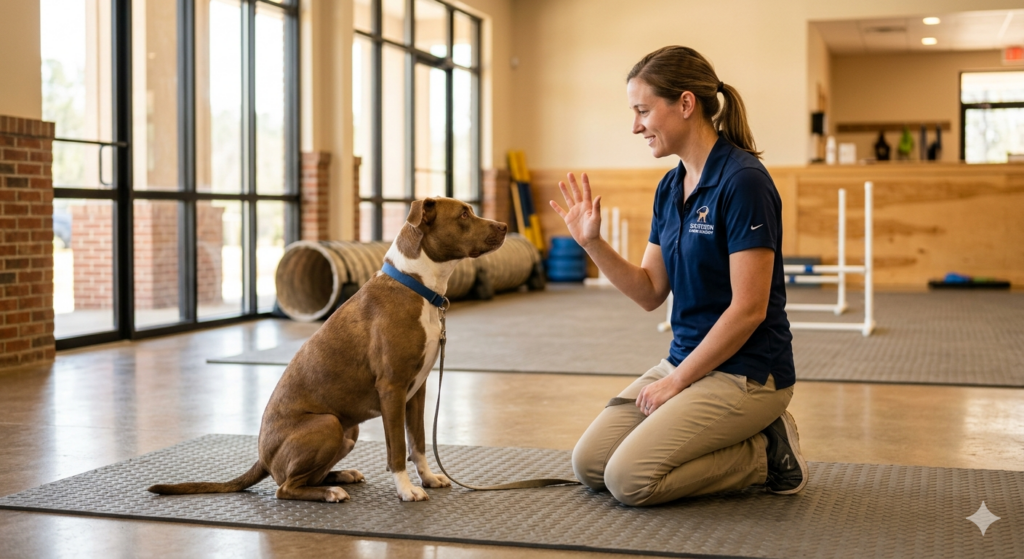
- Basic commands. Heel, recall, sit/stay, down/stay, place, boundary training, and door manners form the foundation every well-behaved dog is built on. Starting these early, while the puppy is in its peak learning window, means the responses become almost automatic by the time the puppy reaches adolescence. For a closer look at what these commands do for a dog long term, see our post on commands every puppy should learn.
- Leash manners. Teaching a puppy to walk without pulling from the start prevents one of the most common adult dog problems. A twelve-pound puppy that pulls on leash is annoying. An eighty-pound dog with the same habit is dangerous.
- Door and threshold behavior. Teaching a puppy to wait at doors, not bolt out of the house or car, and hold a position when guests arrive. These behaviors prevent accidents and create a calmer household dynamic from the earliest weeks.
Why Training at Home Produces Better Results for Puppies
The home environment is where your puppy actually lives. It is where the real triggers exist, where the specific problem behaviors occur, and where the habits you are trying to build will be maintained every single day. Training a puppy in a neutral facility and then returning it to a household with different rules, different people, and different stimuli produces incomplete results.
With in-home training, the trainer works directly in your space. The behavior at the front door gets addressed at your front door. The jumping on the couch gets addressed in your living room. The pulling toward your neighbor’s dog gets addressed on your actual street, whether that is in South Highlands, Broadmoor, Spring Lake, or anywhere across Caddo and Bossier Parish. The solutions are built around your specific household, not a generic template.
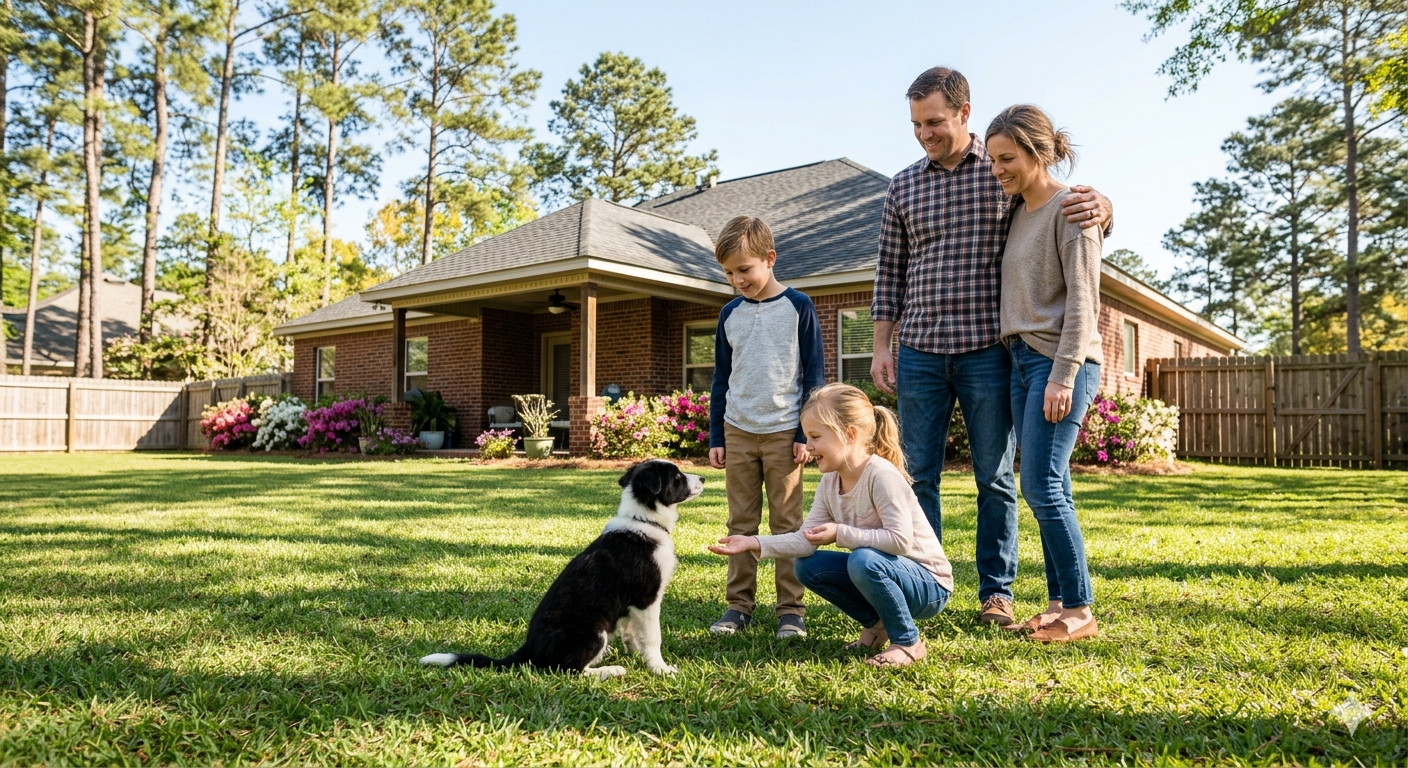
Whole-family involvement is another advantage that cannot be overstated. A puppy learns to respond to the people it lives with. If one family member reinforces a behavior and another does not, the puppy learns inconsistency, and inconsistency is the fastest way to undermine any training progress. Having every household member present during sessions means everyone learns the same cues, the same responses, and the same expectations from the very beginning.
Our in-home dog training program is designed around your behavior goals, not a one-size-fits-all curriculum. Sessions are structured around what your specific puppy needs and what your household dynamics require.
Common Puppy Mistakes Shreveport Owners Make
Most puppy problems are not caused by difficult dogs. They are caused by well-intentioned owners making predictable mistakes in the early weeks. Understanding what those mistakes are makes them much easier to avoid. For a full breakdown, see our post on puppy training mistakes to avoid.
Waiting too long to start
As covered above, the critical learning window does not wait for owners to feel ready. Every week of delay in a puppy’s early months is a week of habit-forming that happens without structure or guidance.
Skipping crate training
Many owners feel that crating a puppy is unkind. The opposite is true. A puppy without a safe, enclosed space has no retreat from an overwhelming environment and no structure around its time when unsupervised. Skipping crate training leads directly to destructive behavior, potty training failures, and a puppy that never learns to self-settle.
Accidentally rewarding bad behavior
A puppy that jumps and gets picked up has learned that jumping works. A puppy that whines at the crate and gets let out has learned that whining works. Owners reward these behaviors without realizing it, and the behavior strengthens each time. Training teaches owners to recognize these patterns and respond in ways that build the behavior they actually want.
Using punishment after the fact
Scolding a puppy for an accident it had twenty minutes ago accomplishes nothing. Puppies do not connect delayed corrections to earlier behavior. Punishment after the fact creates confusion and anxiety without providing any information about what the correct behavior should have been.
Inconsistency across the household
The rules have to be the same from every person, every time. A puppy allowed on the couch by one family member but scolded by another learns that the rule is unpredictable, not that the couch is off-limits.
Socialization: The Part Most Owners Underestimate
Socialization is one of the most misunderstood aspects of puppy development. Many owners interpret it as simply letting their puppy meet as many dogs and people as possible. That approach, without structure, can create as many problems as it prevents.
True socialization is controlled, positive exposure to a wide range of environments, sounds, surfaces, people, and animals during the critical window. The goal is for the puppy to build a history of calm, positive associations with things it will encounter throughout its life, from the foot traffic at Festival Plaza to the trails along Clyde Fant Parkway to the busy weekend crowds at the Bossier City Farmers Market.
The quality of each exposure matters more than the quantity. One overwhelmingly negative experience with another dog during the critical window can create a lasting negative association that takes months of careful work to undo. A professional trainer structures socialization so that each exposure is appropriately paced, positive, and suited to where the puppy is emotionally at that moment.
The socialization window also closes faster than most owners expect. By sixteen weeks, a puppy’s capacity for easy new-experience integration has dropped significantly. This is another reason early professional guidance matters so much.
What to Expect From Professional In-Home Puppy Training
New owners often come in with either very high or very low expectations of what a young puppy can achieve. A professional trainer calibrates those expectations accurately and builds a realistic plan around what your puppy is developmentally capable of at each stage.
Sessions are structured around your puppy’s attention span, which is short at eight to twelve weeks and increases gradually. Early sessions focus on foundational responses and household rules. As the puppy progresses, sessions build on what is already solid and introduce new skills and environments.
Owner homework between sessions is where most of the progress happens. A trainer can establish the correct foundation during a session, but the repetition that makes a behavior reliable comes from daily practice at home. Five to ten minutes of focused reinforcement each day, spread across natural household moments like mealtimes, walks, and greetings, builds habits far more effectively than longer but infrequent formal practice.
Not sure whether in-home training or a structured program away from home is the better fit for your puppy? Our post on which program fits your situation breaks down the key differences between in-home sessions and our Board and Train program. You can also explore our full range of dog training programs to find the right starting point for your puppy.
Give Your Puppy the Best Possible Start
The first months with your puppy are the most important months. A structured, professional start builds the habits, the communication, and the bond that carry through the rest of your dog’s life. Our team at All Dogs Unleashed Shreveport works with new puppy owners every day to make those early weeks count.
Contact us today to schedule your consultation. Call us at (318) 562-6536 or reach out online to get started.
Frequently Asked Questions
How old should my puppy be before starting in-home training?
Puppies can begin structured training as early as eight weeks old. This is the age at which most puppies come home from breeders or shelters, and it is also the beginning of the critical socialization window. Starting immediately means the first habits your puppy builds are the right ones. There is no benefit to waiting, and meaningful costs to it, as every week without structure is a week of habit-forming that happens without guidance.
How many sessions does in-home puppy training typically involve?
The number of sessions depends on your puppy’s starting point, the specific goals you have, and how consistently you practice between sessions. Most puppies show significant progress within four to six weeks of consistent in-home training paired with daily owner reinforcement at home. A trainer will assess your puppy and outline a realistic plan during the initial consultation so you have a clear picture of what the process will look like from the beginning.
My puppy is already four months old. Is it too late to start?
No. Four months is still well within the early training window and an excellent time to begin. The most significant changes in neurological receptivity happen after sixteen weeks, but puppies at four, five, and six months of age are still very much in an active learning phase and respond well to structured training. The main difference is that some habits may already be forming, which makes consistent owner follow-through between sessions especially important.
Do I need to be home during the training sessions?
Yes, and your presence is one of the primary reasons in-home training works so well for puppies. The trainer is not there to train your dog in isolation. The trainer is there to teach you how to communicate with your puppy, how to reinforce the right behaviors, and how to respond to the wrong ones. Every skill taught during a session needs to be maintained by you in the hours and days between sessions. Owner education is as central to the process as puppy training.
What is the difference between in-home puppy training and a Board and Train program for a puppy?
In-home training keeps your puppy at home and integrates training into your household routines from the start. It is especially well suited for families who want to be hands-on, for puppies whose challenges are rooted in the home environment, and for households where getting every family member aligned on consistent responses is a priority. The Board and Train program places your puppy in a structured facility environment for two weeks of intensive daily training. It can be a strong option for busy owners or for puppies that need more focused work early on. Both programs include thorough owner follow-up to maintain results at home.
Will in-home training handle potty training as well as obedience commands?
Yes. Potty training is one of the most immediate priorities in any puppy program and is addressed directly from the first session. This includes establishing a consistent schedule, teaching owners to read the puppy’s pre-elimination signals, structuring the puppy’s time indoors to prevent unsupervised accidents, and building the right outdoor reward patterns. Potty training failures are almost always a function of inconsistent human behavior rather than a slow puppy, and professional guidance makes a significant difference in how quickly the pattern establishes itself.
About All Dogs Unleashed Shreveport
All Dogs Unleashed is Shreveport’s trusted dog training and care center, offering fully customized programs for puppies and dogs of every age, breed, and background. Our balanced, real-world training approach is built around your household and your goals, not a generic template. See what our clients have to say on our client testimonials page.