
Jumping is one of the most common behavioral complaints from dog owners in Carrollton, TX. It is also one of the most misunderstood. Many owners accept jumping as a sign of affection and simply manage around it, hoping the behavior will fade on its own. It rarely does. In fact, without consistent correction, jumping on guests tends to get worse over time.
Carrollton households that regularly host family, friends, or clients know how disruptive this behavior can be. A dog that bowls over an elderly relative, knocks down a child, or puts muddy paws on a guest’s clothing is not just inconvenient. It can damage relationships and create real safety concerns. The good news is that jumping is entirely preventable and correctable with the right approach.
All Dogs Unleashed helps Carrollton dog owners address jumping and other greeting behaviors through clear, consistent training that sticks in the real world. Here is what you need to know about why dogs jump and how to effectively stop it.
Why Dogs Jump on People
Before you can correct jumping, it helps to understand why it happens. Dogs jump on people for a few core reasons:
- Greeting behavior: In the dog world, dogs greet face-to-face. Jumping is a dog’s way of trying to reach your face to say hello, the way they would with another dog.
- Attention-seeking: If jumping has historically resulted in any form of attention, including being pushed down or spoken to, the behavior has been accidentally reinforced.
- Excitement: High-arousal moments like homecomings and guest arrivals trigger impulsive behavior. Excitement without impulse control training produces jumping.
- Lack of an alternative: If a dog has never been taught what to do instead of jumping, jumping remains the default greeting behavior.
The most important takeaway here is that jumping is almost always an attention-seeking behavior. That means the solution must consistently remove attention from jumping and redirect it to an incompatible behavior.
The Core Principle: Remove Attention, Redirect Behavior
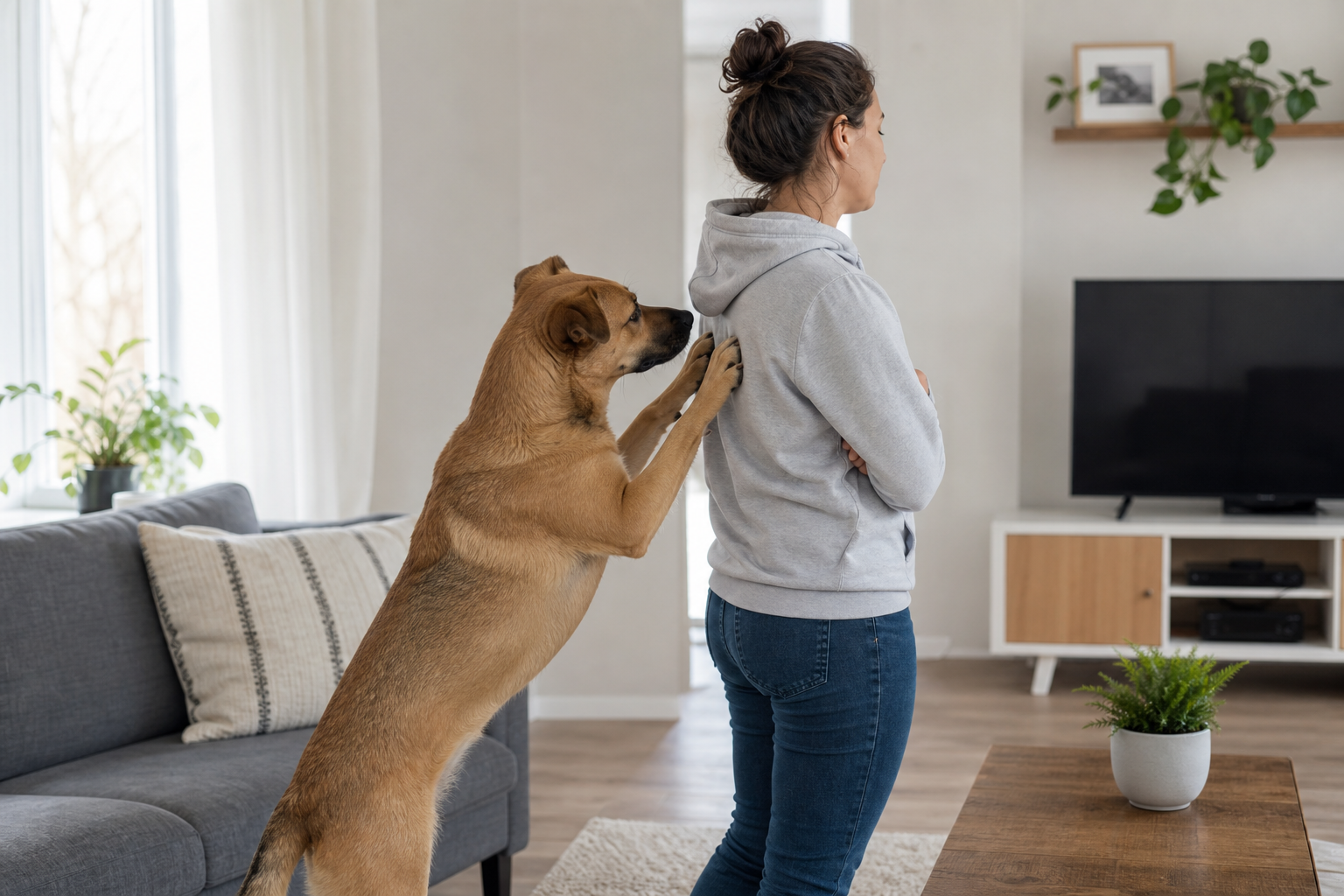
Every person who interacts with your dog needs to follow the same rule: jumping earns zero attention. Not a look. Not a verbal correction. Not a push away. Any of those responses is still a form of attention, and attention is exactly what your dog is seeking.
When your dog jumps:
- 1. Turn your back immediately and cross your arms.
- 2. Say nothing and make no eye contact.
- 3. Wait for four paws to be on the floor.
- 4. The moment all four paws touch the ground, calmly reward with praise or a treat.
This sounds simple, but the key is the word “consistently.” Every single time. Every single person. If your dog learns that jumping works one in ten times, that intermittent reinforcement actually makes the behavior more persistent, not less.
Teach an Incompatible Behavior
The most effective way to stop jumping is to replace it with a behavior that cannot happen at the same time. “Sit” is the classic alternative. A dog cannot jump and sit simultaneously.
Steps to train an automatic sit greeting:
- 1. Practice sit at the door when it is calm with no guests present. Reward generously.
- 2. Simulate arrivals. Have a family member walk in and out repeatedly. Ask your dog to sit. Reward every sit before any petting or attention happens.
- 3. Expand to real arrivals. Brief guests at the door before entering and ask them to only acknowledge your dog when all four paws are on the floor.
- 4. Proof against excitement. Practice when you have been away for longer periods, when guests are visibly excited, and in other high-arousal situations.
Over time, the automatic sit becomes your dog’s default greeting because it reliably earns what they want: attention and connection.
How to Brief Your Guests
Training your dog is only half the equation. The humans in the interaction matter just as much. Brief guests before they come in:
- “Please ignore the dog completely if they jump. Turn away and wait.”
- “When they sit or have four paws on the floor, you can calmly greet them.”
- “No eye contact, no pushing, no saying ‘no’ or ‘down’ while they are jumping.”
This can feel awkward to ask of guests, but a quick 30-second conversation before entering goes a long way. Most guests are happy to help once they understand why consistency matters.
Common Mistakes That Make Jumping Worse
- Pushing the dog down with your hands: This often feels like play to a dog and can increase excitement.
- Saying “off” or “no” repeatedly without following through: Repeated verbal corrections that never result in the dog actually stopping teach your dog to ignore your voice.
- Letting it slide sometimes: Inconsistency is the number one reason jumping persists despite the owner’s efforts to stop it.
- Punishing only after multiple jumps: If your dog jumps three times before you intervene, they have been rewarded by engagement three times before correction happens.
When to Get Professional Help
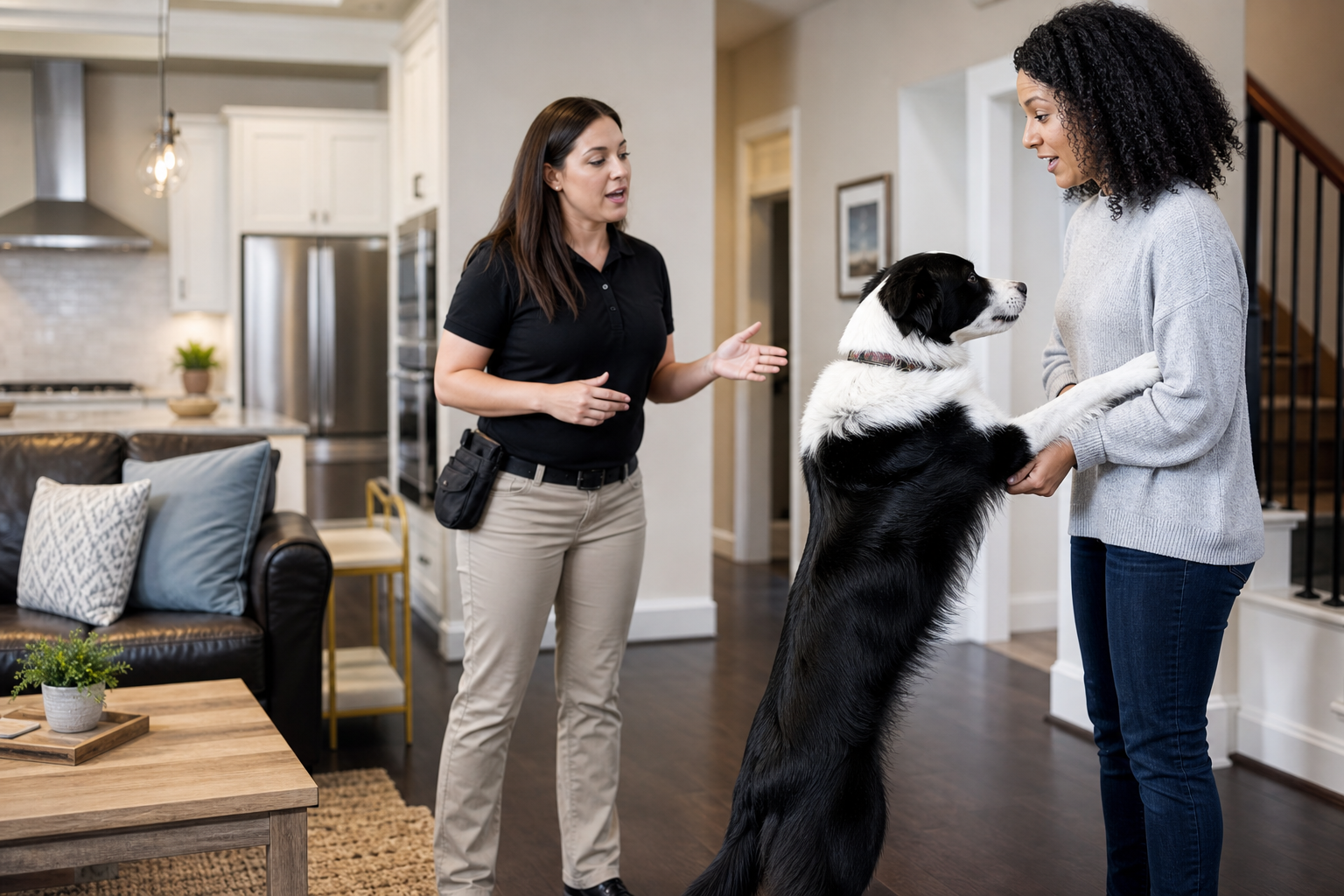
Some dogs with deeply ingrained jumping habits, particularly large or powerful breeds that have been allowed to jump for years, benefit from professional guidance. In-home dog training is particularly effective for jumping because it takes place in the exact environment where the behavior occurs, with the trainer present to coach both dog and owner through real-world situations.
For dogs with broader impulse control issues, a structured board and training program provides intensive daily work that accelerates results significantly.
Frequently Asked Questions
How long does it take to stop a dog from jumping?
With consistent training from every person in the household and a solid alternative behavior in place, most dogs show significant improvement within two to four weeks. Dogs that have been jumping for years may take longer.
My dog only jumps on certain people. Why?
Dogs learn who tolerates jumping and who does not. If your dog jumps on some guests but not others, it is because jumping has been inconsistently reinforced. This is why briefing every guest matters.
Should I use a knee to the chest to stop jumping?
This technique is outdated and not recommended. It can accidentally injure a dog, and for many dogs, it increases arousal rather than reducing it. Turning away and removing attention is consistently more effective and safer.
My puppy jumps and it is cute now. Should I still correct it?
Yes. Behaviors that are allowed in puppies are almost always expected to be acceptable by adult dogs. If you do not want a 60-pound dog jumping on people, do not allow a 10-pound puppy to do it either.
Stop Jumping for Good With All Dogs Unleashed
At All Dogs Unleashed, we help Carrollton dog owners address jumping and other frustrating greeting behaviors with effective, humane training. Call us at (972) 484-3647 or come see us at 2401 Luna Rd, Carrollton, TX 75006 to get started.